She Pushed My Injured Daughter Down the Stairs—Then My Daughter Pointed to the Camera
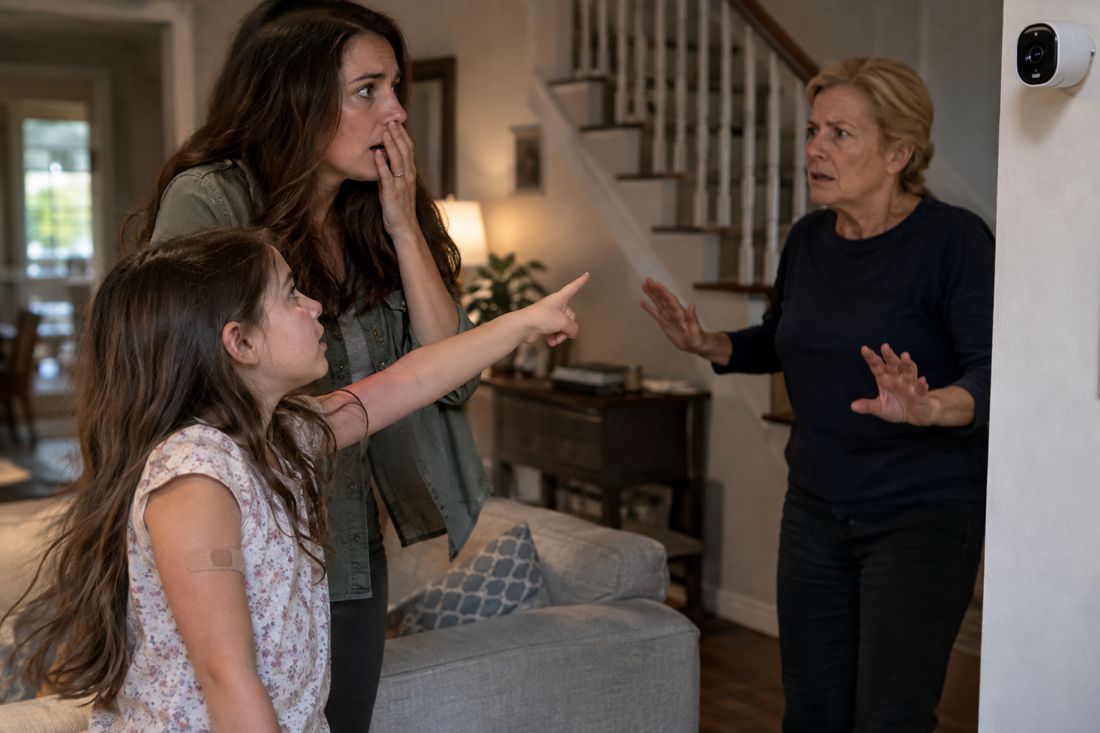
My eight-year-old was barely four steps into her descent when the woman trailing her drove a flat palm straight into her back.
I saw the strike.
I saw the shove.
And in that horrifying, frozen sliver of time, I watched my little girl pitch forward into empty air.
“DADDY!”
Her shriek sliced right through the murmur of the party.
Across the great foyer, half a hundred conversations died at once.
Sophie’s aluminum crutches flew apart, clattering wildly down the treads.
Her right leg—wrapped from toes to just below the kneecap in bright violet fiberglass—twisted at a sickening angle as it slammed against the sharp edge of the hardwood riser beneath her.
Then the next one.
Gasps ripped through the crowded room.
Somewhere nearby, a stem of fine crystal slipped from paralyzed fingers.
SMASH!
My legs were already moving before my mind could register the sound.
“SOPHIE!”
She tumbled across the cold marble landing at the base, curling defensively into a ball around her injured limb.
Shoving past immobilized relatives and stunned acquaintances, I dropped hard onto both knees beside her, pressing a trembling palm against her shoulder.
“Don’t move, sweetheart. Don’t try to shift.”
Her cheeks were completely bloodless.
Streams of tears carved tracks down her face.
“Daddy…”
“I’m right here, baby. I’ve got you.”
My gaze dropped anxiously to the purple cast.
“Where does it hurt most?”
Before she could draw enough breath to answer, a shrill, defensive screech rained down from the flight above.
“SHE SLIPPED!”
My chin jerked up.
Perched beside the polished walnut balustrade stood my sister-in-law, Victoria Hale.
Both her palms were shoved forward toward the crowd below, splayed in a frantic pantomime of innocence.
Every drop of color had fled her skin.
“I NEVER TOUCHED HER!”
Not a solitary person in that entryway had uttered a word of blame.
That was the first detail that struck me like a physical slap.
The second arrived when Sophie choked back her sobs just long enough to stare straight upward at the landing.
Slowly, deliberately, my daughter lifted a trembling, scraped hand.
Not leveled at Victoria’s emerald dress.
Higher.
Aimed directly at the corner crown molding where the upper gallery met the ceiling plaster.
Tucked quietly beneath the carved wood trim sat a compact, dark glass surveillance dome.
Sophie swallowed against the tremor rattling in her chest.
Then her voice drifted out, faint but piercing:
“Daddy…”
I leaned my ear down toward her lips.
“What is it, darling?”
Her gaze never wavered from Victoria’s rigid figure.
“…the camera.”
Victoria froze.
Turned to pure stone.
And in that suspended heartbeat, long before I ever sat down to examine a single frame of digital video, I understood with dreadful clarity that the fragile truce holding our family together had just been shattered beyond recovery.
My name is Andrew Callahan.
I had recently turned forty-three when the foundation beneath our feet collapsed.
The residence where the incident occurred had been in my family for generations, though calling it a mere “house” had always struck our visitors as an understatement.
It was an expansive three-story Georgian manor nestled on the wooded outskirts of Greenwich, Connecticut, originally raised in the roaring twenties. Successive decades of renovations and additions had reshaped nearly everything inside, leaving little of the original blueprint untouched beyond the fieldstone exterior, the grand bifurcated staircase, and a collection of hand-chiseled hearths.
Claire, my wife, always cringed whenever guests casually referred to it as an estate or a mansion.
“It makes us sound like haughty caricatures in an old novel,” she would object.
“Claire, there are thirteen bathrooms.”
“Twelve, plus the little half-bath tucked by the boot room.”
“And that’s supposed to be your argument for modesty?”
She would simply sigh, roll her eyes, and walk away smiling.
Neither of us had been responsible for building the estate.
My grandfather had purchased the sprawling parcel almost a century ago.
My father had added the extended guest wings and updated the infrastructure.
When my parents finally retired southward to the milder climate of coastal Florida, the responsibility of preserving the family home landed squarely on Claire and me.
I earned an enviable living, certainly, but hardly the sort of generational empire required to purchase prime Greenwich land outright.
Alongside two close colleagues, I owned and managed a mid-scale logistics and supply-chain software company.
Claire was a licensed residential architect who had dialed back her firm’s workload to part-time consulting ever since our daughter had come into the world.
Together, we had one child.
Sophie.
Eight years on this earth.
Razor-sharp in her observations.
Fiercely independent.
Gifted with a wickedly dry sense of humor.
And, on the night of my mother’s milestone birthday celebration, thoroughly disgusted with the heavy plaster casing dragging down her right leg.
The fracture had happened roughly three weeks prior.
It had been the most routine, mundane childhood spill imaginable.
No villain behind it.
No twisted family confrontation.
She had merely misjudged her reach across a set of monkey bars at a classmate’s weekend gathering and dropped awkwardly into the wood chips.
A clean, non-displaced snap of the tibia.
Frightening when it happened, fiercely painful in the emergency room, but expected to knit cleanly with basic rest and time.
Her pediatric orthopedist had laid down an uncompromising set of rules.
Strictly partial weight-bearing.
Crutches for every movement.
Zero running, jumping, or roughhousing.
And an absolute ban on taking the stairs without a parent holding her arm every single step of the way.
To spare her the exhaustion, Claire and I had rearranged our first-floor study into a temporary bedroom.
Sophie despised every minute of the confinement.
“I look like a broken lawn flamingo,” she muttered sourly over scrambled eggs one morning.
Claire couldn't suppress a burst of laughter.
“Where in heaven's name did you get that idea?”
“I don't know, Mom. Look at me hopping around.”
When the orthopedic nurse had offered her a choice of cast colors at the clinic, Sophie had boldly selected bright violet.
She came to regret that flair almost immediately when her third-grade classmates took turns covering the shell in silver marker, including a boy named Toby who sketched an enormous Tyrannosaurus rex sporting dark sunglasses across her shin.
I thought the artwork was inspired.
Sophie remained entirely unimpressed.
My mother Margaret’s seventieth birthday party had been circled on our family calendar for six months.
She had politely but firmly rejected every suggestion of a rented country club ballroom or a reserved private dining terrace.
All she wanted was an intimate, energetic celebration under our roof.
Siblings, cousins, partners, and children.
Lifelong companions from her college years.
Roughly fifty guests in all.
The moment Sophie injured her leg, Claire had gently proposed postponing the event by a month or two until our daughter was back on her feet.
Sophie flatly refused to allow it.
“Grandma only turns seventy once in her entire life,” she insisted with solemn drama.
“Technically speaking, everyone only turns any age once,” I countered gently.
She leveled a deadpan stare in my direction.
“Dad. Don't do that.”
“Right. Message received.”
And so the date stayed firm.
Claire and I meticulously arranged the entire first-floor layout so Sophie wouldn't feel excluded or exhausted by the crowd.
The catering stations were positioned throughout the main living areas.
The ground-floor guest washroom was freshly stocked.
We placed an oversized velvet armchair beside the library entrance where Sophie could recline, rest her leg on an ottoman, and greet relatives like a miniature monarch.
There was zero necessity for Sophie to climb the central staircase that evening.
That had been the airtight plan.
Until Victoria walked through our heavy oak front doors.
Victoria was married to Michael, my younger brother.
Thirty-nine years old, she possessed the sort of polished, razor-sharp poise that made every candid snapshot of her look like an outtake from a luxury lifestyle catalog.
Platinum-blonde hair styled without a single rogue strand.
An upright, immaculate posture that seemed carved from marble.
Designer clothing that radiated wealth through sheer cut and fabric rather than loud branding.
She had been a fixture in our extended family for nearly a decade.
During the first five years, our relationship had been warm and remarkably uncomplicated.
Never intensely intimate, perhaps, but genuinely friendly.
Then a quiet, poisonous wedge began driving us apart.
Back then, diagnosing the root cause felt nearly impossible.
Looking back now through the lens of hindsight, the point of origin was glaringly obvious.
It had begun the very afternoon Michael’s speculative real estate firm went under.
My younger brother had always been the charismatic dynamo of our household.
I was the methodical, quiet organizer, buried in spreadsheets and software architecture.
Michael was a hurricane of charm.
While I obsessed over supply-chain logistics and server capacity, Michael could step into a crowded networking gala knowing no one and leave two hours later with four lucrative deals and a dozen dinner reservations.
Our father had endlessly celebrated that magnetic gift.
He used to say with an appreciative chuckle:
“Andrew designs the engine. Michael convinces the customer to buy the whole car.”
For a long while, that formula seemed invincible.
Michael had launched into high-end speculative home development.
His initial ventures brought impressive returns.
His subsequent subdivisions generated jaw-dropping windfalls.
Gradually, he began to drink his own wine, convinced that every parcel of raw land he laid eyes upon would magically turn to gold.
Then a zoning board rejected a critical variance.
An environmental review tied up a flagship coastal development for months.
Federal interest rates climbed sharply.
An essential investment consortium suddenly pulled its capital from the table.
One sprawling luxury development ground to an agonizing halt mid-construction.
Another dissolved into bitter, scorched-earth litigation among the partners.
Over the span of eighteen brutal months, Michael’s commercial empire plummeted from dizzying expansion into frantic survival.
And from survival straight into bankruptcy court.
I stepped into the wreckage to keep him afloat.
That intervention cast a long, complicated shadow in the years that followed.
Yet in the darkest hour of his collapse, helping him felt like the only decent choice a brother could make.
He was my family.
Rescuing his overleveraged corporation was far beyond my personal means.
I couldn't write a check to absorb millions in defaulting debt.
What I could do, however, was absorb his mounting personal legal expenses.
I retained an experienced restructuring advisor on his behalf.
I extended him a private loan to stabilize their domestic bills.
A structured loan, formally documented with clear terms.
Reasonable monthly installments.
Zero interest applied across the initial twelve-month term.
Claire stood behind the decision without a shred of hesitation.
In the early weeks, Victoria showered us with profuse gratitude.
Yet in fiercely proud individuals, gratitude has an ugly habit of souring into quiet humiliation.
Humiliation gradually metastasizes into bitter resentment.
And resentment has an insidious way of rewriting reality to soothe a wounded ego.
Before long, Victoria no longer viewed our financial lifeline as an act of brotherly affection.
In her revisionist narrative, it had transformed into a deliberate, calculated exercise in showing them up.
The earliest biting barb that etched itself into my memory surfaced during a Christmas Eve get-together.
Michael had slipped off into my father’s study to seek advice on a possible consulting gig.
Victoria stood alone beside the limestone hearth, casually swirling a goblet of Pinot Noir.
Her cold, calculating eyes drifted across the expansive woodwork of our living room, and she murmured in an undertone:
“Must be extraordinary living a life where tomorrow never keeps you awake at night.”
Claire, stepping past with a platter of warm appetizers, stopped in her tracks.
“Andrew bears plenty of heavy burdens, Victoria.”
Victoria’s lips curved into a patronizing, razor-thin smile.
“Oh, let’s be honest with ourselves, Claire.”
Claire chose silence, refusing to bite.
Victoria pressed forward anyway.
“Some folks just happen to stumble into winning hands every time the cards are dealt.”
I was standing barely ten feet away, pretending to inspect a book on the shelf.
Every syllable hit my ears with crystal clarity.
I deliberately looked away and acted as though I had missed it entirely.
Looking back, that cowardice became my go-to response.
Another afternoon, Sophie excitedly pulled Victoria by the hand into our music alcove to showcase a compact digital keyboard we had bought for her beginner piano lessons.
Victoria stared down at the black-and-white keys, then turned a cool glare upon the child.
“What, another extravagant prize for being born?”
Sophie blinked, thoroughly bewildered.
“It isn’t my birthday, Aunt Victoria.”
“Oh, I’m well aware.”
“Then why did you call it a prize?”
Victoria gave that practiced, chilling smirk of hers.
“Never mind, darling. Don't worry your little head.”
Later that evening, after the last car had backed out of our driveway, Claire sat before her vanity mirror, unfastening her earrings.
“I cannot stand the condescending way she talks to Sophie.”
“What way?”
“Like an eight-year-old child personally rigged our family finances.”
I waved a hand dismissively, convincing myself Claire was looking for insults that weren't there.
“She was just having a little fun with her.”
Claire turned around slowly, her face lined with exhaustion.
“You trot out that exact defense every single time.”
“What defense?”
“Whenever anyone sharing your bloodline behaves viciously and crosses a boundary.”
A defensive spark flared under my collar.
“That’s an unfair accusation, Claire.”
“Maybe it is,” she whispered softly.
Then she clicked off her bedside lamp and pulled up the covers.
I ought to have listened to her with open ears.
Other warning signs emerged with sickening regularity.
During an Easter brunch, Victoria bent down to whisper in Sophie’s ear:
“You are remarkably fortunate your father can simply wave a checkbook and make every inconvenience vanish into thin air.”
At a midsummer barbecue on the terrace:
“You will never have to experience what real stress feels like in an ordinary family.”
And during Thanksgiving dinner, when Sophie mentioned that the Wi-Fi kept dropping out in her third-floor playroom:
“What a catastrophic emergency. Should we ring the bell for the butler to submit a formal grievance?”
We had never employed a domestic staff in our lives.
A local cleaning service stopped by three mornings a week, and a neighborhood landscaping crew mowed the turf.
Sophie, of course, was far too young to grasp the bitter poison dripping from the sarcasm.
I finally cleared my throat, leaning toward Victoria with a tight whisper:
“That’s plenty, Victoria. Drop it.”
She simply laughed, waving an airy, dismissive hand through the air.
“Good grief, Andrew, learn to take a joke.”
I let the matter die right there.
Claire did not.
Roughly two months before my mother’s seventieth birthday, Claire pulled our bedroom door shut until the latch clicked firmly.
“She despises our daughter, Andrew.”
“Claire, come on. That’s absurd.”
“No, Andrew. It is the absolute truth.”
“Her frustration is aimed at me and my company, not at Sophie.”
“And you think that makes it safe for our child?”
“Of course not, but—”
“Then stop making excuses.”
She crossed the rug toward me, her arms wrapped tightly around her ribs.
“Every single visit, without fail, Victoria finds an opening to slide some venomous remark about wealth and privilege directly into a conversation with an eight-year-old girl.”
“I told her to cut it out.”
“You muttered a single sentence half under your breath.”
“I’ll be much firmer next time.”
Claire locked her eyes onto mine, unblinking and deadly serious.
“Why does our little girl have to absorb another ‘next time’ before you finally stand up and protect her?”
The silence that followed was suffocating.
It wounded my pride deeply.
Yet I remained too stubborn, and too cowardly, to comprehend the danger.
Sophie’s fractured tibia seemed to pour kerosene directly onto Victoria’s simmering envy.
When news of the playground spill reached her, Victoria phoned Claire.
Not to ask about the pediatric surgeon’s prognosis, or how much pain the child was in, or if we needed groceries dropped off.
Her very first observation was breathtakingly callous:
“Well, at least that will finally force her to sit quietly for once in her life.”
Claire went dead silent on the other end of the line.
Victoria continued without skipping a beat:
“Honestly, having to deal with a little adversity might do wonders for her character.”
Claire terminated the call without uttering a word.
When she repeated that sentence to me later that evening, a surge of raw fury rushed through my veins.
“Wonders for her character? Over a fractured leg?”
“Her exact phrasing,” Claire said evenly.
I punched Michael’s number into my phone right then and there.
My brother answered, releasing a ragged, exhausted sigh through the speaker.
“Andrew, she didn't mean anything sinister by it.”
“Then give me the innocent translation, Michael.”
“I don't know, man.”
“Then stop offering excuses for cruelty.”
Michael’s tone hardened with defensive irritation.
“Victoria feels like you two are constantly looking down your noses at us.”
“Sophie? An eight-year-old girl is looking down her nose at you?”
“No, obviously not Sophie!”
“Then why in God’s name is your wife unloading her personal bitterness onto my daughter?”
A long, suffocating pause stretched across the line.
“I’ll have a word with her,” Michael mumbled.
Perhaps he did.
If so, it accomplished precisely nothing.
The night of Margaret’s milestone birthday arrived, and Victoria walked through our entryway clad in an emerald-green sheath dress, carrying a chilled bottle of vintage champagne.
Michael trailed several paces behind her, looking hollow-cheeked, pale, and deeply worn down.
Their six-year-old daughter, Ava, had been left behind with Victoria’s mother for the weekend.
Claire found that choice baffling.
“Ava didn't want to come help celebrate her grandmother?”
Victoria offered a smooth, dismissive reply:
“She had prior social plans on her calendar.”
Ava was six years old.
Children in kindergarten do not maintain personal social itineraries.
Yet nobody pressed the issue.
My mother made her grand entrance fifteen minutes later, glowing with happiness and surrounded by cheers.
The halls filled with warmth, laughter, soft jazz, and the cheerful clinking of glasses.
For the first ninety minutes, pure harmony seemed to rule the house.
Sophie stayed settled beside Grandma Margaret on the living room sofa, happily collecting signatures and funny drawings across the violet shell of her cast.
My cousin sketched another giant lizard right over her ankle joint.
Sophie announced with mock gravity that she was hiring an attorney to sue for vandalism.
Laughter washed through the gathering.
I let my guard drop completely.
It was the most catastrophic failure of my life.
Around seven-thirty in the evening, Sophie gently tugged at Claire’s sleeve, asking if she could go upstairs to her bedroom.
She wanted to fetch her thick knitted cardigan; the front foyer was catching a chilly autumn breeze whenever guests stepped out onto the porch.
Claire shook her head instantly.
“No, honey, stay down here.”
Sophie began her usual bargaining.
“Mom, please. My arms are covered in goosebumps.”
“Then let me run upstairs and grab it for you.”
“I can do it myself! I’ve been practicing on the low step all week.”
“The doctor’s rule is zero stairs without an adult escorting you.”
“I know that!”
My mother overheard the debate and stood up with a radiant smile.
“I’ll go up with her, Claire. We’ll take it as slowly as she needs.”
Sophie beamed up at her grandmother.
The two of them began their ascent, careful riser by careful riser.
Smooth.
Patient.
Completely safe.
Margaret waited patiently in the upper hallway while Sophie went into her room to retrieve the sweater.
Just as my daughter stepped back out into the corridor, one of Margaret’s lifelong friends called out from the entryway below.
My mother moved over to the mezzanine balustrade, peering over the edge.
“What is it, Evelyn?”
Her friend had to yell over the party chatter, asking whether the frosted bakery cake needed to be put into the kitchen refrigerator.
Margaret called back down:
“Give me thirty seconds! I’m heading down right now!”
Sophie walked out onto the runner, her cardigan draped loosely over her shoulders.
Victoria was standing just outside the second-floor powder room down the corridor.
Her presence there would soon become the epicenter of everything.
My mother later recalled that Victoria waved her toward the stairs with a pleasant, reassuring smile:
“Go on down, Margaret. Don't leave your friends hanging. I’ll chaperone Sophie down the steps.”
Mom paused on the upper landing.
“You’re certain you don't mind?”
“Not in the least. Go enjoy your party.”
Sophie had already settled her crutches under her arms, ready to descend.
Victoria’s expression appeared perfectly gracious.
“I’ve got her covered.”
Reassured, my mother turned and walked down into the festivities below.
She trusted Victoria.
To a reasonable degree, all of us did.
Or at the very least, we took for granted that no matter what petty jealousies simmered beneath the surface, basic human decency drew a hard, impenetrable line at physical safety.
We were tragically, horrifically wrong.
The surveillance recording later gave a chilling, unblinking account of Sophie stepping toward the edge of the staircase.
She showed no rush whatsoever.
She exercised immense caution.
She planted the rubber feet of both aluminum crutches firmly onto the first descending tread.
She shifted her upper weight forward.
Brought her uninjured left shoe down to meet the crutches.
Paused to ensure her footing was secure.
Repeated the identical process for the second tread.
Victoria walked directly behind her, hovering close.
To an unsuspecting bystander glancing up from the foyer, she might have looked like a watchful guardian.
One hand hovered just inches behind Sophie’s back.
Then Sophie turned her chin slightly over her shoulder.
The sensitive microphone built into the ceiling sensor caught the audio clearly.
Faint, but perfectly intelligible once the track was cleaned.
Victoria’s voice, quiet and laced with venom:
“Your mother certainly adores bringing the entire house to a dead stop for your little theatrics, doesn't she?”
Sophie glanced back, her forehead bunching up in confusion.
“What?”
“Never mind.”
Sophie took another slow, deliberate step downward.
Victoria’s voice pressed in again, closer this time:
“You really couldn't bear to let your grandmother have a single evening in the spotlight without dragging every eyeball right back to yourself?”
Sophie froze on the fourth tread.
“I only came up to get my cardigan.”
“Your sweater.”
“What?”
“It’s just a sweater, Sophie.”
The little girl looked utterly baffled, her small shoulders rigid with tension.
She turned back around, trying to concentrate on descending.
Victoria stepped down another riser, closing the distance until she was breathing down her neck.
“Everyone scampers like trained mice the second you let out a whimper.”
Sophie defended herself in a small, wounded voice:
“I didn't ask Grandma to walk up here. She offered.”
“Oh, naturally she did.”
Another riser.
Sophie halted again, her small knuckles whitening around the rubber handgrips.
“My leg is really hurting, Aunt Victoria.”
Victoria leaned in even closer.
“Then perhaps you shouldn't have paraded yourself up here in the first place.”
That was the spark.
Sophie twisted her torso slightly to face her.
“You promised Grandma you would help me.”
Something dark and ugly twisted across Victoria’s face.
She cast her eyes down toward the bustling entryway below.
Dozens of guests mingling, laughing, drinking champagne.
Twinkling ambient lights.
Upbeat jazz playing softly from the speakers.
Not a single soul was looking up toward the stairs.
Victoria shifted her eyes toward the gallery railing.
Then her gaze flicked directly toward the dark lens nestled in the ceiling corner.
And she shoved.
The heel of her palm made violent, sudden contact right between Sophie’s shoulder blades.
It was not a shove calculated to send a body flying over a railing.
It was a sharp, vicious thrust—more than enough to obliterate the fragile balance of an eight-year-old child navigating wooden steps on crutches with one leg locked in a rigid cast.
Sophie’s slight frame lurched forward into empty air.
Her left crutch slipped sideways off the polished oak riser.
Her uninjured foot missed the lower step entirely.
And she fell.
By the time my knees struck the marble beside her, Claire was barely two paces behind me.
“Sophie!”
“I’ve got her, Claire! I’ve got her!”
“Don’t lift her head—keep her flat!”
“I know, I’m holding her neck!”
My daughter was choking on her breath, sobbing in sheer agony and shock.
“My leg… Daddy, my cast…”
“Which part, sweetie? Tell me where.”
“The broken leg! Near my knee!”
“Is it sharp pain? Tell me.”
“Right here!”
Her shaking, bruised fingers hovered over the top rim of the purple fiberglass.
Claire dropped onto her knees opposite me, cupping Sophie’s pale cheek in both hands.
“Look at Mommy, Sophie. Look right at my eyes. Can you wiggle your toes for me? Can you feel them moving?”
“Yes…”
“Keep her spine neutral, Andrew.”
“I’m not letting her turn.”
Then, tearing across the horrified silence of the hall, Victoria’s voice shrieked down from the stairs:
“SHE SLIPPED! I NEVER TOUCHED HER!”
My head whipped around.
Michael pushed his way through the frozen crowd of party guests, his face flushed red with panic.
“What happened down here? What just happened?”
Victoria cut in instantly from her perch on the risers.
“Her crutch lost traction! She tumbled!”
Sophie looked up at my face through a curtain of tears.
Her small, bruised hand lifted off the marble, pointing an index finger straight toward the ceiling corner.
“Daddy… the camera.”
Michael caught the motion.
His eyes tracked the angle of her finger up to the dark surveillance dome.
Then his head turned slowly, fixing upon his wife.
Victoria’s face drained of every trace of expression.
Claire’s sharp voice pulled me out of the paralyzing shock.
“Andrew, forget the damn camera right now! Call 911!”
She was entirely right.
Righteous anger was an indulgence.
Our child’s physical survival demanded every ounce of my presence.
I dialed the emergency dispatcher on speakerphone.
One of our guests, a senior trauma nurse from Greenwich Hospital, stepped forward quietly, kneeling beside us to keep Sophie’s head completely immobilized and check her radial pulse.
We draped our suit jackets over her trembling body, speaking to her in low, steady, soothing voices.
The sirens echoed down our long driveway within seven minutes.
Two paramedics strode through the foyer with a backboard and trauma bags.
They evaluated her cervical spine.
They stabilized the encased limb with splints.
They asked whether she had lost consciousness or struck her skull.
None, thank God.
When the lead paramedic asked what had triggered the fall, I spoke with complete composure:
“She took a tumble from several steps up the grand staircase.”
Victoria’s voice chimed in instantly from the outer edge of the gathering:
“Her rubber foot slipped on the polished tread. It was a tragic accident.”
The paramedic shifted a neutral, assessing glance between Victoria and me.
I held his eyes firmly.
“We have closed-circuit surveillance covering the entire foyer. Right now, my only priority is having my daughter transported and scanned.”
That cut off any further commentary.
Claire climbed into the back of the ambulance alongside the gurney.
I prepared to follow behind in my car.
Before pulling away from the curb, I grabbed Michael by the elbow near the stone portico.
“Do not let Victoria walk out of this house.”
He blinked at me, dazed and defensive.
“Andrew, listen to me for a second—”
“Do not let her leave the property, Michael.”
“You weren't standing up on that landing!”
“I saw her guilty stance. I heard her screech an alibi before anyone had even asked what happened.”
“Victoria swore Sophie lost her balance!”
“My daughter pointed straight at the security dome.”
Michael dropped his voice to a strained, frantic whisper.
“She’s an eight-year-old child, Andrew!”
A surge of icy rage stiffened my jaw.
“What are you trying to say right now, Michael?”
“Children get terrified! They get confused and disoriented when they’re in extreme pain—”
“Are you seriously standing here trying to undermine my daughter’s credibility to protect your wife?”
His jaw tightened, his eyes darting away.
“I’m saying you shouldn't throw around wild accusations until you’ve actually seen the file!”
“Fine,” I spat, jabbing a finger toward the front doors. “Go inside. Walk up to my study terminal. And watch it with your own eyes.”
I didn't stick around to view the recording with him.
Not then.
I shifted my car into gear and sped toward the regional trauma center.
That decision probably saved me from doing something that would have ruined my life.
Had I sat in that leather chair and watched the video while Sophie’s cries were still echoing in my ears, I cannot guarantee I wouldn't have physically confronted Victoria right there in the hall.
At the hospital, rage had to be locked in a box.
Nurses and orthopedic residents hurried in and out of the examination room.
Radiology orders were logged.
Claire held Sophie’s small, icy fingers against her face.
I paced a steady line back and forth across the waxed linoleum.
Every few minutes, Sophie would peek out from beneath the hospital blankets, her eyes round with terror:
“Did I break the bone all over again, Daddy?”
“The doctors are looking at the pictures right now, baby. We’re going to find out very soon.”
“Did I?”
“We’re waiting on the scan, sweetheart.”
“Daddy.”
“I’m right beside you, Sophie.”
“She pushed me.”
The temperature in the room felt like it dropped twenty degrees.
Claire’s eyes locked onto mine across the bed.
Sophie spoke again, her small voice shaking but unmistakably clear:
“Aunt Victoria shoved me from behind.”
Claire closed her eyes, letting out a long, shuddering breath.
I sat down gently on the edge of the mattress, wrapping my daughter’s uninjured hand in both of mine.
“Okay.”
“Do you believe me, Daddy?”
That simple, vulnerable question felt like a serrated blade sliding between my ribs.
“Yes,” I told her instantly.
No hesitation.
No caveats.
No “are you positive she didn't just stumble into you?”
No “could you have misunderstood her hand?”
“Yes, Sophie. I believe you completely and entirely.”
A fresh flood of tears welled in her eyes, spilling over her temples.
“I didn't slip. I was holding on tight.”
“I know you were, sweetie. I know.”
The radiographic imaging results came back an hour later with astonishing, miraculous news.
The existing tibial fracture had remained perfectly aligned without any displacement.
She had suffered extensive soft-tissue contusions.
Deep muscular bruising along her flank and hip.
A moderate sprain of the knee ligaments that would require dedicated physical therapy and a newly molded cast.
Her pediatric orthopedist would need to recalibrate her recovery schedule by several weeks.
Yet she did not require emergency surgery that night.
The CT scans of her spine and skull showed zero intracranial hemorrhage.
Zero vertebral fractures.
We were profoundly, unthinkably lucky.
A difference of two inches in how she landed.
A direct blow against the granite edge of a riser.
A slightly awkward torsion of her spine.
Our daughter could have been permanently crippled, or worse.
While Claire and I were waiting at the nurse’s station for the discharge summary, my phone buzzed against my leg.
Michael.
I swiped the screen and brought the phone to my ear.
His voice sounded completely gutted.
Stripped of every ounce of charisma and confidence.
“Andrew.”
“I’m here.”
A heavy, broken breath crackled across the receiver.
Then:
“She pushed her.”
Three simple words.
No rationalizations.
No legal hedging.
“I know she did,” I replied in a quiet, deadened voice.
“No, Andrew… you don't understand…”
His voice cracked right down the middle.
“I pulled up the security archive. I watched her do it on the screen.”
I took several steps down the quiet hospital corridor, putting space between myself and Sophie’s cubicle.
“Where is Victoria right now?”
“Sitting on the couch in your study.”
“Is she still trying to claim innocence?”
“Not… not really.”
“What does that mean, Michael?”
“She admits her hand made contact with Sophie’s back, but she claims she never meant for her to tumble down the flight.”
I glanced back through the glass partition.
Sophie was resting against the white pillows, an ice pack strapped over her knee, Claire gently smoothing the hair from her forehead.
I spoke into the receiver with cold, measured precision:
“Export that video right now.”
“I’ve already saved a copy.”
“The raw, uncompressed source file from the server.”
“Yes. It’s on a thumb drive in my pocket.”
“Do not touch a single second of that recording.”
“Andrew, I would never—”
“And make damn sure nobody attempts to log into the cloud system to overwrite the directory.”
“Andrew—”
“What?”
“The police are in your front hall.”
I stopped in my tracks.
“Who called the police?”
“Mom.”
Of course she had.
My seventy-year-old mother had marched upstairs to the study, watched her daughter-in-law shove her injured eight-year-old granddaughter down a hardwood staircase, and immediately dialed the authorities.
The milestone birthday gala was officially over.
We pulled back into our driveway shortly after one in the morning.
The long row of parked cars that had lined our street was gone.
Only my parents’ sedan and Michael’s SUV remained beneath the exterior floodlights.
Victoria was nowhere to be seen.
The patrol officers had wrapped up their initial interviews, collected signed statements, and left to file their preliminary incident reports.
I won't pretend that having digital surveillance brought instant, tidy cinematic justice.
It did nothing of the sort.
There were sworn depositions.
Formal detective interviews at the municipal precinct.
Strict chain-of-custody forms for the digital storage media.
Subpoenas for hospital records.
Tedious procedural filings.
Criminal defense attorneys quickly stepped in to manage every communication.
The wheels of justice ground along with agonizing, bureaucratic slowness that did nothing to extinguish the burning fury in my chest.
Yet the core truth remained indisputable.
The high-resolution recording clearly showed Victoria’s palm make deliberate, forceful contact with Sophie’s spine just as the child shifted her footing.
And, most damning of all, it captured Victoria surveying the crowded foyer below before delivering the strike.
Premeditation was stamped across every frame.
My mother was sitting in a high-backed armchair in the front hall when I carried Sophie through the threshold.
The birthday decorations still hung around the room like a cruel parody.
A gleaming gold Mylar balloon shaped like the number 70 drifted gently against the ceiling plaster.
Half of an untouched frosted cake sat under glass on the sideboard.
Beneath a side table, the glittering shards of the shattered champagne flute remained on the floor because everyone had been too panicked to sweep them up.
Mom rose the moment Sophie appeared in my arms.
Her eyes filled with tears.
“Oh, my precious girl…”
Sophie leaned her cheek against Margaret’s shoulder as I lowered her onto the sofa cushions.
“Happy birthday, Grandma.”
My mother broke down right there, burying her face in her granddaughter’s hair and weeping uncontrollably.
That was Sophie in a nutshell.
Eight years old.
Her leg freshly reinjured.
Shoved down a staircase by an adult relative.
And her foremost concern was apologizing for ruining her grandmother’s party.
I walked across the hall into the wood-paneled library.
Michael was slumped alone in a leather wingback chair.
His face was buried in his hands.
As the heavy door latched shut behind me, he pushed himself up slowly.
For nearly thirty seconds, neither of us said a word.
Then Michael whispered:
“I am so sorry, Andrew.”
I met his bloodshot eyes.
“You weren't the one who shoved her.”
“No,” he stammered, his chin trembling. “But I… God help me, I defended her.”
“At first.”
“I stood on the driveway and tried to make it sound like Sophie was confused.”
“You did.”
He collapsed back onto the leather seat, completely broken.
“I don't even know why I said those things.”
I knew exactly why.
Because accepting the truth meant confronting an unthinkable horror: that the woman he was married to was capable of intentional cruelty against a defenseless child.
When faced with an unbearable reality, human beings will grasp frantically at whatever flimsy lie protects them from ruin.
That doesn't make it excusable.
Especially when that lie requires throwing an eight-year-old victim under the bus.
Michael dug the heels of his hands into his eye sockets until his knuckles went pale.
“She tried to claim she just wanted Sophie to stop.”
“Stop what, Michael?”
“Stop acting so helpless.”
A wave of pure disgust washed through my stomach.
“Sophie had a broken leg in a plaster cast!”
“I know.”
“She’s eight years old!”
“I know that, Andrew!”
“What on earth was an eight-year-old with a broken bone supposed to ‘stop’ doing?”
Michael looked physically sick to his stomach.
“I don't know.”
I stepped forward, towering over his chair.
“No, give me the rest of it. What did she actually say to you?”
“She said… she claimed Sophie was milking the injury for drama and attention.”
I stared at him in utter disbelief.
“Milking a bone fracture?”
“I’m not saying it makes any rational sense!”
“You chose to share a life with this woman, Michael!”
He looked up at me, his eyes rimmed in red.
“Do you honestly think that means I can explain the darkness inside her head?”
For the first time that night, I had no reply.
Then Michael laid bare the ugly undercurrents I had been blind to for months.
Victoria’s simmering resentment toward our household hadn't merely lingered over the past year—it had consumed her thoughts.
It wasn't just directed at my financial stability.
It had turned into an obsessive, toxic fixation on Claire.
On Sophie.
On our parents.
Even on the very architecture of this house.
She viewed every blessing we enjoyed as a deliberate, mocking insult to their own hardships.
In her warped perception, she had begun pitting Ava against Sophie in an imaginary, bitter rivalry.
Sophie attended a rigorous private preparatory school.
Ava went to the neighborhood public elementary school down the road.
Sophie took classical piano lessons and had just started horseback riding.
Ava attended park-district tumbling classes once a week.
Sophie lived in an expansive, historic family home.
Ava lived in a modest, four-bedroom colonial that Victoria now routinely sneered at as a “cramped shoebox.”
Every single difference became grievance fuel.
Not the ordinary, varying circumstances of different family branches.
To Victoria, it was a personal conspiracy of injustice.
Michael spoke in a flat, deadened monotone:
“She convinced herself that Dad always loved you more.”
“Dad treated us differently because we were completely different people,” I answered.
“She believed my business collapse was proof that this whole family was secretly celebrating my failure.”
“Did you believe that, Michael?”
“No.”
“Then why did you let her fill your ears with that poison?”
“I didn't know how to shut it down.”
He glanced miserably toward the closed library door.
“She was convinced you got a thrill out of rescuing me with that loan.”
That cut deeper than I wanted to admit.
“A thrill? Watching my own brother’s life fall apart?”
“I told her she was losing her mind.”
“Did you? Every single time she spewed that garbage?”
He dropped his gaze to the Persian rug and offered no answer.
His silence spoke volumes.
“Why didn't you come to me?” I pressed, my voice shaking. “Why didn't you warn me about the hatred she was aiming at my daughter?”
“I thought it was just venting, Andrew. I thought she was just blowing off steam because she was under so much pressure.”
There it was.
The very same pathetic, cowardly excuse I had leaned on myself.
I dragged a heavy wooden chair across from him and sat down hard.
“Claire warned me months ago.”
Michael looked up.
“About Victoria?”
“She told me Victoria had a bizarre, dangerous malice toward Sophie.”
“When did she tell you that?”
“Last winter. And again right before Easter.”
“And what did you do?”
“I brushed it off. I told Claire she was overreacting.”
The room fell into an eerie, heavy silence.
Neither of us looked like protectors that night.
It would have been convenient for me to write Michael off as a spineless, weak husband while styling myself as a noble, watchful father.
That story would have been pure fiction.
Claire had spotted the danger from the very beginning.
I had smoothed it over to keep things peaceful.
Michael had seen the poison building every single day.
He had swept it under the rug to avoid an argument at home.
Two brothers playing the identical game of cowardly avoidance.
And our little girl had paid the price on a flight of stairs.
The following morning, after Claire had tucked Sophie into a downstairs guest bed with pain medication, I sat down at my laptop and opened the video file.
I watched it once through from start to finish.
Then I dragged the slider back and played it a second time.
The first pass unleashed a wave of blinding rage.
The second pass turned my blood to ice.
The mechanical calculation in her movements was undeniable.
Victoria stopping on the upper landing.
Glancing down through the wooden spindles to make sure the room below was looking elsewhere.
Looking directly toward the corner camera unit.
A cold, two-second hesitation.
Then the decisive, flat-palmed shove.
After Sophie plunged down the stairs, Victoria’s involuntary physical response was extraordinarily telling: she took an immediate half-step backward, smoothing her hands down the fabric of her skirt.
Only when the room exploded into panic did she rush forward to drape herself over the railing.
That single motion gave away everything.
So did the frantic words that erupted from her mouth.
She didn't cry:
“Sophie!”
She didn't scream:
“Someone help her!”
Or:
“Is she hurt?”
Her very first reaction was an airtight alibi:
“SHE SLIPPED!”
Self-preservation before a single drop of empathy.
Followed immediately by:
“I NEVER TOUCHED HER!”
Long before anyone had cast a single glance of suspicion in her direction.
Claire pulled up a chair beside me and watched the clip once.
Just once.
When the video finished, she reached out and closed the laptop screen.
“I warned you, Andrew.”
I braced myself for the fury in her voice.
Instead, she simply shook her head, tears running down her cheeks in total silence.
“Don't look at me like that.”
“Like what?”
“I take zero pleasure in having been right.”
“I know you don't.”
“I told you she was targeting our child.”
“I know.”
“You told me she was stressed out. You told me she was suffering because of Michael’s bankruptcy.”
“I know, Claire.”
“You insisted that we needed to extend her some grace.”
I couldn't look her in the eye.
“I was wrong.”
Claire’s voice dropped to a quiet, razor-sharp whisper:
“Your grace for her became physical danger for our daughter.”
That single sentence severed whatever lingering illusions I still possessed about family peace.
I offered no hollow excuses.
No pathetic deflections:
I was only trying to protect our family’s unity.
Or:
How could anyone have predicted something so unthinkable?
I looked Claire in the eye and said:
“You saw the truth clearly from day one. I chose to look away because dealing with it made me uncomfortable. I forced you to constantly defend your maternal instincts. I failed both of you, and I am deeply, profoundly sorry.”
Claire wept quietly.
I held her in my arms, tears soaking into her shoulder.
When she finally pulled back, her jaw was set like forged steel.
“We never do this again, Andrew.”
“Never.”
“If someone makes our daughter feel unsafe, we don't demand courtroom-level evidence before drawing a line.”
“I hear you.”
“No matter whose last name they share.”
“Especially if they share ours.”
That commitment became the absolute law of our home.
Sophie’s physical recovery moved forward, but the invisible damage ran far deeper.
While the bone quietly knit inside the cast, her sense of safety had been blown to pieces.
The sweeping central staircase became an object of sheer terror.
That was entirely understandable.
Even weeks after her pediatric orthopedist cleared her for normal walking, she refused to go near the grand staircase, choosing the narrow back service stairs instead.
If anyone started walking down a flight behind her, she would freeze instantly, pressing her back against the wall.
“You go down first,” she would whisper firmly.
We never forced the issue.
A wonderful child trauma therapist guided our steps throughout the long months that followed.
Gentle, gradual exposure.
Rebuilding her sense of personal control.
Stable, predictable routines.
Zero parental pressure.
Finally, nearly four months after that awful evening, she stood at the head of the main staircase once more.
She took a slow, deep breath.
Claire waited at the foot of the flight.
I stood two treads above her.
Sophie glanced between the two of us, a sly, familiar smirk returning to her face.
“You two look completely ridiculous standing like that.”
Claire let out a laugh through a sudden tightness in her throat.
“You’re probably right, sweetie.”
Sophie rolled her eyes, placed her hand firmly on the polished wood railing, and walked down the steps without stopping.
Her emotional connection to the security footage was complicated.
During those first few weeks, she viewed that camera lens as a guardian angel.
She would glance up at the ceiling corner and call it “my friend who saw.”
Our therapist advised us to help her gently untangle that emotional crutch.
We had to make sure she didn't grow up believing a child’s truth is completely meaningless unless an electronic sensor validates it.
One evening, while reading a story in her bedroom, she looked up at me:
“Daddy? If that camera had been unplugged, would you have believed Aunt Victoria instead of me?”
The question lodged in my chest like a lead weight, but I answered without a fraction of hesitation:
“I would have believed you, Sophie.”
She looked back at me with the fierce, sharp skepticism of an eight-year-old.
“Aunt Victoria shouted that I tripped. Everyone heard her scream it.”
“I know she did.”
“And Uncle Michael thought she was telling the truth at first.”
“He wanted it to be an accident because the truth was too painful for him to bear.”
“So what if there was no video?”
I sat down on the edge of her mattress, meeting her gaze squarely.
“The video was helpful because it forced everyone else to face reality right away. But your voice, Sophie, is what mattered to me.”
“Even if nobody else saw it happen?”
“Even if it happened in pitch-black darkness.”
“Always?”
I weighed my response with infinite care.
“Whenever you come to me and say someone harmed you, my first duty is to stand in front of you and take you seriously. We might have to untangle confusing details, but you will never have to present courtroom evidence just to earn my protection.”
She searched my eyes for several seconds, then offered a quiet nod.
That was my unbreakable vow to her.
Not an impossible promise that I could prevent every hardship in the world.
A promise of immediate trust, unconditional protection, and unyielding support.
Four days after the birthday gathering, Victoria sent a lengthy text message to my smartphone.
I left it unopened for hours.
When I finally read through it, her words said:
Andrew, you must know that I never had any intention of causing Sophie serious physical harm. I simply placed my hand on her back because she was moving so slowly on the stairs and blocking the walkway. I understand the surveillance footage looks awful. I panicked in the moment. I am deeply sorry that she got hurt.
I read through the paragraph twice.
Then I slid the phone across the granite countertop to Claire.
Claire skimmed the screen, then looked up with absolute calm:
“Do not reply while your temper is flaring.”
I gave a bitter laugh.
“Now you’re the one telling me to stay calm?”
“No,” Claire said firmly. “I’m telling you not to hand her a single piece of ammunition. Don't write something furious that her lawyers can twist into a story about your uncontrollable rage.”
She was right, as she always was.
I waited until the following morning to send a cold, precise reply:
Do not attempt to contact Sophie in any way, directly or indirectly. Any future communication regarding this matter will happen strictly through our respective legal counsel and formal channels.
I hit send, then blocked her number immediately.
Michael moved out of their house within a week.
He took a lease on a small furnished apartment near his commercial office.
Arrangements for Ava’s care were structured carefully with the help of family mediators and child advocates.
I kept a strict distance from their custody arrangements unless they directly touched Sophie’s well-being.
Holding back that instinct was excruciating.
Every protective nerve in my body wanted to control everything.
Yet Victoria was still Ava’s mother.
Ava was an innocent six-year-old child who loved both of her parents dearly.
No matter what unforgivable act Victoria had committed against Sophie, my niece did not deserve to become collateral damage in the explosion.
Claire was my rock during those volatile months, pulling me back every time my anger threatened to burn down every bridge around us.
My parents wrestled with their own agonizing heartbreak.
My mother remained white-hot with fury.
My father was completely crushed.
He would sit in our sunroom for hours, staring blankly into his coffee cup, whispering:
“How could we have been so blind to what was taking root?”
One morning, I pulled up a chair beside him and spoke softly:
“We weren't entirely blind, Dad.”
He looked over at me, his eyes tired and sunken.
“What do you mean?”
“We heard the cruel jokes. We watched her envy growing.”
“Hearing a snide remark isn't the same as predicting someone will shove a crippled child down a flight of stairs, Andrew!”
“No, it isn't.”
“Then how could we have possibly seen it coming?”
“We couldn't predict the specific crime,” I acknowledged gently.
That distinction was crucial.
Warning signs are symptoms, not crystal balls.
Petty insults do not always lead to assault.
Simmering jealousy doesn't always erupt into physical violence.
We had no right to torture ourselves with:
We should have known she would throw an injured child down the stairs.
What we could legitimately hold ourselves accountable for was much simpler and far heavier:
We knew she treated our daughter with contempt, and we kept inviting her into our home anyway.
That was our real failure.
We didn't need to invent false guilt to make it worse.
A month later, Michael asked to meet me privately.
We agreed to sit at a quiet corner table in a low-key diner.
He looked as if he had aged ten years in four weeks.
He had started individual therapy.
Victoria was under separate psychiatric care.
He stirred his mug, then met my eyes across the booth:
“Victoria admitted something to her counselor.”
I braced myself. “What?”
“She knew that camera was running.”
I nodded slowly. “She looked right at it on the tape.”
“No, Andrew. You don't get it. She knew about that specific dome.”
“How?”
“Think back to last Christmas. You were talking in the living room about upgrading the foyer security array because an older sensor failed.”
The memory hit me. I had chatted about the new lenses over drinks while Victoria was leafing through a magazine nearby.
Michael continued in a quiet whisper:
“She was convinced that dome only covered the second-floor mezzanine and the double entrance doors.”
I stared at my brother.
“She thought the staircase was a blind spot?”
“Yes.”
That revelation made the crime feel colder than anything else.
Not because calculating an angle changes the moral reality of an assault.
It proved that before she laid a hand on my daughter, she had calculated whether anyone would be able to prove she did it.
Michael looked down at the table.
“She swears she never meant for Sophie to go tumbling all the way to the bottom.”
I kept my mouth shut.
“She told her therapist she just wanted to jolt her.”
“To what end, Michael?”
He swallowed hard.
“To scare her.”
My teeth ground together.
“Why terrorize an eight-year-old child?”
“Because she was drowning in her own bitterness.”
“At Sophie?”
“At her whole life. At where we ended up.”
“That isn't an excuse.”
“I’m not calling it one!”
Then Michael revealed the final match that had lit the fuse that evening.
Earlier during the party, Victoria had been standing in the butler’s pantry hallway and overheard my mother speaking to Sophie in the parlor:
“The minute that cast comes off and you’re running around again, Grandpa and I are taking you for two weeks in the Vermont mountains.”
An ordinary, affectionate promise from a loving grandparent.
My parents had already reserved a cabin large enough for everyone, planning to bring Ava along on the exact same trip.
Victoria, however, had walked away before Ava’s name was spoken.
All her ears registered was Sophie.
A mountain getaway.
Doting grandparents.
Lavish attention.
She filtered that innocent exchange through months of poisonous jealousy, and it broke whatever restraint she had left.
Upstairs on the staircase, watching Sophie take her time on the treads, Victoria saw exactly what her distorted worldview wanted to see.
Not a hurting little girl carefully navigating stairs on crutches.
In her eyes, Sophie was a spoiled princess reveling in the spotlight, forcing fifty people to wait on her every step.
Her mind had become so poisoned by resentment that an injured child with a broken bone looked like a manipulative prima donna.
Michael whispered:
“She told me she snapped because she wanted Sophie to stop being the center of the world.”
I stared at my brother in disbelief.
“And pushing her down a flight of stairs was supposed to accomplish that?”
“She says she wasn't thinking straight.”
“She checked the room below for witnesses, Michael.”
“I know.”
“She checked the position of the camera.”
“I know.”
“She was thinking with terrifying precision.”
Michael buried his face in his hands.
“Yes. She was.”
The legal machinery ground through the municipal system over the months that followed.
There was no cinematic courtroom drama with a tearful breakdown from the witness stand.
Real life is far more tedious and bureaucratic.
There were formal depositions.
Signed witness statements.
Evidentiary hearings to establish the digital chain of custody for the video files.
Orthopedic affidavits and voluminous medical bills.
Extended negotiations between legal representatives.
Pre-trial conferences.
Protective restraining orders.
Court-mandated psychological therapy and legal terms that unspooled across eighteen grueling months.
Claire and I remained fixed on one solitary goal: our daughter’s physical and emotional healing.
We followed our legal counsel’s instructions to the letter.
We kept the digital video locked inside an encrypted hard drive in our home safe.
We flatly refused to circulate the footage among our extended family.
That refusal triggered bitter arguments with distant relatives.
An out-of-state cousin phoned us repeatedly, insisting:
“If Victoria’s circle is whispering excuses, leak the tape online and shut them up once and for all!”
Claire gave an absolute, uncompromising no.
I agreed with her entirely.
Sophie’s terrified face was captured in stark high resolution on that file.
Her pain was not a weapon for internet vindication or family gossip.
The individuals who possessed a legitimate legal need to inspect the recording were granted access through formal channels.
The court of public opinion had no claim to our child’s trauma.
That boundary proved essential when the rumor mill began to churn.
An in-law from Victoria’s family started floating a story that the entire incident was “just an accidental trip that Andrew exaggerated to gain leverage over Michael’s business debts.”
The accusation made my blood boil.
I sat down at my desk, ready to upload the file to a shared family folder, but Claire’s hand came down firmly over mine.
“Every person who genuinely matters in our lives already knows the truth.”
“They are spreading lies about us, Claire! They’re portraying me as a vindictive extortionist!”
“Let them talk.”
“They’re claiming Sophie made the whole shove up!”
“Andrew, look at me.” She cupped my chin, turning my face toward hers. “The second you put that video online, you turn our daughter’s trauma into public property forever. Is soothing your wounded ego worth sacrificing her dignity?”
The question took all the fight right out of me.
She was right.
Once again, she was completely and totally right.
With time, the truth found its footing without the need for public spectacle.
Key family members viewed the recording in private legal consultations.
Too many witnesses had seen Victoria’s bizarre, defensive hysteria on the stairs.
Michael formally refused to provide any defense for his estranged wife’s narrative.
My parents stood unequivocally behind us.
The people who formed Sophie’s circle of safety knew the facts.
That was more than enough.
Those determined to invent fables could do so in their own echo chambers; we refused to take part in their performance.
I finally understood that defending the truth and parading it for applause are two completely different things.
When Sophie was nine, a certified envelope arrived from Victoria.
Claire and I kept the letter sealed until our family therapist had reviewed its contents.
The opening sentence was stark:
Sophie, nothing you said or did that night could ever justify what I did to you.
That acknowledgment carried undeniable weight.
The letter continued:
I was carrying an enormous amount of anger about adult problems that had nothing to do with you, and I took that bitterness out on an innocent child. I pushed you. I told myself in that terrible moment that I only meant to startle you, but that excuse is meaningless. When you fell, I was terrified of facing the consequences, and I chose to lie rather than help you. I am deeply, profoundly sorry.
There were no subtle excuses hidden in those sentences.
She went on to describe her ongoing therapy.
Her deep shame.
Her toxic habit of constantly measuring our family’s life against her own.
Her realization that she had felt judged by us even when no one was judging her.
Sophie eventually asked to read the pages herself.
She sat on our living room sofa, reading through every word in silence.
When she reached the end, she looked up at me:
“Do I have to forgive her now?”
“Not if you don't want to, Sophie.”
“Will Grandma be upset with me if I don't?”
“No, sweetheart.”
“Grandma says people who hold grudges poison their own hearts.”
I smiled softly.
“Grandma also says that eating bread crusts will make your hair curly.”
Sophie giggled.
Then I knelt down beside her:
“Forgiveness isn't a chore you check off to make an adult feel better. You don't have to decide a single thing today.”
“Can I choose to forgive her, but still tell her she’s never allowed in our house again?”
“Absolutely.”
“Can I just stay mad for a while longer?”
“For as long as you need to be.”
“What if I change my mind when I’m twenty?”
“That will be entirely your choice.”
She neatly folded the letter and slipped it back into the envelope.
“Okay.”
And just like that, she closed that chapter of her childhood.
Michael and Victoria’s marriage reached its formal dissolution eighteen months later.
I won't pretend Sophie’s fall was the sole reason their marriage ended.
Their relationship had been fracturing under immense strain long before that fateful night.
Financial panic.
Deep-seated insecurities.
Broken communication.
Yet the incident stripped away Michael’s ability to live in denial.
He told me over lunch one afternoon:
“I kept convincing myself that if I could just close one massive commercial deal, Victoria would soften up and our home would feel peaceful again.”
I recognized that trap.
Fixating on the tangible crisis to avoid looking at the emotional rot underneath.
Yet money had stopped being their primary problem years before the bankruptcy filings.
Michael eventually offered Sophie his own personal apology.
Not for the push.
For having hesitated to believe her.
He drove out to our house on a quiet Sunday afternoon.
He sat on a low ottoman directly in front of her chair.
No Victoria.
No extended family.
Just an uncle speaking to his niece:
“When you tumbled down those stairs, Sophie, Aunt Victoria shouted that you tripped. I wanted with all my heart for her to be telling the truth, because the alternative was too horrifying to accept.”
Sophie listened with quiet intensity.
Michael swallowed against the tightness in his throat:
“And because I was afraid, I let my own wishful thinking matter more than the words coming out of your mouth. I failed to stand up for you right away, and I am so deeply sorry.”
Sophie studied his face for several seconds.
“Did you think I was lying?”
Michael’s eyes filled with tears.
“I didn't let myself think clearly at all. But I didn't stand by you the way an uncle should have.”
Sophie considered that for a moment.
Then she whispered:
“The camera stood by me.”
Michael nodded softly.
“The camera showed the truth.”
“No,” Sophie said, gently shaking her head. “The camera believed me.”
I opened my mouth to explain that an electronic sensor doesn't possess belief.
Then I caught myself.
Michael simply said:
“You’re right, Sophie. It did.”
Later, her therapist helped her understand that surveillance lenses don't possess empathy or faith.
People believe.
Lenses merely capture light.
Humans interpret the evidence.
Yet in that raw moment, I understood her perspective completely.
A camera lens cannot be intimidated by family loyalty.
It cannot be charmed by polished manners.
It has no stake in keeping the peace at a birthday party.
It simply preserves reality.
Sophie’s body healed steadily.
The day finally came for the violet cast to be removed.
She shrieked in absolute terror when the oscillating saw whined to life, convinced the rotating blade was going to slice into her bone.
Seconds later, she burst out laughing when she realized the blade merely buzzed against her skin.
When her bare leg was finally revealed, she stared down at it in mild horror.
“That is completely gross.”
Claire chuckled from the corner of the exam room.
“That is your leg, young lady.”
“It looks like an overcooked french fry!”
Dedicated physical therapy followed.
Her range of motion returned.
Her muscle strength came back.
Her vibrant confidence bloomed all over again.
By early summer, she was launching cannonballs into the community pool.
By autumn, she was sprinting across our back lawn with our golden retriever.
The first afternoon I looked through the kitchen window and saw her sprinting at top speed, tears blurred my vision so suddenly I had to set down my mug.
Claire caught me rubbing my eyes.
“Are you crying, Andrew?”
“There’s dust in the air.”
“We are standing in an air-conditioned kitchen.”
“A very localized pocket of dust.”
She wrapped her arms around my neck and kissed my cheek.
The grand staircase stayed right where it had always stood.
Well-meaning friends asked if we planned to remodel the foyer or tear out the steps.
We refused.
The oak treads hadn't assaulted our daughter.
Victoria had.
I had no intention of teaching Sophie that architecture carries malice, or that a victim must remodel their home because someone else committed a crime inside it.
We added an additional low handrail along the lower run of treads.
Not as a monument to a tragedy.
Simply because the house was a century old and practical safety is never a mistake.
The corner camera remained operational as well.
Not as a shrine of vindication.
Just a security tool doing its job.
Two years after the incident, my mother reached her seventy-second birthday.
She requested another gathering under our roof.
A much smaller, quieter affair.
Sophie looked over at me from the kitchen table:
“Are we having it here at our house?”
“Only if you are completely comfortable with that, sweetie.”
She thought about it for half a second.
“Yes.”
“You’re sure?”
She gave me that classic, dry Sophie look.
“Dad.”
“What?”
“They’re just wooden stairs.”
I couldn't help but smile.
“Fair enough.”
She bounded up the flight two steps at a time.
Claire yelled after her from the hallway:
“One step at a time, young lady!”
Some parts of life heal with such quiet gentleness that you don't even realize the shadow has lifted until it brings a smile to your lips.
Victoria received no invitation.
That was not an act of spite.
It was an immovable boundary.
By all accounts from Michael, she had completed extensive psychological counseling.
She had met every single condition imposed by the courts.
She had expressed written remorse.
All of those things could be entirely genuine.
Yet none of them entitled her to access to our daughter.
Personal rehabilitation is a private moral journey; it is not a VIP pass back into the lives of the people you traumatized.
The years rolled forward.
Sophie grew into an independent, sharp-minded young woman.
The purple cast became family folklore.
We preserved the fiberglass shell in a memory box in the attic because she refused to let us throw it away.
“Why on earth are we keeping this?” I asked during a spring clean.
“Look at the signatures,” she answered.
“There is an enormous reptile wearing sunglasses over the ankle bone.”
“Which makes it fine art, Dad.”
She barely held any physical memory of the fracture itself.
The incident on the stairs lingered with greater clarity, yet its emotional hold had shifted completely.
When she was fourteen, she asked to view the surveillance footage for the first time since childhood.
It was entirely her choice.
Claire and I sat on either side of her at the study desk.
She watched the recording in complete silence.
Victoria hovering behind her.
The sharp remarks.
The sudden shove.
The tumble.
The panic in the foyer below.
And then her eight-year-old self pointing a trembling finger toward the ceiling.
“Daddy… the camera.”
Fourteen-year-old Sophie tapped the spacebar, freezing the frame.
“I was so small.”
I smiled softly. “You were eight.”
“Look how terrified I was.”
I knew she was speaking of her own expression on the screen.
“You had every reason to be.”
She stared at her younger self.
Then she whispered:
“I remember thinking that nobody was going to believe me.”
The admission pierced my heart.
“Why would you think that, Sophie?”
“Aunt Victoria was a grown-up.”
I had no defense to offer.
“She was shouting so loudly, and she sounded so sure of herself.”
There it was.
The grotesque imbalance of power summarized in a single breath.
Victoria had seized control of the room with volume and adult authority.
Loud.
Authoritative.
Grown-up.
SHE SLIPPED!
While an injured child in agony could only whisper:
Daddy… the camera.
Had that lens been disconnected, whose version of reality would have commanded the room?
It was a sickening thought to contemplate.
Yet Sophie was already looking past it with maturity.
She turned to me:
“Would Grandma have believed her?”
“No,” I answered firmly.
“How can you be sure?”
“Because Grandma knew you, and she knew Victoria.”
“What about all the other guests?”
“Some would have believed you right away. Some would have stayed confused. A few might have bought into Victoria’s confidence.”
Sophie nodded slowly.
“That’s what I figured.”
She closed the laptop screen.
“I don't need to watch that ever again.”
And she never did.
When she turned sixteen, she casually brought up Victoria during a drive.
Not about the push.
About her life.
“How is she doing these days?”
I was caught off guard.
“From what Michael tells me, she’s doing all right.”
“Does she still live in Connecticut?”
“No. She moved outside of Boston.”
“Did she ever remarry?”
“No.”
“Does Uncle Michael hate her?”
“I don't believe so, Sophie.”
She frowned, looking out the passenger window.
“How can he not hate her after what she did?”
“Two people can end a marriage without carrying lifelong hatred around in their pockets.”
“She shoved me down a flight of stairs, Dad.”
“She did.”
“Wouldn't you hate someone who pushed your kid?”
I paused, choosing my words carefully.
“I was entirely capable of it for a very long stretch.”
A tiny grin touched her lips.
“That’s an evasion.”
“It’s the honest truth,” I said. “I was consumed by rage at Victoria for years. A part of me detested her existentially.”
“So what changed?”
“Time passed. Distance grew. Watching you thrive. Watching her take genuine responsibility for her breakdown.”
“Did you ever forgive her?”
“I reached a point where I didn't need to carry the fire of that anger around every morning.”
“Is that the same as forgiveness?”
“Perhaps. I’m not entirely sure.”
To this day, I still don't know the exact answer.
When Sophie was seventeen, Victoria reached out through Michael to ask if she might send a second letter.
I brought the request to Sophie.
The decision was entirely hers.
She agreed.
The letter was brief and arrived without any decorative pleasantries.
No self-pitying explanations.
No recitations of past financial strain.
No references to Michael’s bankruptcy or family tensions.
Simply:
Sophie, I wanted to offer an apology that asks absolutely nothing of you. What I did to you that night was intentional, reckless, and entirely wrong. You were an injured child who trusted me to keep you safe on those stairs, and I shattered that trust. I am profoundly thankful that your body healed. I understand completely if you choose to never speak to me again. I wish you a future filled with joy and absolute safety. — Victoria
Sophie read it through once.
She placed it in her desk drawer.
She sent no reply.
Not at that time.
Sophie headed off to college in Boston to study architecture.
Following directly in Claire’s footsteps.
I jokingly accused my wife of subliminal conditioning.
Claire protested her innocence:
“I never pushed her toward architecture!”
“Your drafting table was sitting in the living room for a decade, Claire. That’s unfair advertising.”
Sophie merely rolled her eyes at our banter.
She adored her university classes.
She cursed structural engineering calculations.
She thrived in design studios.
Despised seventy-two-hour studio crunches.
Called us in tears when deadlines loomed.
Flew home for every single winter holiday.
The Greenwich house grew quieter in her absence.
One Thanksgiving during her sophomore year, she brought home a classmate.
As they walked down the main staircase toward the dining room, her friend noticed the discreet black camera dome nestled in the molding.
“Wait, you guys have indoor security cameras?”
Sophie glanced up at the lens.
For a split-second, I tensed, anticipating a spike of tension.
Instead, she offered a relaxed half-shrug:
“Long story.”
And she kept walking right into the kitchen.
That was the entirety of it.
A long story.
Not a life-defining trauma.
I considered that moment a quiet, monumental victory.
Michael gradually rebuilt his career on smaller, sturdier foundations.
He transitioned into boutique zoning consultancy.
Later, he secured a minority partnership in a regional architectural firm.
He repaid every solitary cent of the loan I had extended him during his collapse.
Every single dollar.
It took him nearly seven years of disciplined monthly installments.
The afternoon he remitted the final payment, he walked into my software company’s downtown office.
He slid the bank confirmation across my desk.
“Account settled.”
I looked down at the receipt, then back up at him.
“You didn't need to hand-deliver this, Michael.”
“I needed to do it for myself.”
He sat down in the guest chair.
A moment of silence drifted between us.
Then he spoke:
“Victoria always convinced herself that loan was your way of proving you were the superior brother.”
“I never thought that, Michael.”
“I know you didn't.”
“Did you?” I asked, surprising myself.
He blinked. “Did I what?”
“Did you think I viewed you as a failure?”
Michael looked out toward the city skyline.
“In the darkest moments… yeah, sometimes I did.”
The honesty bruised my pride. “Why?”
“Because you always looked like you had every variable under complete control.”
I burst out laughing.
“Projecting control is completely different from actually having it, Michael.”
“I realize that now,” he smiled faintly. “Back then, after everything fell apart, every Sunday dinner felt like you were conducting an audit of my life.”
“I was just trying to help keep a roof over your head.”
“I know that now, Andrew.”
So much of the pain that had festered in our family had flourished inside unspoken assumptions that neither of us had possessed the courage to challenge.
“Did you ever share that insecurity with Victoria?” I asked.
“Not nearly enough.”
There were those two tragic words again.
Not enough.
A tiny phrase that explained an ocean of heartbreak.
Not enough candid communication.
Not enough healthy boundaries.
Not enough willingness to dismantle envy before it hardened into cruelty.
Yet I had made my peace with the limits of hindsight.
We could have handled early warnings with greater courage.
That did not mean we had possessed some magical power to prevent Victoria from making the vicious choice she made on that staircase.
Her agency was her own.
Her crime belonged entirely to her.
Taking on false responsibility is just another disguised attempt to control the uncontrollable.
My father passed away when Sophie was twenty-one.
A swift battle with pancreatic cancer.
He had time to say goodbye to his family.
At the memorial service, Michael stood shoulder-to-shoulder with me at the altar.
Victoria did not attend.
She sent a quiet, tasteful arrangement of white lilies directly to my mother’s home.
No note addressed to Sophie.
Entirely appropriate.
Following the reception, my mother gripped my wrist and Michael’s in her frail hands.
“You two stay anchored to one another.”
Michael offered a soft, tearful smile.
“Mom, we’re in our late forties.”
“I don't care if you’re ninety. You’re still my boys.”
She looked between us with that sharp, matriarchal clarity.
“Don't make me haunt this house just to knock your heads together.”
Michael laughed through his grief.
“That would be genuinely terrifying, Mom.”
Dad would have loved that exchange.
Five years later, when my mother joined him, Sophie was twenty-six.
Victoria formally requested permission to attend the funeral service.
She submitted the request through Michael.
When I brought it to Sophie, she answered without hesitation:
“It’s Grandma’s farewell. Victoria was her daughter-in-law for a decade. She has a right to pay her respects.”
So Victoria came.
I spotted her across the church foyer.
Time had softened her features.
Silver threads ran through her blonde hair.
Her shoulders were slightly less rigid.
Her eyes met mine across the crowd.
A single, respectful nod passed between us.
Nothing more.
Then her gaze found Sophie.
Victoria stopped dead in her tracks.
Sophie was a grown woman now.
Tall.
Commanding.
Exquisitely composed.
No fiberglass cast.
No aluminum crutches.
No terrified little girl weeping on cold marble.
Victoria made no move to approach.
She stayed respectfully in the background.
Two hours later, during the fellowship reception, Sophie walked across the parquet floor directly toward her.
I watched from twenty feet away.
Every protective fatherly neuron in my brain screamed at me to intervene.
I forced my feet to stay planted.
Sophie was twenty-six years old.
Her boundaries were hers to establish, defend, or alter.
They conversed for roughly ten minutes.
I never interrogated Sophie about the specifics of their conversation.
She shared only one fragment on the ride home.
Victoria had murmured:
“I never expected you to forgive me, Sophie.”
To which my daughter had replied:
“I forgave you years ago for my own sanity. I simply had no reason to inform you.”
That was quintessential Sophie.
Then she had added:
“I don't wish to build a relationship with you, Victoria. But I refuse to spend my adult life carrying the weight of your choices.”
Victoria had wept quietly.
Sophie had shed no tears.
They shared a brief, courteous embrace.
And then they parted.
That encounter served as the final chapter of their direct interaction for nearly half a decade.
When Sophie reached twenty-nine, she announced her engagement.
She insisted on holding the wedding celebration at our Greenwich home.
Claire asked her gently:
“Are you completely certain you want it here, sweetie?”
Sophie threw her head back and laughed.
“You two really have to stop treating this house like a haunted museum!”
The vows were spoken in the sunken garden.
The reception dinner was hosted inside an illuminated pavilion on the sweeping lawn.
Yet formal bridal portraits were staged throughout the estate.
At five that afternoon, Sophie appeared at the top of the grand staircase, breathtaking in an ivory lace gown.
I stood waiting at the foot of the flight.
She caught my eye and smiled:
“You look like you’re about to pass out, Dad.”
“I’m terrified.”
“Of what?”
“You’re navigating nineteen risers draped in eight yards of French silk.”
She chuckled.
Then she began her descent.
Slowly.
Measured.
Not out of fear.
Simply managing the weight of the train.
Halfway down the flight, she paused and cast a knowing glance toward the corner molding.
The surveillance camera had been updated twice over the intervening twenty-one years.
A newer, sleeker sensor.
Same corner.
Different technology.
A serene smile touched her lips.
And she walked down the remaining steps.
At the bottom landing, she threaded her arm through mine.
“Daddy?”
That single syllable.
No matter if she was twenty-nine and holding a master’s degree, that word could instantly transport me back to kneeling on cold stone beside an injured child.
“Yes, sweetheart?”
“Are you holding up?”
“Never better in my life.”
She glanced up toward the ceiling dome, then tapped my arm.
“Don't start getting sentimental on me.”
“I haven't uttered a syllable.”
“You’re projecting sentimental thoughts.”
“I’m allowed to have an internal monologue, Sophie.”
“Not until after the first dance.”
I laughed, blinking back emotion.
And I walked my daughter out toward the gardens where the man she had chosen was waiting.
During my toast that evening, I made zero reference to the staircase incident.
A few older relatives had subtly hinted that it would make for a dramatic redemption story.
I refused to entertain the idea.
That celebration belonged to Sophie the architect.
Sophie the brilliant, hilarious, beloved woman.
Not Sophie the victim of a long-ago assault.
Instead, I toasted her ferocious loyalty.
Her creative vision.
Her astonishing habit of loading the dishwasher with complete disregard for spatial geometry.
Her new husband doubled over with laughter.
Sophie launched a dinner roll directly at my chest.
Ordinary, messy, beautiful family joy.
Precisely what our home had always been meant to shelter.
Late that evening, after the music had faded and the final guests had boarded their shuttles, I found Sophie sitting on the bottom step of the staircase.
Her satin gown pooled across the marble tiles.
I walked over and sat beside her on the riser.
“Incredible day, kiddo.”
“I’m utterly wiped out.”
“Well, you still have time to sprint for the gate.”
“And abandon my husband?”
“Legally, the paperwork isn't filed until Tuesday.”
She laughed, leaning her shoulder into mine.
Her hand wandered over and touched the smooth walnut balustrade.
“Do you see that night every time you walk by these stairs, Dad?”
I thought about offering a comforting white lie, then chose honesty.
“No.”
She looked at me, mildly surprised.
“I used to,” I confessed.
“When did it fade?”
“I don't think there was a specific calendar date.”
And that was the truth.
At some imperceptible juncture, a staircase had simply reclaimed its identity as a staircase.
A pathway for carrying laundry hampers.
For hauling down dusty boxes of holiday garland.
For lugging vacation luggage.
For welcoming dogs, friends, and ordinary days.
Sophie had traversed those steps thousands of times since she was eight years old.
One terrible, malicious act had occurred upon them.
Followed by thousands of mundane, joyful, forgettable acts.
The mundane eventually reclaims every space if you give it room to breathe.
Sophie looked at me sideways.
“Do you still keep that video file on your drive?”
“I do.”
“Why?”
“Historical records, I suppose.”
“Dad.”
I sighed softly, smiling.
“Honestly? I don't know.”
“Erase it.”
Her request took me completely by surprise.
“You want me to delete it?”
“Yes.”
“Sophie, that file was your shield. It was your proof.”
“I don't need proof anymore, Dad.”
She turned to face me, her eyes clear and unshadowed.
“You believe what happened, right?”
“With every cell in my body.”
“Mom believes me?”
“Unconditionally.”
“Uncle Michael believes me?”
“Yes.”
“Grandma believed me until the day she passed?”
“She did.”
“Then what work is that video doing now?” she asked.
Nothing.
Not a single thing.
She was entirely right.
The following morning, after the newlyweds had departed for their honeymoon, I sat at my desk and pulled up the encrypted archive.
There the file rested.
Date stamped.
Time stamped.
Foyer_Sensor_03.mp4
I clicked play one final time.
Not out of doubt.
Simply to understand what I was bidding farewell to.
Eight-year-old Sophie appeared on the monitor.
Vivid purple cast.
Aluminum crutches.
Victoria trailing directly behind.
Step down.
Pause.
Step down.
Pause.
The murmured venom.
The shove.
The terrifying plunge.
Gasps echoing through the foyer.
My own figure sprinting into frame.
Victoria’s piercing shriek:
“SHE SLIPPED! I NEVER TOUCHED HER!”
And then, my daughter curling on the floor, lifting that small, shaking hand toward the ceiling trim.
“Daddy…”
A pause for breath.
“…the camera.”
I paused the player.
For more than two decades, I had viewed that sentence as the heroic turning point—the moment the truth was miraculously rescued.
It wasn't.
The truth had existed long before the lens recorded it.
Victoria had committed an assault.
Sophie had known reality in her bones.
The digital surveillance hadn't created the truth.
It had merely prevented the adults in the room from lying to themselves about what they were seeing.
That distinction was everything.
I highlighted the file.
Selected delete.
Bypassed the recycling bin and purged the sector permanently.
The display reverted to empty grey.
I braced myself for an overwhelming wave of catharsis.
Tears, grief, closure.
Nothing dramatic occurred.
The sun simply streamed through the office window, highlighting dust motes in the air.
I closed the laptop casing.
Claire stepped into the doorway, holding two ceramic mugs.
“Is it done?”
“It’s gone.”
She kissed my temple and handed me the coffee.
“Come have breakfast.”
“Coming.”
Life went forward.
A year later, Sophie gave birth to a daughter.
Our granddaughter, Lily.
The second I cradled that newborn against my chest, I morphed instantly into the exact species of overbearing grandfather I had spent decades mocking.
Bursting with unsolicited photos.
Lavishing unnecessary toys.
Voicing aggressive opinions on car-seat safety ratings.
Claire found it hilarious.
Sophie took immense pleasure in calling me out.
By the time Lily turned three, she developed an absolute obsession with our central staircase.
She viewed those nineteen steps as her personal Everest.
She would march toward the bottom riser, and I would trail precisely half an inch behind her elbow.
Sophie leaned against the library archway, watching us.
“Dad.”
“I’m monitoring, Sophie.”
“You’re hovering.”
“I am exercising prudent grandfatherly oversight.”
“You’re practically breathing down her neck.”
Claire’s voice drifted in from the dining room:
“He’s definitely hovering, Sophie.”
Betrayed by my own partner.
I reluctantly stepped down half a tread.
Lily reached the top landing, spun around with triumphant joy, and grinned down at us.
Then she planted her tiny red sneakers to begin coming down.
Sophie stepped to my side at the foot of the flight.
For one fleeting fraction of a second, an ancient reflex caused my shoulders to tighten.
Sophie sensed it immediately.
She reached over and took my hand in hers, squeezing gently.
“She’s completely fine, Dad.”
I let out the breath I was holding and nodded.
Lily navigated the descent.
One step.
Then another.
Then another.
Zero cameras required.
Zero malice waiting in the shadows.
Zero history repeating its nightmares.
Simply a happy child mastering the world beneath her feet.
When her shoes hit the bottom landing, Lily flung both arms toward the chandelier:
“I DID IT ALL BY MYSELF!”
I swept her into my arms, spinning her around the foyer.
“You certainly did, sweet pea.”
Sophie smiled warmly.
And in that sunlit room, the grand staircase finally surrendered the last ghost it had ever held over me.
People frequently crave family memoirs that tie themselves off with neat, cinematic bows.
The antagonist vanquished.
The innocent vindicated.
The family restored in perfect harmony.
The curtain descending on cue.
Human reality rarely conforms to such fairy tales.
Victoria committed a dangerous, malicious act against an injured child.
She also spent years engaged in deep psychological labor, ultimately accepting the full moral debt of her actions.
Michael failed his niece in the initial terror of that evening.
He also spent the subsequent two decades being a devoted, humble uncle who never again asked a child to bow to an adult’s vanity.
I failed to heed early warnings when vigilance might have spared my daughter pain.
I also learned how to listen, how to apologize, and how to change.
Claire was proven entirely right.
Yet being right brought her zero joy.
Sophie was wounded.
Yet that wound did not dictate the architecture of her adult life.
The surveillance camera played an undeniable role.
Yet the camera was never the hero of our story.
Sophie was.
She was eight years old, hurting, terrified, surrounded by fifty bewildered adults, and facing a grown woman who had already launched a loud, confident lie.
And yet she raised her bruised arm.
Pointed upward to the ceiling.
And demanded that the truth be recognized.
Whenever my thoughts drift back to that seventieth birthday gathering, the sensory details return in sharp clarity.
The melody of the jazz quartet.
The clatter of crystal.
The cheerful chatter of old friends.
My mother fussing over the placement of her cake.
And then—
Sophie’s terrified scream tearing through the room.
“DADDY!”
The clatter of crutches striking hardwood treads.
Gasps rippling through the foyer.
My shoes pounding against the marble as I sprinted.
Claire right behind me.
Our eight-year-old curled on the floor, holding her plaster cast.
“Where does it hurt, sweetheart?”
Followed by Victoria’s shrill, panicked defense from above.
Loud.
Immediate.
Defiant.
“SHE SLIPPED! I NEVER TOUCHED HER!”
For a heartbeat, that adult confidence dominated the hall.
And then my daughter looked up through her tears.
Violet plaster on her leg.
Her small hand trembling as she pointed toward the molding.
“Daddy…”
I bent my ear to her lips.
And she whispered the two words Victoria had prayed were forgotten.
“…the camera.”
Victoria froze.
Fifty guests looked up.
And yes—
the digital footage established the legal facts.
Yet looking back across a lifetime, that isn't the memory that remains etched in my soul.
What lingers is the sorrow of knowing my little girl believed she needed a machine to be believed at all.
That is the single detail I would erase if I could rewrite time.
Not the stairs.
Not the party.
Not even the presence of the lens.
I wish eight-year-old Sophie had already known the truth that twenty-nine-year-old Sophie understood on her wedding day:
Evidence belongs to detectives and courtrooms.
It should never be the entry fee a child must pay to be protected by the people who love them.
Because long after the digital files were purged, long after the plaster was discarded, long after Victoria disappeared into our family’s history, and long after our home filled with new birthdays, new milestones, and the joyous thud of grandchildren’s footsteps—
my daughter’s voice was always enough.
It always should have been.
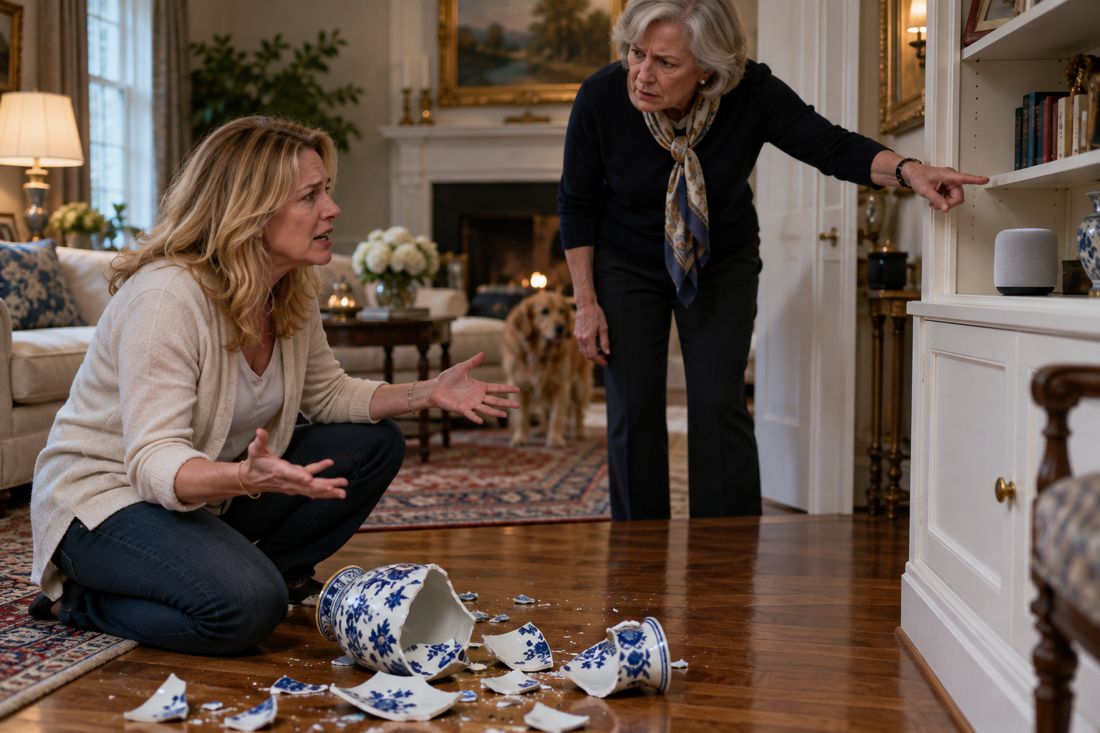
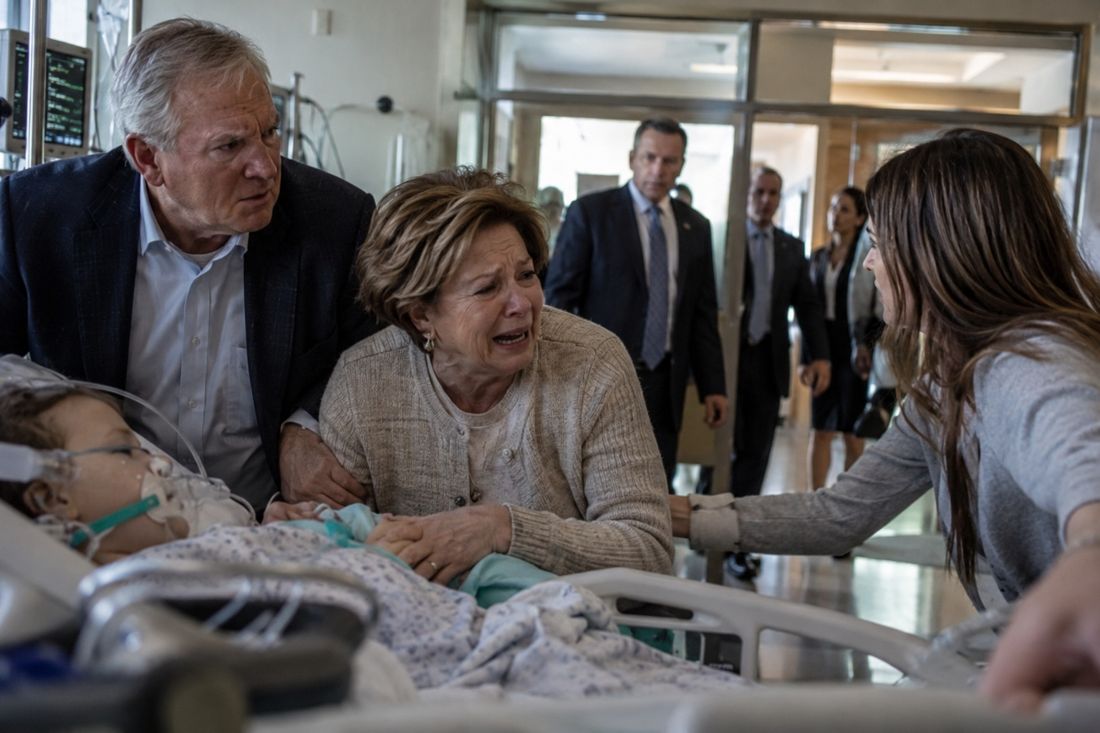
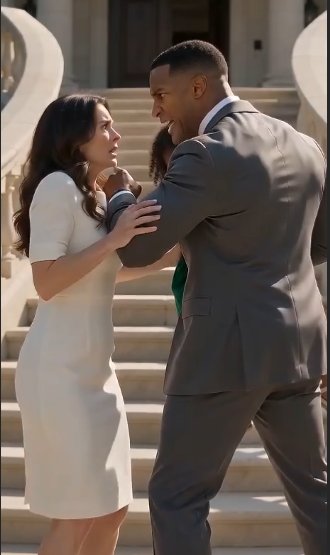
COMMENTS
Loading…