My Brother Threw My Belongings In The Mud Claiming Mom Left Him Everything-Then The Family Lawyer Played An Old Voicemail
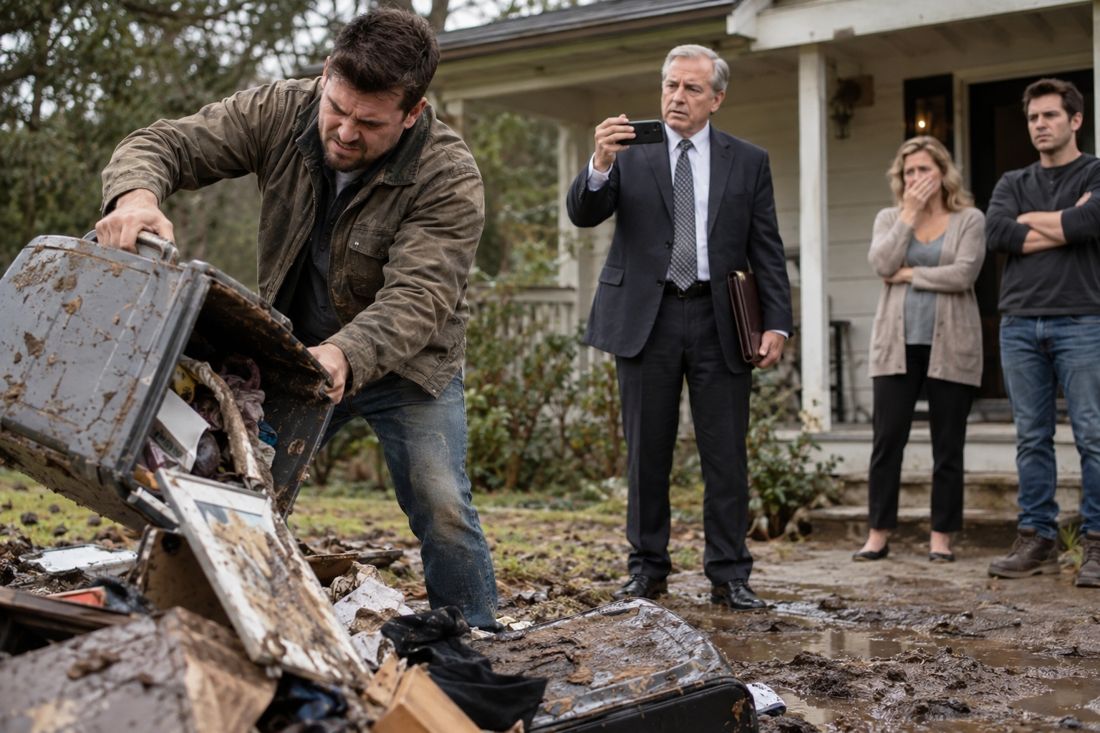
I stood in the freezing October rain holding the carved rosewood box containing my mother's ashes, watching two hired security guards heave my drafting table into the mud.
On the covered front porch of our family's sixteen-acre estate, my older brother Bradley leaned against the cedar railing in a cashmere coat, sipping a glass of our mother's vintage port with a victorious sneer on his face.
He told me I was nothing more than an unpaid hospice nurse who had overstayed his welcome, unaware that thirty miles away in downtown Bellingham, an elderly lawyer was sitting by a telephone waiting for morning.
The bird's-eye maple table splintered when it hit the gravel. Dad had built that desk thirty years ago. Thirty-two sketchbooks filled with my hand-drawn furniture joinery and botanical studies tumbled into the puddles, soaking up black silt.
"Careful with the heavy stuff, boys," Bradley called out lazily. "I don't want ruts in my lawn. The landscaping crew arrives Monday to prep for the private auction."
I couldn't breathe. My fingers dug into the rosewood urn, pressing Mom's ashes against my chest.
"Bradley, what is this?" My voice cracked with exhaustion. "Her funeral was yesterday. I just came back from the crematorium. What are you doing with my workshop?"
Bradley chuckled that dry, arrogant laugh he used whenever he found someone's existence inconvenient. He pulled a folded paper in a plastic sleeve from his coat and waved it in the air.
"Securing my property, Julian," he said smoothly. "As sole heir and sole executor. You had three days of grace out of the goodness of my heart. But the party's over. You don't live here anymore."
"Your property?" I choked out. "Mom never left Blackwood Ridge to you. She told Arthur Sterling—"
"Arthur Sterling is an eighty-year-old dinosaur," Bradley cut in, his eyes turning cold. "Mom signed a complete holographic amendment seven weeks ago. Dated August 14th. Hand-drafted, witnessed, and notarized. The house, the outbuildings, the orchard, the investments. Everything to me, Julian. She finally realized leaving sixteen acres to a struggling carpenter was a joke."
A guard hurled a crate of Dad's Japanese carving chisels into the bed of my battered 2011 Tacoma. The steel tools slammed against the truck bed with a sickening clang.
When I stepped forward, the second guard blocked me, hand resting on his duty belt.
"Step back, sir," the guard droned. "You've been served a trespass notice. You have fifteen minutes to vacate."
Bradley stepped down the porch stairs, reeking of expensive cologne and tobacco.
"You lost, little brother," he whispered into my ear. "You spent eighteen months wiping her drool and changing bedpans. And for what? She looked at you at the end and saw a loser. Now take your box of dust and get off my mountain before I have you jailed."
To understand why my brother hated me, you have to understand the Vance family.
Our parents, Thomas and Eleanor Vance, bought Blackwood Ridge in 1984. Dad was a master shipwright who built custom timber homes. Mom was a renowned botanical illustrator whose watercolor plates of native conifers were licensed worldwide.
Together, they spent thirty years turning sixteen rugged acres on the Cascades into a paradise: an heirloom cider orchard, a four-bay workshop, and terraced gardens.
Bradley was born first, and Dad treated him like royalty. Tall, charismatic, and completely devoid of empathy, Bradley went to private prep schools and drove sports cars our parents paid for. When he lost two hundred thousand dollars of family money on a failed crypto firm in 2018, Dad bailed him out with a wire transfer and a gentle lecture about entrepreneurial risk.
I was born five years later. I loved the smell of cedar sawdust, sharp hand planes, and the damp soil. When Dad died of a sudden stroke six years ago, Bradley didn't even stay for the wake. He took a red-eye back to his Seattle high-rise, leaving me and Mom to handle the estate taxes.
For four years, Bradley only called Mom when he needed cash for luxury condo down payments or bad investments. Every time Mom said no, he punished her with six months of radio silence.
Then, eighteen months ago, the hammer fell.
Mom collapsed in the kitchen. Stage IV peritoneal mesothelioma. The oncologist gave her under a year.
I called Bradley in tears from the hospital waiting room.
"Dr. Chen says she needs round-the-clock care, Bradley. She can't live alone."
Bradley sighed against the backdrop of a noisy steakhouse. "Well, that's awful, Julian. But my schedule at the firm is slammed. You're living out in the carriage house anyway. Your woodworking is freelance. You can easily adjust your hours."
"Adjust my hours? Bradley, she needs full-time hospice care!"
"Then do it," he snapped. "You've lived there rent-free for years. Consider this your rent. Keep me posted on her prognosis, and let me know when we need to liquidate."
He hung up. He didn't visit for the next six months.
Those eighteen months were the most exhausting and sacred of my life.
I shut down my custom furniture shop. I moved my mattress into the small room across from Mom's suite so I could hear her if she coughed at night. I learned how to flush PICC lines with saline, administer anti-nausea shots, and puree organic squash when she could no longer swallow solid food. When neuropathy flared in her feet, I sat on the floor rubbing lavender salve into her skin until she fell asleep.
In those quiet hours before dawn, Mom told me the truth about our family.
She told me Dad had secretly covered Bradley's gambling debts for a decade, and how Bradley had forged promissory notes that nearly cost them the timberland in 2012.
"Bradley thinks the world is a balance sheet, Julian," she whispered one night, her grey eyes clear as glass. "He thinks because I am quiet, I am blind. But a mother sees everything."
"Don't worry about Bradley, Mom," I told her. "I'm right here."
"I know you are," she murmured. "And you will never have to run again. I promise you that."
The only time Bradley ever came to the house was Tuesday, August 14th.
Mom had suffered a sudden spike in breakthrough pain, and our local pharmacy was backordered on her fentanyl patches. Her oncologist found three boxes at a specialty pharmacy in north Seattle, but they couldn't deliver across county lines. I had to pick them up in person.
"Go, Julian," Mom urged. "Mrs. Gable is bringing soup at three. I will be fine."
I raced down I-5 through a summer storm, but an overturned tanker near Everett turned a two-hour trip into three and a half.
When I finally pulled back into the driveway, Bradley's grey Porsche Macan was speeding away. He swerved around my truck, showering my fenders with gravel, and gave me a mocking salute.
My stomach dropped. I sprinted into the house and threw open Mom's bedroom door.
The room was in shambles.
Mom was sitting upright in bed, gasping for air, her oxygen cannula knocked crooked. Her nightstand was shoved aside; her water glass was shattered on the floor, and old legal folders were scattered across the quilt. She was clutching a black pen, her knuckles dead white.
"Mom! What happened?" I fell to my knees, fixing her oxygen tube.
"He had papers, Julian," she wheezed, trembling violently. "He shook my bed. He said if I didn't sign his handwritten codicil, he would call the county, have you arrested for elder abuse, and stick me in a state ward to die alone."
Rage boiled in my throat. "Did you sign it?"
Mom looked at me, and a faint, razor-thin smile touched her cracked lips.
"I signed what he wanted, Julian," she whispered. "I gave him his rope. Call Arthur Sterling tomorrow. Tell him the wolf came to the door. Tell him... the trap is set."
Mom passed away four weeks later, holding my hand as morning sun filled the room.
Her funeral was small—forty close friends, fellow artists, neighbors, and Arthur Sterling, leaning on his walnut cane. Bradley arrived forty-five minutes late, stood on the gravel path in sunglasses on his phone, and left before the casket was lowered.
And then came yesterday's eviction in the mud.
I spent that night parked behind a 24-hour truck stop outside Burlington. The rain beat against the cab like pebbles. I didn't run the heater because I only had forty-two dollars left to my name and couldn't waste gas.
I wrapped Mom's rosewood urn in my heavy flannel coat, held it to my chest, and watched the green dashboard clock tick until dawn.
At eight, I washed my face in the diner sink, put on my funeral suit, and drove into downtown Bellingham for the ten o'clock reading of the estate.
Bradley was already waiting in the fifth-floor reception lobby of Sterling, Vance & Croft. He sat on the leather sofa beside his wife Victoria—dripping in diamonds and tapping her manicured nails on a designer clutch—and Vance Holloway, a ruthless Seattle corporate estate litigator in a tailored pinstripe suit.
When Bradley saw me, he smirked. "Did you sleep in your truck, Julian? You smell like wet dog and diesel exhaust."
Victoria sneered. "Bradley, don't engage with him. It's degrading."
Bradley tossed a crisp hundred-dollar bill onto the table. "For breakfast and a cheap motel, little brother. Consider it an advance on your zero-dollar inheritance."
I left the bill where it lay. "Keep your money, Bradley. You're going to need it."
The double doors swung open, and Arthur Sterling emerged.
At seventy-four, with thick white hair, wire-rimmed spectacles, and a posture like a mountain cedar, Arthur carried a thick, red-rope legal dossier tied with black ribbon.
"Good morning, gentlemen. Mrs. Vance," Arthur said in his gravelly baritone. "Please join me in the conference room. We have serious matters to conclude."
The conference room was lined with leather-bound legal volumes overlooking the slate-grey waters of Bellingham Bay.
Arthur took the head of the mahogany table. I sat on his left. Bradley, Victoria, and Vance Holloway sat directly opposite us.
Before Arthur could speak, Holloway unclasped his briefcase and slid a laminated document across the wood.
"Mr. Sterling," Holloway began smoothly. "Before you waste time unsealing outdated instruments, we wish to present the definitive testamentary document of the late Eleanor Vance."
Arthur looked over his spectacles. "And what is this, Mr. Holloway?"
"A formal holographic codicil and will executed by Mrs. Vance on August 14th," Holloway declared. "It revokes all prior wills and trusts, naming my client, Bradley Vance, sole executor and sole beneficiary of all real property, timber acreage, and investment portfolios."
Bradley leaned forward, smirking across the table. "She realized Julian was bleeding her dry, Arthur. She begged me to take over, wrote every word in her own hand, and signed it right in front of me."
Arthur didn't touch the document. He uncapped his fountain pen and looked Bradley in the eye.
"So you state, on the record, that our late client was completely lucid and acted entirely of her own free will on August 14th?"
"I do," Bradley said firmly. "Under penalty of perjury."
"And you, Mr. Holloway? You assert this document's total validity?"
"Without hesitation," Holloway replied. "The signature matches. The intent is clear. We demand immediate surrender of the deed to Blackwood Ridge."
Arthur took a slow breath. He set down his pen and looked at Bradley with chilling pity.
"Bradley," Arthur murmured. "Your father told me thirty-two years ago in this very room: 'Bradley believes everyone around him is as blind and corrupt as he is.' Your mother agreed. And she spent years preparing for the day your greed would outrun your common sense."
Bradley banged his fist on the table. "Validate the will, Sterling, or I'll file a motion in Superior Court by noon!"
Arthur didn't blink. He reached into his dossier, produced a small black audio dock, and connected it to his tablet.
"On August 14th at precisely 2:14 PM," Arthur said calmly, "Eleanor's phone auto-dialed my direct emergency line when it fell behind her headboard. My server records all emergency calls to a secure cloud repository. The recording lasted six minutes and forty-two seconds. Listen."
Arthur pressed play.
Static hissed through the conference room speakers, followed by the mechanical rhythm of an oxygen concentrator and Mom's labored breathing.
Then, a door crashed open on the recording.
Hurried footsteps crossed the bedroom floor. And then Bradley's voice—loud, venomous, and stripped of all polish—exploded into the room.
"Wake up, Mom! Wake up right now!"
The sound of sheets tearing. A sharp gasp from Mom.
"Bradley...?" Mom's recorded voice was terrified. "What are you doing here? Where is Julian?"
"Julian is stuck in traffic forty miles south, you old hag! You and I are handling this right now!"
Papers slapped violently against the wooden nightstand.
"Sign it!" Bradley roared. "Take the damn pen and sign this codicil!"
"I... I will not," Mom wheezed. "Arthur has my papers. Everything is for Julian. Julian took care of me. You never came..."
A sickening crash shook the speaker—a fist slamming into the headboard, followed by Mom's water glass shattering on the floor.
"Julian is a useless carpenter who hasn't made fifty grand in his life!" Bradley screamed. "I run forty-million-dollar funds! You think I'm letting you hand sixteen acres of prime timber to a guy who plays with blocks of wood? Sign the paper, or I swear to God, I will unplug this oxygen machine right now!"
In the conference room, Attorney Vance Holloway went completely white, recoiling from Bradley as if he were radioactive.
"Bradley..." Holloway stammered. "What is this?"
"Turn it off!" Bradley shrieked, lunging across the table toward Arthur's tablet. "That's an illegal wiretap! Turn it off!"
"Sit down, Mr. Vance," Arthur barked, his voice booming with authority. "Washington statute RCW 9.73.030 explicitly permits emergency recording of violent felonies, extortion, and bodily harm. Sit down, or the bailiffs outside will restrain you."
Bradley collapsed into his chair, panting in cold terror.
On the tape, Bradley hissed: "Sign it, or I'm calling Adult Protective Services. I'll tell them Julian has been starving you and stealing your narcotics. He'll be in county jail before dark, and you'll die in a state ward choking on your own vomit. Sign it!"
Silence hung on the tape. Then Mom's voice spoke.
It was no longer weak. It was cold, clear, and terrifying.
"I will sign your paper, Bradley," Eleanor Vance said. "I will write your little words. But you have made a fatal mistake. You think love is a transaction. You think power is a hammer. Take your paper and run... but know that you have only walked into your own tomb."
Arthur tapped the screen. The recording clicked off.
The conference room was suffocatingly quiet.
Victoria sat pressed against the far arm of the sofa, clutching her purse, staring at Bradley in disgust. "Bradley... you told me your mother begged you. You told me Julian abused her."
"Shut up, Victoria!" Bradley snarled, his face mottled purple.
Vance Holloway didn't utter another word. He closed his briefcase, dropped the laminated will into a folder, and slid it to Arthur.
"Mr. Sterling," Holloway said rigidly. "My firm was retained under false pretenses. Effective immediately, I withdraw my appearance on behalf of Mr. Bradley Vance. Good day."
Holloway walked out the door without looking back.
"Wait! Vance!" Bradley shouted. "I paid you fifty grand!"
"Which you will need for criminal defense, Bradley," Arthur said calmly.
Arthur opened the blue-ribbon dossier.
"Now, allow me to present the true operative instrument governing the Vance estate."
Arthur slid a thick parchment toward me.
"Two years ago, in July 2024, before her diagnosis, your mother established the Eleanor Vance Irrevocable Living Trust. Under its terms, title to Blackwood Ridge, all sixteen acres of timber, the workshops, and the primary three-point-eight-million-dollar investment portfolio were transferred irrevocably to the trust entity."
Arthur looked directly at Bradley.
"Because the property was held in an irrevocable trust, Eleanor herself lacked the power to alter beneficiaries through a handwritten will. Even if your coerced document were genuine, Bradley, it transfers nothing. The trust owns everything."
Bradley gripped the table. "Who is the trustee?"
Arthur smiled. "Julian Vance is the sole trustee. And the sole primary beneficiary."
I let out a ragged breath, tears blurring my vision.
"Furthermore," Arthur continued, "your mother included a customized in terrorem clause. Any beneficiary attempting coercion or challenging the trust was to be disinherited completely."
"You can't leave me with zero!" Bradley shrieked. "I'm the firstborn!"
"She didn't leave you with zero, Bradley," Arthur replied. He slid a small yellow envelope across the table. "First: your father's 1982 Sears riding mower, stored behind the shed with a cracked engine block. She noted you promised him you'd fix it thirty years ago, and felt it was time you kept your word."
Bradley stared at it in disbelief.
"And second," Arthur added, pulling out a thick audit binder, "a forensic report on the Thomas Vance Memorial Scholarship Fund."
Bradley turned the color of wet chalk.
"You diverted four hundred and eighty-six thousand dollars from that charity into personal accounts for margin calls and Porsche leases, Bradley. Your mother repaid the foundation secretly so your father's name wouldn't be dragged through court. But she instructed me to hand this binder to the police the moment you challenged her estate."
Arthur picked up his phone. "Detective Miller. You can come in now."
The double doors opened.
Two plainclothes detectives from the Whatcom County Sheriff's Financial Crimes Division stepped in with an armed deputy.
Detective Miller walked straight behind Bradley's chair.
"Bradley Vance?" she asked.
Bradley sat frozen, hyperventilating, staring wildly at the audit binder.
"Stand up, please," Detective Miller said. "You are under arrest for first-degree identity theft, grand larceny, and felony elder abuse."
"No! Wait!" Victoria cried out, scurrying toward the door. "I had nothing to do with this! I swear, I thought his mother signed it freely!"
"Victoria, shut up!" Bradley screamed, breaking into hysterical sobs. He lunged across the table toward me, tears and snot streaming down his face. "Julian! Julian, please! We're brothers! You have the house! You have the money! Just tell them not to press charges! I'll lose my license! I'll go to prison!"
I looked at him.
I looked at the brother who had abandoned our dying mother.
I looked at the brother who had threatened to pull her oxygen plug.
I looked at the brother who had thrown my father's tools into the mud yesterday morning.
"Officer Davis gave me fifteen minutes to clear my things from the driveway yesterday, Bradley," I said, my voice ice-cold. "You've had thirty-seven years of grace. Your time is up."
The deputy wrenched Bradley's arms behind his back.
The sharp click of the steel handcuffs locking around his wrists echoed like a gunshot.
Bradley collapsed to the floor, screaming curses at Arthur, Victoria, me, and our dead mother, until the detectives dragged him through the glass doors.
Victoria didn't look at him once as she fled down the hall.
When the doors closed and Bradley's screams faded down the hall, the conference room fell into quiet peace.
Arthur Sterling took off his spectacles and smiled at me with warm, paternal eyes.
"Your mother was an extraordinary woman, Julian," he said softly. "She knew the burden you carried. She wanted to ensure that for the rest of your life, no one could ever make you feel small again."
He handed me a cream-colored envelope sealed with lavender wax.
"She asked me to give you this when everything was finished."
My hands shook as I broke the seal and unfolded the cotton paper. Her graceful hand read:
My dearest Julian,
If you are reading this, Arthur has finished his work, and Bradley has reaped the harvest of his own planting. Do not carry guilt in your heart. You cannot save a man who chooses his own destruction.
Thank you, my sweet son. Thank you for holding my hand in the dark. You put your life on hold so that I could leave this world surrounded by love and dignity. That is a debt no mother could ever repay, but this home is my blessing to you.
Take care of Blackwood Ridge. Let the sawdust fly in the workshop. Plant the honeycrisp apples where the old timber wall fell. And whenever you walk through the orchard in the autumn sun, know that I am walking beside you.
With all my love forever,
Mom
I drove back up the mountain that afternoon.
The storm had passed. Sunlight poured through the towering Douglas firs, turning the damp needles on the forest floor to copper and gold.
When I pulled into Blackwood Ridge, the security guards and their van were gone.
My father's bird's-eye maple drafting table was still lying in the wet grass near the orchard gate.
I walked over and inspected it. The wood was damp and a leg joint was loose, but the core was rock-solid. It had been built to endure.
I lifted the desk onto my shoulders, carried it up the front steps, and set it in the center of the sunlit veranda.
Then I went to my truck and lifted the rosewood box.
I carried my mother inside, walked into the living room, and placed her urn on the stone mantel above the fireplace, beside the photograph of her and Dad laughing on the day they planted the first apple tree.
The valley was quiet. The wind smelled of cedar, wet earth, and woodsmoke.
I took off my suit jacket, rolled up my sleeves, and walked to the workshop to fetch my tools.
I had a drafting table to rebuild.
COMMENTS
Loading…