Neighbor Karen Used My Driveway for Her Pool Delivery—Then I Closed the Gate
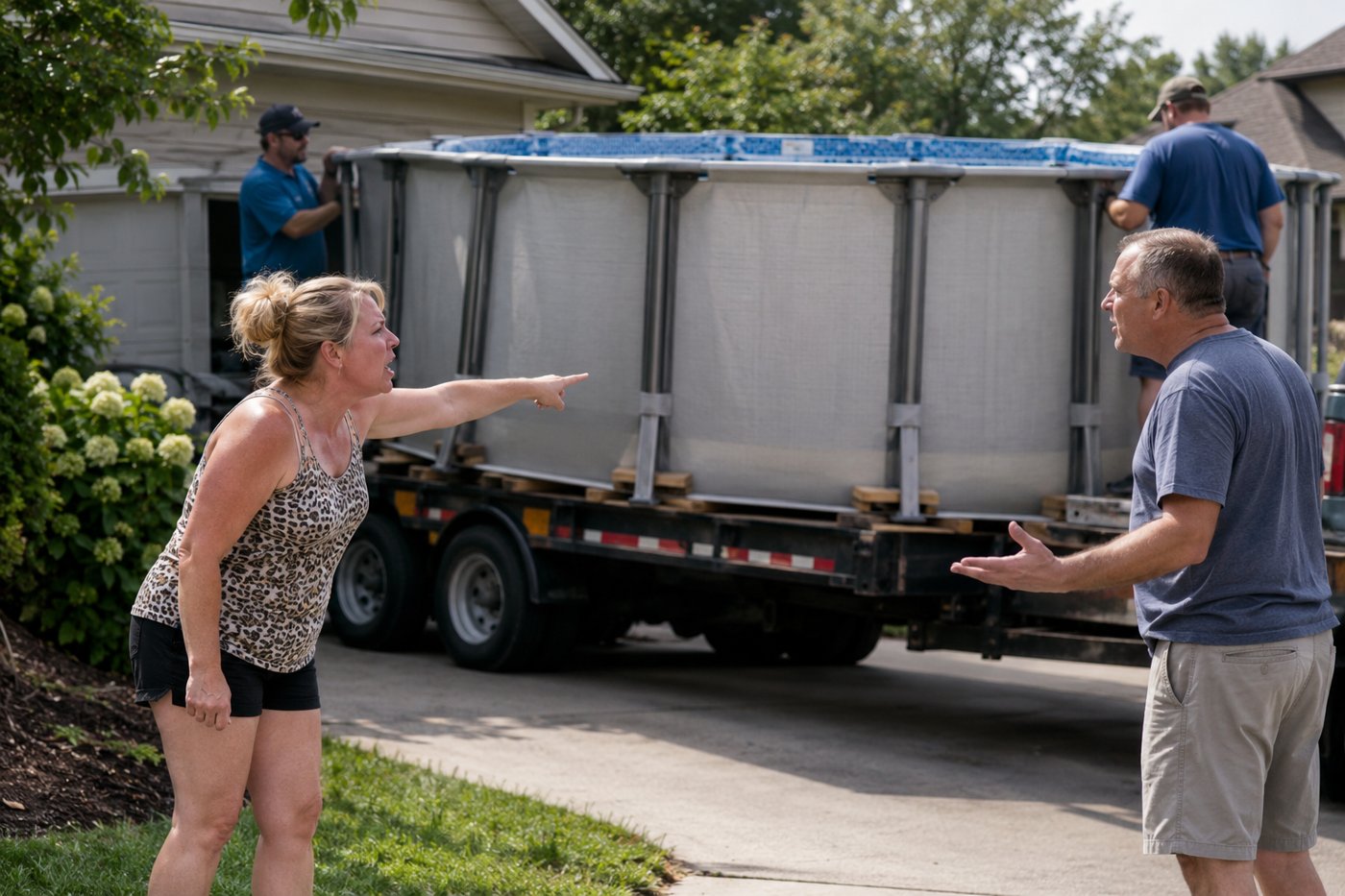
A massive commercial dump truck had already breached my front entrance by the time I caught sight of Karen ushering the next hauler inside.
She was planted square in the center of my asphalt drive, gesturing with the absolute certainty of someone who believed the county had deeded the entire zip code to her name.
One arm waved high in the air.
The other swept toward the ridge rising behind my timberline.
“BRING IT ON UP!” she hollered.
A ten-wheel white dump truck rumbled across the cattle guard.
Idling right behind its tailgate sat a towering concrete boom pump.
Stacked behind that was an extended flatbed loaded with pallet after pallet of cut stone.
And trailing the whole procession was an immaculate heavy-duty crew cab with HARTWELL CUSTOM POOLS stenciled across the doors.
I stepped out into the daylight from my workshop.
“TURN THOSE RIGS AROUND.”
The lead driver stomped his air brakes with a sharp hiss.
Karen whipped around to face me.
She had on crisp white designer trousers, oversized tortoiseshell sunglasses, and the sour scowl of someone deeply offended that the real world had interrupted her agenda.
“OUT OF THE WAY!” she snapped.
I stayed right where I stood.
She marched straight down the slope toward me.
“YOUR DRIVEWAY IS THE ONLY PRACTICAL ACCESS TO MY POOL!”
I glanced over her shoulder.
Far beyond my fence line, up on the wooded bluff to the west, the expansive slate roof of her three-story mansion peeked through the trees.
Then I brought my eyes back to hers.
“Then you don't have access.”
Her jaw clamped tight.
She swung an arm toward the idling caravan.
“I'VE ALREADY PAID FOR THIS WORK—GET OFF THE ROAD!”
I didn't bother arguing.
I walked right past her.
Headed straight down to the mouth of the drive.
And shoved the heavy black iron gates shut.
The solid steel drop-bar slammed into the concrete sleeve with a loud, ringing CLACK.
Karen let out a sharp, mocking chuckle.
A genuine laugh of disbelief.
“You honestly think a closed gate is going to stop this?”
Right then, the lead trucker poked his head out the driver-side window.
“Excuse me, ma'am?”
Karen turned around.
The driver motioned over his shoulder toward the road.
“No legal access, no delivery.”
With a heavy hydraulic clunk, the dump truck dropped into reverse.
The massive concrete pump truck did the same.
A piercing backup beeper sliced through the morning air.
Then another chimed in.
Then a third.
The haughty smirk vanished from Karen's face in an instant.
“WHAT DO YOU THINK YOU'RE DOING?”
The driver leaned out and answered flatly:
“Pulling out.”
“I PAID FOR TODAY'S DROP!”
“Understood, ma'am.”
“THEN UNLOAD IT!”
He stared down at my chained gateposts.
“Not across private ground without permission.”
And slowly, deliberately, the entire line of heavy commercial rigs began backing out toward the county road.
That was the exact second she finally grasped the lesson I had spent the last month and a half trying to explain.
Holding the deed to a three-million-dollar showplace didn't mean she owned the right-of-way leading up to it.
My name is Daniel Hart.
Back then, I was fifty-two and looking after just under nine acres out in the countryside near Franklin, Tennessee.
It wasn't an operating farm in any modern sense.
Not anymore, at least.
A half-century ago, it had been a working cattle pasture.
By the time my wife, Laura, and I purchased the place, developers had already sliced the surrounding countryside into sprawling executive enclaves.
Our parcel was one of the odd remnants that escaped the bulldozers.
Long.
Narrow frontage along the two-lane county road.
Broadening out significantly toward the rear.
Bordered by dense hardwood forest on the western boundary.
Flanked by a rocky, winding creek along the eastern edge.
Our home sat back roughly four hundred feet from the county highway.
A single private asphalt lane connected our front porch to the pavement.
That entire lane sat squarely within our surveyed property lines.
That simple legal fact would soon become an insurmountable obstacle.
Resting on the ridge directly behind our woods sat Bellmere Ridge.
Bellmere was hardly your typical suburban subdivision.
It was one of those guard-gated compounds where even the smallest cottage looked large enough to swallow an entire starter subdivision whole.
Stacked stone façades.
Imported slate shingles.
Four-bay carriage houses.
Manicured security gates.
Winding nature paths.
A sprawling stone clubhouse where nobody ever seemed to gather.
The parcels ranged from two to six landscaped acres.
The monthly association assessments alone rivaled what working families paid for rent in town.
Laura always described it as:
“A country retreat for private equity managers.”
I told her she was selling them short.
A fair number were orthopedic surgeons.
We were not members of Bellmere Ridge.
Our acreage existed long before the first developer ever drove a surveyor's stake.
When the syndicate acquired the surrounding farmland, they attempted to buy our parcel to expand their master plan, but the original farmer flatly refused to sell.
Years afterward, Laura and I bought the property directly from the farmer's estate.
Our deed was completely free and clear.
No membership in the Bellmere Ridge Homeowners Association.
No architectural review board dictating what color we painted our barn.
No shared-maintenance agreements.
No ingress or egress easements granting passage to the hilltop lots behind us.
The county held a standard utility easement near the public road.
The water district held a minor drainage easement along the creek bank.
Not a single line in any legal register gave our uphill neighbors the right to set a tire on our property.
For nearly eight years, that distinction never caused a single ripple.
Then Karen Caldwell bought Lot 17.
Karen was forty-eight.
Her husband, Mitchell Caldwell, was a senior partner at an investment advisory firm headquartered in downtown Nashville.
They purchased one of the grandest estates inside Bellmere's gates.
Five sprawling suites.
Seven bathrooms.
A temperature-controlled wine room.
A private fitness studio.
A detached carriage apartment.
A fully equipped outdoor granite kitchen.
The luxury real estate brochure had praised the listing as:
“A secluded hilltop sanctuary offering uncompromising luxury.”
That description became intensely ironic later on.
Because that secluded sanctuary possessed one glaring, fatal flaw.
Its backyard was almost impossible to reach with heavy equipment.
The Caldwell estate perched right on the edge of a severe limestone bluff.
The front driveway connected smoothly to Bellmere's private paved loop.
Behind the house, however, the topography plummeted down a sheer slope straight toward my timberline.
When the custom home was originally framed, the builders had utilized a temporary dirt haul road cut across an adjacent, vacant parcel.
That route vanished the moment that adjacent lot was sold, cleared, and terraced with private gardens.
For day-to-day living, none of this presented an issue.
Family sedans drove through Bellmere's electronic gate.
Guests strolled along the stone verandas.
Riding lawnmowers squeaked through a garden gate along the side yard.
The setup worked fine.
Until Karen decided she needed an Olympic-sized swimming pool.
Not a modest fiberglass insert.
An elaborate aquatic complex that looked like it required an army corps of engineers to build.
My first warning came when a surveying crew showed up near my western fence line.
Two men wearing fluorescent orange vests.
Surveying tripod.
A bundle of pink marking flags.
I strolled across the lawn to meet them.
“Morning fellas.”
One looked up from his sights.
“Morning.”
“What are you staking out?”
“Access corridor.”
“Access for what?”
“Excavation and pool construction.”
I glanced up the steep timbered slope toward Karen's mansion.
“Access for whom?”
The surveyor hesitated, checking his ruggedized tablet.
“The Caldwell place.”
“Through my private ground?”
He tapped his screen.
“That's the route we've been asked to map.”
That was how the storm began.
I gave Karen a call later that afternoon.
Over the years, we had exchanged pleasantries maybe four or five times.
The annual neighborhood barbecue down the road.
Lending a hand after a winter ice storm.
Catching her runaway golden retriever once when he slipped his collar.
Civil enough terms.
“Karen, I noticed surveyors planting stakes along our shared boundary today.”
“Oh, yes!”
“You're putting in a pool?”
“We certainly are.”
“Well, congratulations on that.”
“Thank you, Daniel.”
“The surveyor mentioned they were mapping an access lane across my parcel.”
A short pause hung on the line.
Then:
“It's just for staging and equipment while they build.”
“Through my private driveway?”
“Yes.”
I waited for her to elaborate.
She breezy added:
“It's only temporary, obviously.”
“Were you planning on asking for my permission?”
Another pause, noticeably stiffer this time.
“I assumed our contractor handled those arrangements.”
That response set off immediate alarm bells.
“Who told your contractor my private driveway was available?”
“I don't know the technical details, Daniel. They're just work trucks.”
“On my property.”
“They would just drive in, cross over, and head right up the back hill.”
“Karen, there is no road connecting my driveway to your bluff.”
“The excavation team said they'll lay down heavy ground-protection mats.”
I rubbed my forehead.
“You're talking about running an industrial haul road straight through my yard.”
“Only along the fringe of the woods.”
“Karen.”
“What?”
“You need my explicit legal permission.”
Her tone was thick with disbelief.
“For temporary construction vehicles to pass by?”
“Yes.”
“Even if your driveway is the only feasible way to get the equipment in?”
“Yes.”
Complete silence on the line.
Finally:
“I'll have our project manager reach out to you tomorrow.”
That conversation should have settled the matter once and for all.
It didn't even slow it down.
The pool contractor phoned early the following morning.
His name was Ben Mercer, a senior project supervisor with Hartwell Custom Pools.
He was crisp, direct, and completely professional.
“Mr. Hart, I understand our logistics team has been looking into temporary staging access across your lower driveway.”
“You might be looking at it, Mr. Mercer, but nobody has permission to use it.”
He went quiet for a beat.
“Understood, sir.”
I appreciated that answer.
He took a breath and laid out the engineering headache they were facing.
Karen's hillside infinity pool required extensive subgrade excavation.
They needed to move heavy excavators onto the site.
Fleet dump trucks to haul tons of rocky soil out.
Concrete transit mixers.
Pallet haulers for flagstone coping and coping materials.
The side setbacks along the Caldwells' foundation were far too tight for standard excavation rigs.
The grade dropping from Bellmere's paved loop was dangerously steep for loaded trucks.
A mobile crane setup was technically viable, but it would inflate the mobilization budget into the stratosphere.
My driveway offered a gentle, wide grade straight to the base of the ridge.
“Convenient for whom, exactly?” I asked.
Ben let out a dry, wry chuckle.
“Point taken.”
“What exactly would this operation do to my property?”
He offered to email over the preliminary access diagram.
I opened the attachment a few minutes later.
My jaw tightened as I traced the lines.
Their proposal called for heavy commercial vehicles to enter through my security gate.
Rumble roughly three hundred feet up my private asphalt drive.
Veer off across my manicured side lawn.
Tear across two hundred and forty feet of wooded ground.
Lay down interlocking composite roadway mats.
Chop down several mature hardwood trees.
Cross our natural drainage swale.
And then grind their way up the hillside toward Karen's back boundary.
That wasn't just a friendly shortcut.
That was an industrial haul highway carved right across our homestead.
I dialed his number back immediately.
“The answer is no.”
“Understood, Mr. Hart.”
“Just like that?”
“It's your land. You have every right to refuse.”
I liked Ben right away.
He added:
“I'll notify Mrs. Caldwell that we have to develop an alternate plan.”
“Thank you, Ben.”
And once again, I figured common sense had prevailed.
Once again, I was mistaken.
Three days later, a sharp knock echoed through our front porch.
Karen was standing on the steps, flanked by Mitchell.
Mitchell was composed, dressed in casual weekend clothes, holding a thick leather portfolio.
“Daniel, we'd like to make this financially worthwhile for you,” Mitchell began.
Now that was a different tone.
It didn't alter our rights, of course.
But at least it acknowledged that our property wasn't free public infrastructure.
He opened the folder and presented an offer of $5,000 for temporary access privileges.
I asked about the timeframe.
“Roughly six weeks from start to finish,” Mitchell replied.
“And what kind of vehicle traffic are we talking about?”
Karen answered with an airy dismissiveness:
“Oh, hardly any. Just a few trips.”
Mitchell gave her a side glance.
Then he turned back to me with honest eyes.
“Realistically? Dozens of loaded passes.”
I respected the honesty.
“What about the trees marked on that diagram?”
“We would restore and replant everything afterward.”
“What about the structural wear on my private driveway?”
“Fully covered under Hartwell's commercial liability insurance.”
“The wet drainage swale?”
“They'll install protective timber swamp mats.”
“And who is engineering that swale crossing so a flash flood doesn't wash out my lower yard?”
Neither of them had an answer.
Laura stepped through the screen door onto the porch.
She had been listening from the kitchen.
She folded her arms and looked at Mitchell.
“What happens if a thirty-ton tandem hauler buckles our asphalt down to the dirt base?”
Mitchell answered steadily:
“We will cut it out and repave it.”
“What if an overloaded mixer crushes our driveway culvert?”
“We'll replace the culvert pipe.”
“What if a backhoe rips up the root systems of our hundred-year-old oaks?”
“We will compensate you for the loss.”
“What if a driver rolls a rig on the slope and gets hurt on our land?”
“Our umbrella policy indemnifies you against all liability.”
Laura glanced over at me, then looked Karen straight in the eye.
“And what if we simply have no interest in turning our private yard into a noisy construction corridor for anyone's money?”
Karen's face hardened instantly.
That was the one roadblock she couldn't compute.
Because she operated on the assumption that every principle had a dollar amount attached to it.
“You won't even notice most of the equipment from your house,” Karen insisted.
Laura pointed past the porch railing toward the tree line.
“I have a clear view of that exact swale right through my kitchen window.”
“It's only for a few short weeks!”
“Six weeks of vibrating foundations and diesel fumes.”
“Possibly eight,” Mitchell conceded quietly.
Karen glared at him, then stepped closer to us.
“We are offering to pay you very fair compensation.”
I looked at her calmly.
“An offer to purchase doesn't force a property owner to sell, Karen.”
She crossed her arms, chin raised.
“Nobody is trying to buy your property, Daniel.”
“You are attempting to purchase a temporary private easement across it.”
“Exactly.”
“And our answer is no.”
Mitchell took the refusal like a seasoned businessman.
He neatly closed the leather folder.
“All right. We hear you.”
Karen snapped her head toward him.
“Mitchell, no!”
“Karen, we asked. They said no.”
“But this makes the pool almost impossible to build!”
He looked at her, his voice weary.
“Then we sit down with Ben and figure out another route.”
Karen spun on her heel and stared at me with venom.
“Can't you at least take a few days to think it over?”
“I've already thought it through.”
“That isn't being reasonable.”
Laura gave her a quiet, final smile.
“It's very reasonable when the answer is no.”
They walked down the driveway and drove away.
Forty-eight hours later, an official white envelope arrived in our mailbox bearing the return address of the Bellmere Ridge HOA.
That gave me pause.
The letter was penned by the community management company's legal department.
It claimed the board had been alerted to the potential existence of a “historic construction access right-of-way” crossing our private parcel.
The letter politely requested that Laura and I provide copies of any title records or deed covenants regarding historic access agreements.
A historic route?
I reached out to our attorney that very afternoon.
Her name was Maya Ellison.
She was a sharp, no-nonsense property litigator based in Williamson County.
I emailed over the HOA's letter, our warranty deed, our boundary survey, our title insurance policy, and the construction schematic Ben had sent.
Her call came through first thing the next morning.
“Daniel, where did this phrase ‘historic construction access route’ come from?”
“I have absolutely no idea.”
“Has there ever been an active roadway through your timber?”
“Not in the eight years we've lived here. Not even an overgrown logging track.”
“Give me forty-eight hours to dig through older subdivision plats and county deed books.”
When she called back, she had uncovered the missing piece of the puzzle.
Nineteen years earlier, while Bellmere Ridge was first breaking ground on its infrastructure, the original master developer had struck a side deal with the elderly farmer who then owned my property.
It was not an easement.
It was a strictly limited, private license agreement.
The contract had permitted heavy excavation machinery to cross a designated strip of pasture for a period of exactly nine months.
It contained an automatic expiration clause.
The developer had compensated the farmer, graded the land back to pasture once the window closed, and that was the end of it.
That temporary disturbance explained why vintage aerial maps showed a faint scar through the grass.
Crucially, however, that temporary license had expired nearly two decades ago.
It did not run with the land.
It conferred zero perpetual rights to the developer.
It conferred zero rights to Lot 17.
And it granted the Bellmere Ridge Homeowners Association absolutely nothing today.
Maya sent a detailed letter along with the recorded documents directly to Bellmere Ridge's retained counsel.
The HOA's attorney took one look at the paperwork and immediately conceded.
By Friday afternoon, the HOA management company issued a courteous, formal retraction.
No access easement existed.
The file was closed.
For the third time, I thought the matter was laid to rest.
Karen, however, was not about to give up.
A week later, my cell phone rang.
It was Karen.
“I managed to get a copy of that original construction agreement from the county archives,” she said, her voice brimming with confidence.
“My attorney reviewed it days ago, Karen.”
“Then you know your land has historically provided access for heavy equipment!”
“Under a private, temporary license that expired nineteen years ago with the previous owner's consent.”
“What difference does nineteen years make?”
“Nineteen years, and the fact that you don't have the current owner's consent.”
She let out a heavy, exasperated sigh.
“Daniel, you are turning this into an unnecessary dispute.”
“Karen, I'm not the one trying to build a pool on a cliff.”
“You know what I mean.”
“I do. And my answer hasn't changed.”
She didn't hang up.
Instead, she raised the stakes.
“Ten thousand dollars.”
“No.”
“Fifteen thousand.”
“Still no.”
“Twenty thousand dollars, Daniel. Cash.”
I hung up, walked into the living room, and looked at Laura.
Neither of us was driven by greed.
Yet twenty thousand dollars is enough money to give any sensible homeowner reason to pause and weigh the options.
We sat down at the table and talked it through honestly.
Could we tolerate six or eight weeks of disruption?
Could we draft an ironclad contract?
Could we demand heavy swamp mats, daily dust control, and restricted operating hours?
Could we require a large cash escrow deposited in advance to cover any potential landscape or structural repairs?
The following afternoon, Ben Mercer sent over the comprehensive project timeline.
The moment Laura and I reviewed the actual construction schedule, every thought of compromise evaporated.
The supposed “six weeks” had expanded into an estimated fourteen weeks.
The projected truck traffic exceeded one hundred separate heavy-vehicle movements.
Several of those loads weighed tens of thousands of pounds.
The plans called for cutting down eleven mature oak and hickory trees.
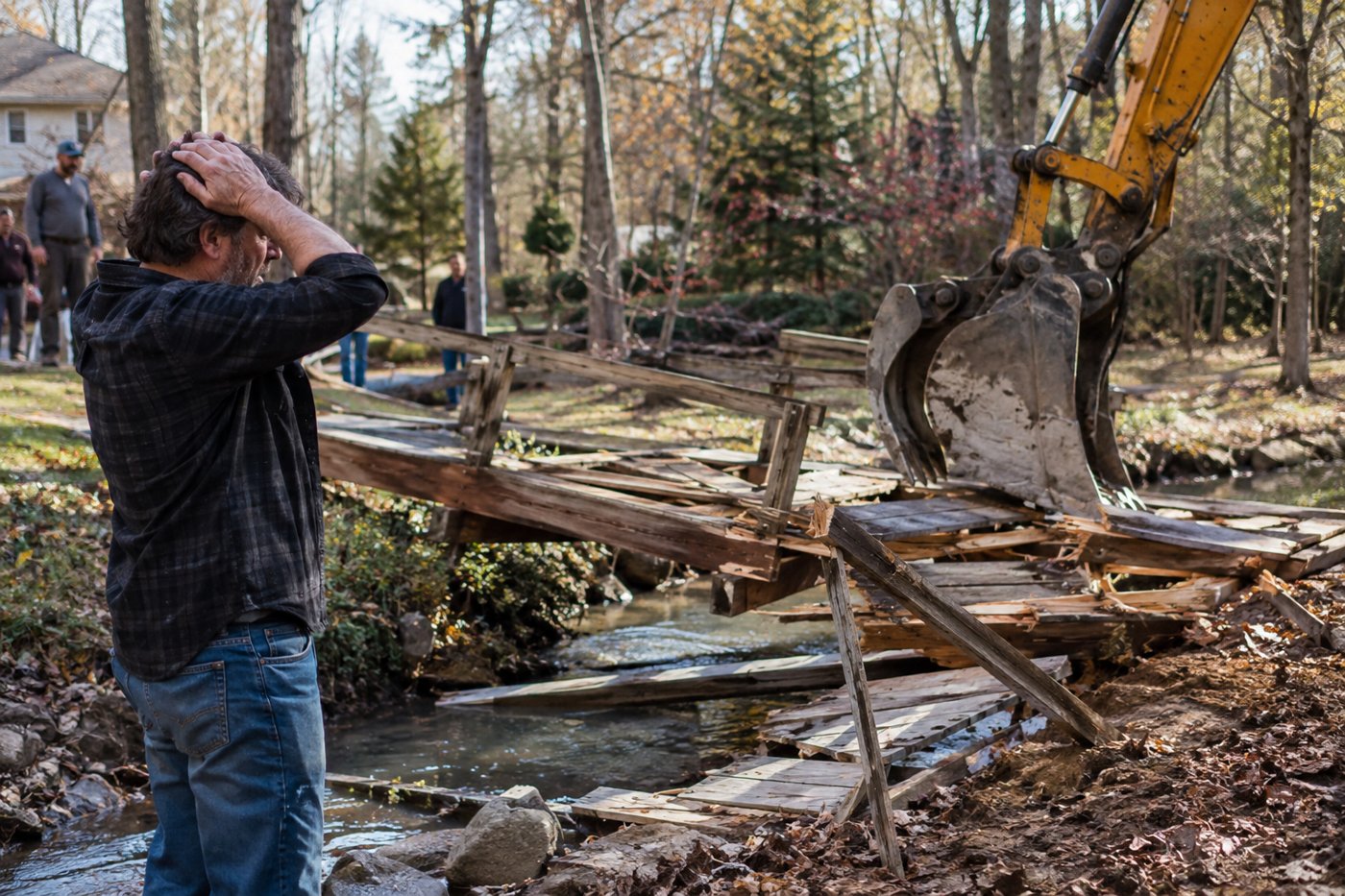
The drainage swale would require building a full temporary timber bridge.
Our security gate would need to stay propped open throughout all daylight hours.
And because our hillside turns into slick mud after heavy rains, seasonal weather delays would almost certainly stretch the project well past fourteen weeks.
Laura pushed the schedule across the counter.
“No way in hell.”
I nodded.
“Agreed. Not happening.”
We issued our final, formal refusal.
Maya drafted the official letter.
Crisp.
Polite.
Unambiguous.
Zero permission granted.
No commercial vehicles.
No construction personnel.
No equipment staging.
No felling of timber.
No tampering with our security gate.
No implied right of access whatsoever.
To ensure there was no confusion, I mounted two fresh, highly reflective signs to the gateposts: PRIVATE DRIVEWAY — STRICTLY NO CONSTRUCTION ACCESS.
Nothing hostile about them.
Just clear, undeniable legal notice.
Karen went completely silent.
For about ten days, we enjoyed total peace.
Then, on a bright Thursday morning, a flatbed trailer stopped right outside our closed gate, hauling a tracked skid-steer loader.
The driver idled outside the gate and pulled out his cell phone.
Less than five minutes later, Karen's white Mercedes SUV came flying down the county road from Bellmere's entrance.
She parked on the shoulder, marched up our driveway, and banged on our front door.
“You need to open the gate for the landscapers,” she declared.
“No, I don't.”
“They're only clearing underbrush!”
“On whose property, Karen?”
“Along the access corridor.”
“There is no corridor. We've established this repeatedly.”
“You know what I'm talking about!”
“I know you are attempting to clear trees off my land without a permit or permission.”
She glared at me, her cheeks burning.
“You are genuinely getting a kick out of this, aren't you?”
That rubbed me raw.
“Karen, I would give almost anything to stop having to explain basic property law from my front porch before breakfast.”
She wheeled around and stormed back down the lane.
The landscape trailer backed onto the highway and drove away.
After that, everything went quiet.
Uncomfortably quiet.
Ben Mercer stopped calling.
No more surveying crews or trailers showed up.
I figured Hartwell Pools had finally begun engineering an internal route inside Bellmere Ridge.
And as it turned out, that was exactly what they had done.
The alternate plan involved setting up a mobile crane to hoist a compact excavator over a wing of their residence, combined with extensive manual labor and mini-haulers.
It was complicated.
Slow.
Meticulous.
And Karen loathed it.
Mitchell later admitted to me that the internal redesign tacked nearly $90,000 onto the project's bottom line.
That staggering figure explained a great deal.
It didn't justify her disregard for our property line.
Not by a long shot.
But it certainly revealed why the pressure had been mounting so furiously.
And that was when Karen made the reckless gamble that transformed a stubborn neighborhood boundary dispute into an outright disaster.
She went ahead and scheduled a full-scale delivery convoy straight down my driveway anyway.
The showdown erupted on an unseasonably warm Tuesday morning.
Laura had driven into Nashville for a three-day visit with her sister.
I was working at my desk in my home office, which looked out over the front pasture and the main drive.
Around 9:10, a deep, resonant diesel vibration rattled the glass panes of my window.
Then came the hiss of commercial air brakes.
I stood up and looked down the lane.
A ten-wheel commercial hauler was already nosing past our open front gate.
Open.
That sent an immediate jolt of adrenaline through me.
I had personally closed and securely latched that gate less than an hour earlier after walking down to check the morning post.
I dropped my paperwork and headed out the front door.
That was the moment I saw Karen.
She was standing right in the middle of our driveway, waving both arms like an aircraft marshaller on a flight deck.
Behind that first dump truck stretched a continuous line of heavy contractor rigs, their tires crunching against the gravel shoulder of the county road.
I broke into a fast jog down the lane.
The lead truck crested the small rise near our pasture fence.
I stepped out into the center of the asphalt and threw both hands up in the air.
“HOLD UP! STOP RIGHT THERE!”
The driver reacted quickly, his front bumper dipping as the air brakes engaged.
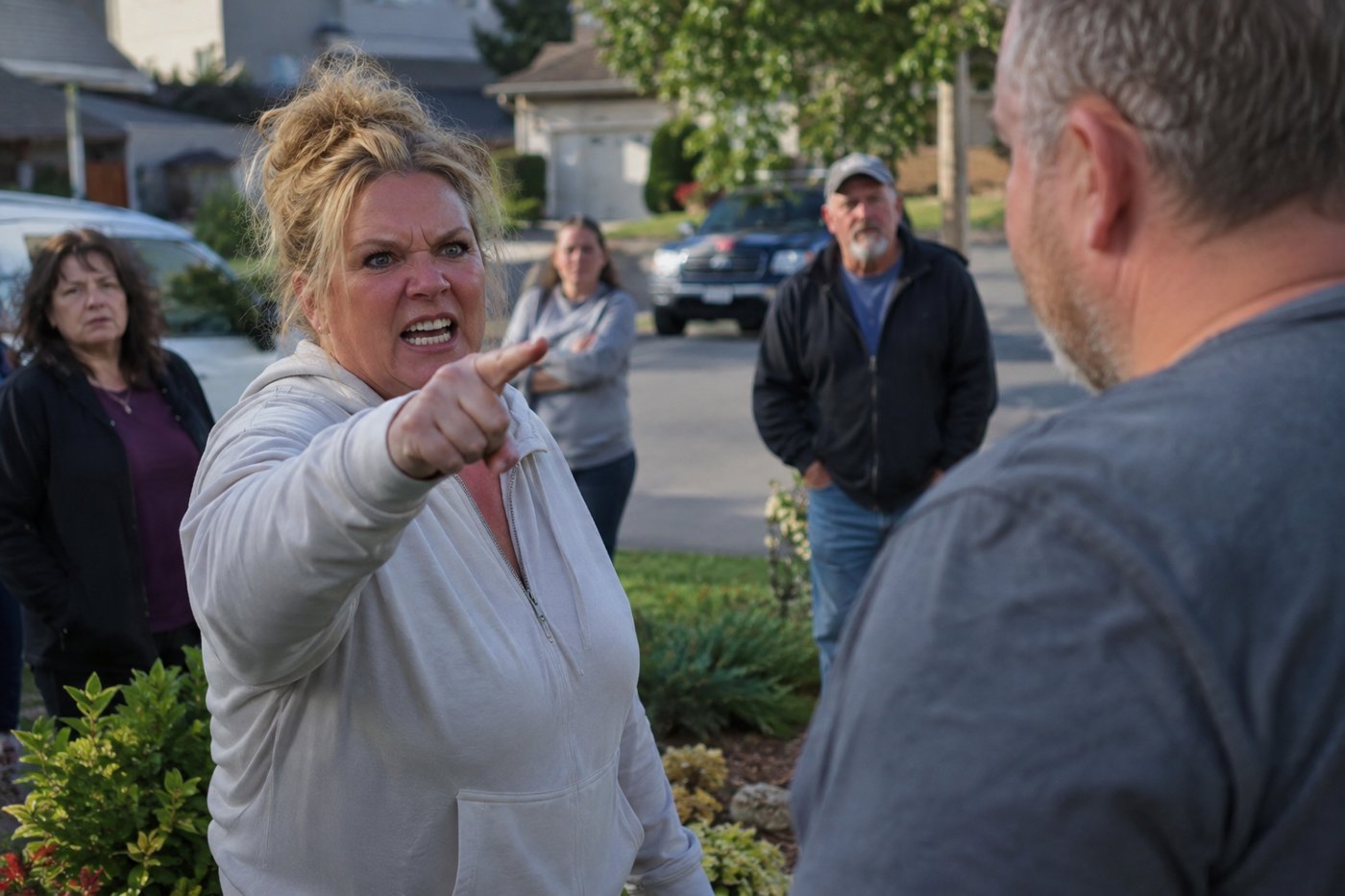
Karen spun around, her face flushed with fury.
“DON'T STOP! KEEP COMING!” she screamed at the cab.
I turned my back on the truck and looked straight at her.
“TURN THESE RIGS AROUND RIGHT NOW.”
She stomped down the asphalt toward me, practically vibrating with indignation.
“GET OUT OF THE WAY! YOUR DRIVEWAY IS THE ONLY WAY TO GET TO MY POOL!”
I didn't blink.
“Then you don't have a way to build it.”
Her face turned a deep, blotchy crimson.
“I HAVE PAID THOUSANDS OF DOLLARS FOR TODAY'S DROP—GET OFF THE DAMN ROAD!”
I didn't offer a single word of rebuttal.
I simply walked past her.
Headed straight down to the gateposts.
Grabbed the iron frame.
And swung the gates shut.
The heavy steel locking bar dropped into the concrete sleeve with an unmistakable, resonant CLACK.
Karen barked out a harsh, disbelieving laugh.
“You think locking a gate is going to trap these trucks?”
“I have no desire to trap anyone,” I replied calmly.
The driver of the dump truck lowered his side glass and peered out.
I walked over to the cab.
“Who told you that you had authorization to drive onto this private land?” I asked him.
He looked over at Karen, looking distinctly uneasy.
“We were given a dispatch order saying site access had been approved by the property owner.”
“It has not,” I stated clearly.
Karen hurried over, yelling at the top of her lungs:
“DON'T LISTEN TO HIM! THE ACCESS HAS ALREADY BEEN SETTLED!”
I looked directly at the driver.
“My name is Daniel Hart. This entire nine-acre parcel belongs solely to my wife and me. No contractor has permission to operate commercial vehicles on this property for the Caldwell project.”
The driver's expression shifted from confusion to professional caution.
“Do you hold the deed to this driveway, sir?”
“I do. And there are no easements.”
Karen cut in shrilly:
“THE BELLMERE HOA ALREADY RESOLVED THIS WEEKS AGO!”
That was an outright lie.
And the driver was far too seasoned to risk his commercial driver's license and a fifty-thousand-dollar rig on a homeowner's desperate bluff.
He grabbed his radio handset.
Contacted his company dispatcher.
Then placed a direct call to Ben Mercer.
I caught snippets of his half of the conversation:
“Yeah, Ben.”
“No, he's standing right in front of the gate.”
“He says absolutely no authorization was ever granted.”
He paused, listening closely to the earpiece.
“Yes, she's standing right here on his asphalt.”
Another long silence.
Then the driver hung up the handset, looked down at Karen, and shook his head.
“Ma'am, we're pulling out.”
Karen's mouth dropped wide open.
“I PAID FOR TODAY'S SCHEDULE!”
“Yes, ma'am, I understand that.”
“THEN BRING IN THE MATERIALS!”
The driver pointed toward my closed iron gates.
“No access, no delivery.”
He threw the heavy transmission into reverse with a mechanical clunk.
BEEP. BEEP. BEEP.
The high-pitched alarm pierced the morning calm.
The massive white dump truck began backing slowly down the drive.
Directly behind it, the concrete boom pump dropped into reverse.
Its backup alarm kicked in.
Then the flatbed loaded with pallets of stone started its retreat.
A ridiculous, noisy parade of heavy construction machinery creeping backward down our private lane.
Karen stood stranded in the middle of the driveway, shaking with rage.
“You have no right to do this to me!”
I couldn't help a dry smile.
“I haven't done anything to you, Karen. The drivers are simply leaving my land.”
“You deliberately trapped them!”
“The gate is closed to keep trespassers out. They are backing out freely.”
“You are intentionally sabotaging my pool!”
“On my own property.”
“Everything with you always comes back to ‘my property’!”
“Today, that happens to be the only thing that matters.”
Just then, tires screeched out on the county road.
Mitchell's dark sedan pulled onto the gravel shoulder.
He jumped out of the car, slammed the door, and hurried toward the gate.
He took in the entire spectacle: the convoy of haulers creeping in reverse, the locked iron gates, Karen standing on my driveway, and me standing beside the fence.
“What on earth happened here?” Mitchell asked, out of breath.
Karen immediately pointed an accusing finger at me:
“Daniel deliberately blocked our deliveries!”
I looked Mitchell straight in the eye.
“Karen came onto our property without permission, opened my latched security gate, and waved a commercial convoy onto our driveway.”
Mitchell's face lost all its color.
He turned slowly toward his wife.
“Karen... did you open his gate?”
She looked away, defensive and frantic.
“The trucks were running behind schedule! They had to get through!”
“Karen,” Mitchell said, his voice dropping into a stern, measured register. “Did you open his private gate?”
A heavy, painful silence fell over the driveway.
“Karen?”
“...Yes.”
Mitchell closed his eyes and let out a long, slow breath.
That was the exact moment I realized he had known nothing about her scheme.
Twenty minutes later, Ben Mercer's company truck pulled up to the shoulder.
Ben stepped out, and he was livid.
Not with me.
With the disaster Karen had orchestrated.
“Mrs. Caldwell, our dispatch board specifically flagged this parcel as off-limits,” Ben said, his tone icy.
Karen crossed her arms.
“I informed your scheduling department yesterday that the access issue was resolved.”
Ben walked right up to her, staring down into her sunglasses.
“You told our office manager that you had signed written authorization from Mr. Hart.”
“I told them the access was taken care of!”
“That is not the same thing, and you know it.”
“I have paid your company a massive deposit!”
Ben's voice dropped, quiet and deadly serious.
“Paying a deposit does not grant this company a license to commit criminal trespass on neighboring private land.”
That sentence hung in the air like a lead weight.
Karen swallowed hard, then muttered:
“Then I want my deposit refunded.”
Ben answered coldly:
“That is a contractual breach we will discuss through legal counsel.”
Within thirty minutes, the road was clear.
The trucks were gone.
No concrete was poured.
No stone was delivered.
The only physical impact was a set of faint tire marks near the lower apron of the drive.
I spent the next hour documenting every single detail.
Photographed the gate latch.
Photographed the tire compressions on the shoulder.
Photographed Karen's SUV parked outside.
Photographed the PRIVATE DRIVEWAY signs.
Recorded the license plate numbers of every truck that had backed out.
Then I returned to the house and reviewed our high-definition security camera footage.
The video quality was flawless.
At precisely 9:04 AM, the footage showed Karen walking along the roadside from Bellmere.
She approached our closed gate.
Pauses right in front of the reflective PRIVATE DRIVEWAY — STRICTLY NO CONSTRUCTION ACCESS sign.
Reaches over the top rail.
Lifts the heavy steel latch.
Pushes both gate leaves fully open.
And then begins waving the first dump truck into the driveway.
There was zero room for debate.
No misunderstanding.
Premeditated, deliberate trespass.
I packaged the digital video files and emailed them to Maya Ellison.
Her response came back via text within three minutes:
Archive every raw file. Do not edit or trim a single second.
Followed shortly by:
Expect a call shortly.
Remarkably, Karen's personal attorney contacted our counsel before Maya even picked up the phone.
That told me Karen knew she had crossed a line and was trying to play defense through offense.
The attorney's letter was bombastic, claiming that I had intentionally interfered with contracted commercial deliveries, causing immense financial damages to the Caldwell family.
Maya called me while reading it.
Halfway through the second paragraph, she broke down laughing.
Not a polite chuckle.
A full, uncontrollable belly laugh.
“Maya? What is it?”
“She unlatched your posted, locked gate after receiving two formal written denials of access.”
“Yes.”
“And their opening legal strategy is tortious interference?”
“Apparently so.”
“Good luck with that in front of a Williamson County chancellor.”
Her written response was a masterclass in legal evisceration.
She attached our certified warranty deed.
Our official boundary survey.
The expired nineteen-year-old temporary license agreement.
All prior written notices prohibiting access.
The formal retraction letter from Bellmere Ridge's own legal counsel.
And six crisp, high-resolution still photographs pulled directly from our security cameras showing Karen Caldwell lifting the latch on our gate.
She concluded the letter by advising Karen's attorney that any subsequent entry onto the Hart parcel by Mrs. Caldwell or her agents would be met with an immediate criminal trespass warrant and a suit for civil damages.
The Bellmere Ridge Homeowners Association was forced into the fray once again.
This time, however, they moved swiftly to protect themselves.
The association president was a man named Stephen Lowell.
Stephen was an attorney himself and wanted the HOA as far away from Karen's legal quagmire as humanly possible.
He sent an official memorandum to every homeowner in Bellmere Ridge:
“Notice: The Bellmere Ridge HOA possesses no legal authority to grant construction access, staging rights, or vehicular easements across any privately owned neighboring parcels. All residents and independent contractors are strictly responsible for verifying their own legal access.”
No names were mentioned.
None needed to be.
Every resident in the community knew exactly whose project was referenced.
Karen was incandescent with rage over that memo.
She accused the board of humiliating her in front of her peers.
Stephen Lowell reportedly met with her and gave a blunt response:
“You told a commercial contractor that access was handled when you had no legal right to do so.”
“I believed the historical route justified our access!” she protested.
“Karen, that document was an expired temporary license from nineteen years ago.”
“It proved that accessing our lot through that driveway is necessary!”
Stephen looked at her and delivered a line that became legend around the neighborhood:
“Necessary does not mean legally available.”
That sentence cut right to the core of the entire dispute.
Up on the hill, Karen's pool project ground to a complete standstill.
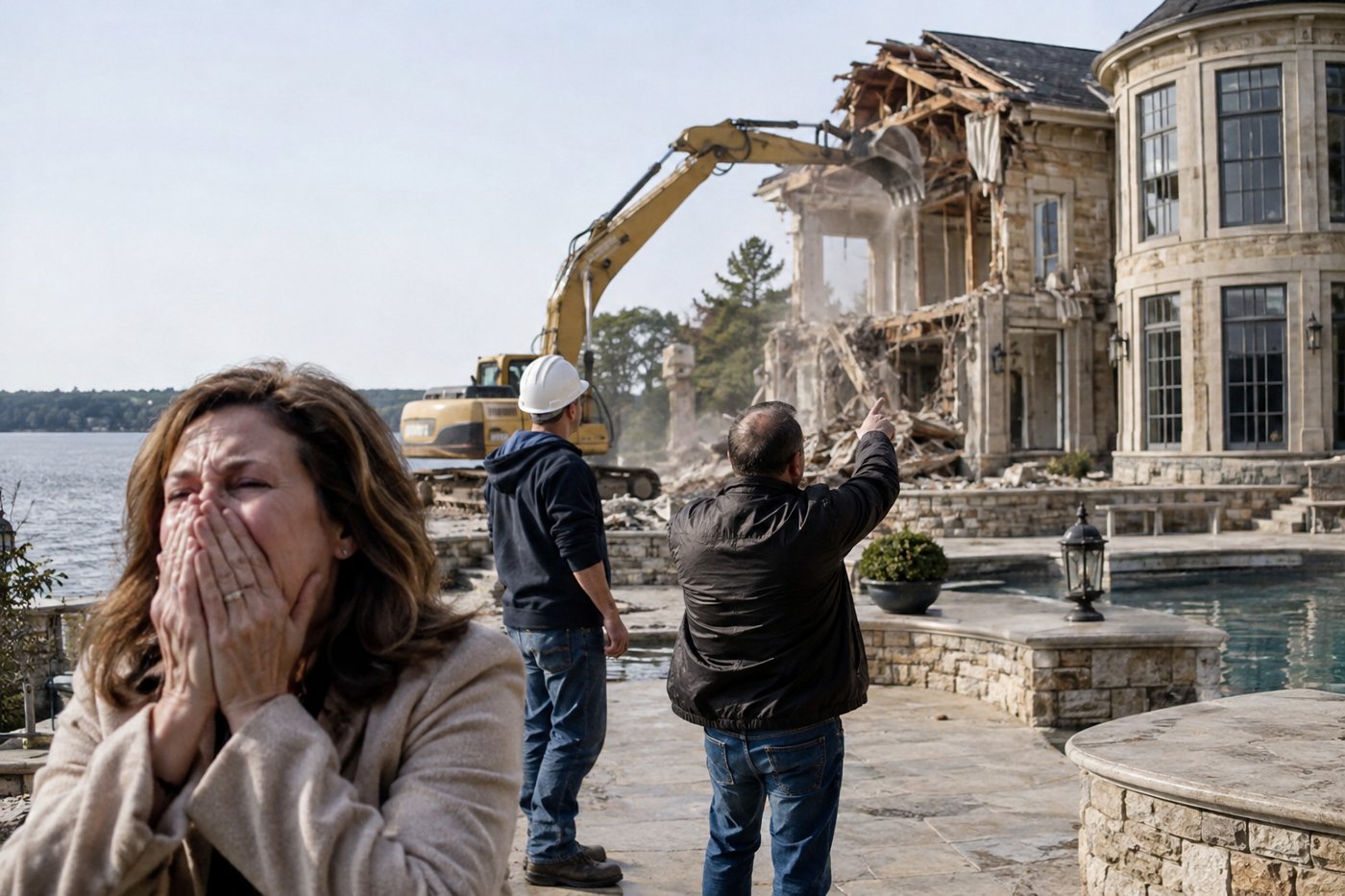
The preliminary digging in her backyard had already carved out an enormous, gaping crater behind the house.
Surrounded by orange plastic safety fencing.
Piles of exposed red clay.
Stacks of unused PVC conduit.
And no practical way to bring in the concrete or heavy equipment needed to finish the job.
Then the late autumn rains arrived.
That massive hole quickly transformed into a murky, five-foot-deep mud pit.
Sump pumps ran around the clock, groaning and whining as they discharged muddy runoff down the bluff.
Uphill neighbors began filing formal noise and drainage complaints with the HOA.
Karen had built herself an expensive, muddy monument to entitlement right outside her master bedroom window.
Two weeks later, the situation took another unexpected turn.
Mitchell Caldwell walked down our driveway alone.
No entourage.
No Karen.
He knocked quietly on the front door, looking thoroughly defeated.
I invited him inside, and he sat down with Laura and me at our kitchen table.
“Daniel, Laura, I want to apologize directly for what took place with the trucks,” Mitchell said, his voice quiet and sincere.
Laura gave him a small nod.
“You weren't driving the trucks, Mitchell.”
“No,” he sighed. “But I should have intervened long before things reached that point.”
Then he finally explained the emotional storm driving Karen's frantic behavior.
Their youngest daughter, Sophie, was scheduled to be married the following summer.
Karen had made it her personal mission to host an unforgettable wedding reception at their estate.
In her mind, an opulent infinity pool cascading toward the wooded valley was supposed to be the breathtaking centerpiece of the entire celebration.
She had already booked high-end caterers.
Committed massive non-refundable deposits to marquee tent companies and florists.
Promised family and friends a fairy-tale garden celebration on the bluff.
As the weeks slipped by and the access hurdles multiplied, Karen had fallen into a blind panic, terrified that her promises would collapse into public embarrassment.
Hearing the human story behind the conflict changed how we looked at it.
It didn't make her trespassing acceptable.
Not in the slightest.
Yet it transformed a caricature of neighborhood arrogance into something painfully human.
Mitchell opened a fresh folder on the table.
He was offering $50,000 for a strictly defined, temporary construction license.
This was not a vague bribe or a casual favor.
Mitchell had hired an independent construction attorney to draft a comprehensive, professional agreement.
A $25,000 cash restoration escrow held by a neutral bank.
A mandatory commercial umbrella insurance policy naming Laura and me as additional insureds.
Rigidly restricted operating hours: nothing before 8:30 AM, and everything shut down by 4:00 PM.
Strictly enforced quiet hours on weekends.
Independent pre-construction and post-construction engineering surveys of our asphalt driveway.
A dedicated tree-protection plan supervised by a certified arborist.
A hard completion deadline, with daily financial penalties if the contractor overstayed.
And an automatic termination clause ensuring no permanent easement could ever be claimed.
Everything that should have been put forward before a single surveyor ever set foot on our boundary.
Laura looked across the table at me.
“Maybe,” she said quietly.
I raised an eyebrow at her.
She gave a small shrug.
“Fifty thousand dollars, full escrow protection, and complete restoration?”
“Potentially,” I admitted.
“And Sophie gets her wedding.”
I looked at Mitchell, whose expression was a mixture of gratitude and profound relief.
“We will have Maya review the draft,” I told him.
Mitchell stood up and shook my hand firmly.
“Thank you, Daniel. That's all I can ask.”
Maya reviewed the document line by line.
She made several necessary adjustments:
Increasing the contractor's liability limits.
Requiring an engineered design for the temporary swale crossing.
Narrowing the list of trees permitted for trimming.
Binding Hartwell Custom Pools directly to the cleanup obligations.
And ensuring the restoration funds were deposited in escrow before a single vehicle touched our driveway.
For about four days, it seemed as though rational minds would prevail.
Then Karen got involved again.
The moment the amended contract reached her hands, she began pushing back.
She objected violently to locking up $25,000 in an escrow account:
“Why should we tie up our cash when we're already paying them fifty thousand dollars?”
Because promises are cheap, and asphalt repairs are expensive.
She fought the restricted operating hours:
“Concrete pours start at seven in the morning! Eight-thirty is ridiculous!”
Not when the cement mixers are passing within fifty feet of our bedroom window.
Most vehemently of all, she objected to our legal right to shut down access if the contractor breached safety protocols:
“You'll just use that clause to hold the project hostage!”
It was our private land.
Holding control over our property was precisely the point of the contract.
Negotiations ground to a bitter halt once more.
Then came the physical reality check that rendered the entire debate completely irrelevant.
The independent civil engineering firm hired by the Caldwells arrived to inspect the proposed route through our woods.
The engineer conducted soil borings near the drainage swale.
His findings killed the project route stone dead.
The soil along our swale was saturated, alluvial silt.
It could never support the repetitive weight of sixty-thousand-pound loaded dump trucks without extensive subgrade stabilization.
To prevent haulers from sinking to their axles, the contractor would have to excavate hundreds of yards of soft dirt, drive steel foundation pilings, and construct a substantial temporary timber bridge.
The engineering cost alone exceeded $40,000.
Furthermore, stabilizing the hillside slope would require cutting down not just a few saplings, but nearly twenty mature oak and hickory trees, permanently gutting our forest buffer.
The potential restoration costs skyrocketed into six figures.
Suddenly, using my driveway was no longer the cheap, convenient shortcut.
It had turned into an astronomical engineering money pit.
Faced with those numbers, Ben Mercer went back to the drawing board at Hartwell Custom Pools.
He presented Mitchell with an ingenious, all-internal staging plan contained entirely within Bellmere Ridge.
The plan required temporarily dismantling a section of the Caldwells' decorative stone courtyard wall.
Staging a specialized heavy-lift mobile crane on their wide paved parking court.
Hoisting compact excavation machinery up and over the eastern terrace.
And transporting excavated materials in smaller, motorized rubber-tracked buggies down to mini-dumpsters.
It was complicated.
It was noisy for Bellmere Ridge.
It added significant equipment rental expenses.
Yet it possessed one overwhelming advantage:
It didn't require a single square foot of Daniel Hart's land.
Mitchell signed the authorization that very afternoon.
Karen fought the decision for another week, mourning the extra expense and the loss of her garden wall.
Eventually, she bowed to reality.
The pool construction restarted.
From inside Bellmere Ridge.
Where it should have been orchestrated from the very beginning.
Five months later, the pool was finished.
The project had missed its original spring landscaping target.
Yet it was completed with nearly two months to spare before Sophie's wedding.
We knew the date was approaching because an elegant cream-colored envelope arrived in our mailbox.
Laura pulled out the heavy cardstock and looked at me, astonished.
“You are not going to believe this.”
Inside was a formal wedding invitation.
Tucked into the envelope was a handwritten note penned on personal stationery:
Dear Daniel and Laura,
I know things became incredibly complicated and stressful between our properties during the construction. It would mean the world to both Mitchell and me if you joined our family to celebrate Sophie's big day.
Warmly, Sophie.
Laura looked at me.
“We're going,” she said.
“We are,” I agreed.
The Caldwells' backyard was an absolute masterpiece.
I had to give credit where credit was due.
A sweeping multi-tiered Pennsylvania bluestone terrace.
A fifty-foot negative-edge pool that mirrored the afternoon sky.
Natural stone waterfalls spilling into lower retention ponds.
Lush ornamental plantings concealing every scar of the winter's excavation.
An outdoor stone hearth crackling with hickory logs.
A string quartet playing softly beneath an open-air pavilion.
Not a single piece of construction machinery in sight.
Not a single rut on my property.
Karen caught sight of us as we stepped onto the terrace.
For a split second, her posture stiffened.
Then she took a deep breath, handed her champagne flute to a passing waiter, and walked straight over.
“Daniel. Laura.”
“Karen. Beautiful evening,” I said.
She looked distinctly humbled.
“Thank you both so much for coming.”
Laura gave her a gentle, reassuring hug.
I didn't hug her.
But I reached out and shook her hand with genuine warmth.
Later in the evening, I found myself standing near the edge of the stone terrace with Mitchell.
The view stretched out over the darkening woods below, where the soft amber lights of our house glowed through the trees.
Mitchell took a sip of his bourbon and pointed down the hill.
“You want to hear something truly remarkable?” he asked with a faint grin.
“Tell me.”
“That modular crane and courtyard route ended up costing about fifteen thousand dollars less than the bridge and restoration on your swale would have cost us.”
I broke into a laugh.
“Please tell me you didn't tell Karen that.”
“Oh, she was in the room when the final accounting came across my desk,” Mitchell chuckled.
“How did she take it?”
“Let's just say she found another glass of wine.”
We both had a quiet laugh into the evening air.
Then Mitchell's tone softened.
“I really should have stepped in and demanded proper engineering from day one, Daniel.”
“You were trying to support your wife, Mitchell.”
“I was letting money substitute for honest planning. I kept thinking if I wrote a large enough check, reality would just bend to fit it.”
“Offering compensation isn't wrong,” I told him.
He looked at me.
“No?”
“No. Asking to buy something isn't a sin.”
I nodded toward the glowing pool.
“Assuming you've already bought it before the owner says yes—that's where the wheels come off.”
Mitchell nodded slowly.
“Lesson learned.”
A few minutes later, Karen slipped over to the balustrade.
Mitchell drifted away to greet some colleagues, leaving the two of us alone.
She was holding a glass of vintage champagne.
I held a mug of black coffee.
She gazed out over the water, watching Sophie laughing with her new husband on the dance floor.
“It turned out lovely,” she murmured.
“It really did, Karen. You should be proud.”
She turned her head to look at me.
“Daniel... I owe you a genuine, unreserved apology.”
I stayed quiet, letting her speak.
“I should never have touched your gate latch.”
“No, you shouldn't have.”
“I shouldn't have lied to Hartwell Pools about having written permission.”
“That put their crew in a terrible spot.”
“And I had no right to act like my bank account gave me the authority to dictate what happens on your land.”
That was the admission that truly mattered.
I looked at her, curious.
“Why did you do it that morning, Karen? What made you think that convoy would work?”
She looked back toward the dance floor.
“I was terrified,” she whispered.
“Terrified of what?”
“Of failing Sophie. Of having the wedding look like a disaster. I had convinced myself that this pool was the only thing that would make her wedding day feel magical.”
I looked over at Sophie, radiant in her lace dress, beaming as she twirled across the stone flags.
“Did Sophie ever actually ask for this pool?”
Karen let out a soft, rueful laugh.
“Never once.”
“Did she even care?”
“She told me a tent in an open pasture would have been perfect.”
There it was.
The entire six-month feud had never been about Sophie's happiness.
It had been born of Karen's personal vanity, her fear of social judgment, and an inability to accept that nature and property law didn't bend to her social calendar.
Karen looked down at her champagne.
“I was so deep into the expenses that I couldn't bear the thought of pausing.”
“Classic sunk-cost fallacy,” I said.
“Mitchell said the exact same words.”
“He's an investment manager. It's his job to spot bad bets.”
“He was terribly smug about it, too,” she said, rolling her eyes with a faint smile.
I laughed with her.
Then she looked at me with remarkable sincerity.
“You know, when you closed that gate and dropped that steel bar, I despised you.”
“I could tell from the volume of your voice.”
“I thought you were deliberately trying to strip away my dignity in front of all those workers.”
“Karen, I wasn't thinking about your dignity. I was protecting my front yard.”
“I see that now,” she said quietly.
She took a slow sip.
“But sitting there on your driveway, listening to those backup alarms...”
I remembered the scene vividly.
BEEP. BEEP. BEEP.
One heavy rig after another.
An entire mountain of entitlement groaning in reverse down the hill.
“I had bragged to the contractor and my friends that everything was taken care of,” she confessed.
“And it wasn't.”
“Not even close.”
“That's what hurt,” I suggested. “The realization that your words didn't make it true.”
She nodded slowly.
It wasn't the gate.
It wasn't me.
It was the sudden, undeniable collision between her self-image and the cold reality of property lines.
Following the wedding, our relationship with the Caldwells settled into an unexpectedly comfortable rhythm.
We never became intimate confidants.
Yet we became genuinely good neighbors.
Which is far rarer, and arguably much more valuable.
We waved from our vehicles when passing on the county road.
We checked on each other's property lines after severe ice storms.
Laura swapped tins of homemade sourdough bread for Karen's pecan fudge around the holidays.
Mitchell borrowed my hydraulic log splitter one autumn when an oak fell across his upper driveway.
He brought it back three days later, thoroughly power-washed and with a full tank of ethanol-free gasoline.
A solid, dependable neighbor.
And for the rest of the time they lived on that hill, Karen never set a single foot past our gate without asking first.
Not once.
About two years later, a severe windstorm sheared off a massive limb from a walnut tree right along our shared fence line.
My phone chimed with a text message from Karen:
“Good morning Daniel. One of our tree contractors needs to place a ladder about ten feet inside your boundary to safely lower a dangling branch. Would that be acceptable to you?”
I stared at the screen, smiling.
I walked over to show Laura.
She read it and chuckled.
“You ought to print that out and frame it above the mantel.”
I tapped out a quick reply:
“No problem at all, Karen. Just ask the crew to give me a quick call before they start.”
Her response came back within seconds:
“Thank you so much.”
Civil.
Simple.
Respectful.
No legal briefs.
No surveys.
No convoy of diesel haulers backing down the road.
Human cooperation works with astonishing ease when permission is requested before action is taken.
The original black iron gate remained on its hinges for years.
Sturdy steel.
Twin swinging leaves.
Nothing fancy, but reliable.
Following the truck incident, I went ahead and installed an electronic heavy-duty gate opener.
Laura teased me as I bolted the control box to the brick pillar.
“Are you doing that because of Karen?”
“Purely for convenience when it rains,” I insisted.
“Daniel.”
“All right. Mostly for convenience.”
She laughed.
I wired in a digital keypad on the outside post.
Changed the access code every six months.
Karen never asked for it, and I never offered.
Years later, when we finally hired a local welding outfit to replace the worn hinges, the technician noticed the slight bow in the old steel drop-rod.
“Looks like somebody put some serious muscle into this latch,” the young man remarked.
I chuckled.
“A neighbor once brought a convoy of commercial pool trucks through and expected me to leave it open.”
He paused his wrench and looked at me, grinning.
“No kidding? How many trucks?”
“Enough to pave a highway.”
“What'd you do? Call the sheriff?”
“Nope. Just walked down and latched the gate.”
He looked almost let down.
“That's it? No tow trucks? No blowout fight?”
“That's all it took.”
People always crave sensational drama.
They want screaming matches, dramatic arrests, and bulldozers facing off at the property line.
Real life is so much more grounded.
I didn't need vengeance.
I didn't need to ruin anyone's life.
I simply needed those thirty-ton haulers off my asphalt.
Shutting the gate accomplished that in about thirty seconds flat.
There were legal costs, of course, but nothing dramatic.
As part of a quiet, private settlement, Karen reimbursed the minor surveying and legal fees Laura and I had incurred responding to her attorney's letters.
No sensational lawsuits.
No punitive damage awards.
No sheriff's deputies knocking on mansion doors.
Hartwell Custom Pools updated their internal dispatch protocols to require certified title deeds or notarized access agreements before staging off-site.
Bellmere Ridge reinforced its community policies regarding boundary disputes.
And our property records remained exactly as they had been for decades.
Our deed had already spoken for itself.
The expired nineteen-year-old construction license offered a valuable civics lesson as well.
The fact that a piece of land was once utilized for a specific purpose doesn't mean it belongs to the public forever.
A nine-month courtesy granted to a developer by a long-deceased farmer does not spawn an eternal easement for every future homeowner on the ridge.
Easements, prescriptive rights, licenses, doctrines of necessity—the law has very clear definitions for these terms.
We relied on surveyors and title attorneys to read the actual documents.
Not neighborhood gossip.
Not emotional entitlement.
That is what every homeowner should do before ordering fifty tons of gravel across a neighbor's lawn.
Karen's original rallying cry had sounded formidable to her ears:
“YOUR DRIVEWAY IS THE ONLY WAY TO MY POOL!”
Yet that statement carried its own inherent defeat.
My driveway.
Not hers.
Not Bellmere's.
Not Hartwell Pools'.
Mine and Laura's.
If your luxury construction project requires rights over property you do not own, then the project's design must adapt.
The property boundaries do not have to move to accommodate your swimming pool.
I walked away from the ordeal with an important lesson of my own.
My immediate reaction after Karen's initial arrogance was to dig in my heels and reject every olive branch out of sheer frustration.
That instinct was understandable, but it wasn't wise.
When Mitchell came forward with a legitimate, professionally structured proposal, it deserved honest consideration.
We gave it that consideration.
The fact that engineering realities ultimately doomed the idea didn't make the process any less valid.
Neighbors are going to need help from time to time.
Storms topple timber.
Underground water lines rupture.
Fences decay.
Every now and then, a contractor genuinely needs temporary access to handle a repair.
Saying yes when conditions are safe isn't surrender.
Saying no when boundaries are violated isn't malice.
The fundamental truth is that the choice must always belong to the person who holds the deed.
Five years after the pool standoff, Laura and I finally pulled permits to expand our detached workshop and pour a new equipment pad.
The contractor needed to bring in a full-sized commercial concrete truck.
And naturally, the only route for that truck was our private driveway.
The transit mixer arrived early on a Tuesday morning.
I walked down, opened the electronic gate, and waved the driver forward.
Right at that moment, Karen happened to be out for her morning power walk along Bellmere's perimeter trail near the roadway.
She stopped dead in her tracks, watching the massive drum churn as the truck pulled in.
She cupped her hands around her mouth and hollered down the hill:
“DANIEL!”
I turned and looked up at the ridge.
She pointed a finger at the rumbling mixer.
“DOES THAT DRIVER HAVE WRITTEN PERMISSION?”
I stood there for a second, then doubled over laughing.
“COMPLETELY AUTHORIZED!” I yelled back.
She threw her head back and laughed right along with me.
The cement truck driver looked down from the cab, utterly baffled by the exchange.
I didn't bother explaining it.
Some inside jokes belong solely to the county register of deeds.
Eventually, the Caldwells decided to downsize.
With Sophie married and Mitchell transitioning out of daily firm management, they sold the estate and moved to a penthouse closer to downtown Nashville.
The afternoon before their final moving van arrived, Karen walked down the lane.
She stood outside the closed gate.
Did not touch the latch.
That small courtesy did not go unnoticed.
I strolled down to meet her.
She held out a small, flat package wrapped in brown craft paper.
“Don't worry,” she joked softly. “It's not an easement filing.”
I smiled and took it.
Inside was a framed photograph from Sophie's wedding reception.
A twilight shot of Sophie and her husband dancing on the bluestone terrace, the turquoise water of the pool glowing softly beneath the stone balustrades.
Written on the back in Karen's elegant, cursive hand was a single sentence:
Turns out there was another way.
I still have that photograph on my workshop desk.
The estate was purchased by a young couple relocating from Chicago, Andrew Patel and his wife.
About ten days after their closing, Andrew called me to introduce himself.
“Mr. Hart, I just wanted to say hello and say what an honor it is to be your neighbor.”
“Welcome to Tennessee, Andrew.”
“Also,” Andrew added with an amused chuckle, “the previous owner spent nearly twenty minutes walking us along the back tree line, explaining in extreme detail that under no circumstances were we ever to direct contractors onto your driveway without your written consent.”
I had to laugh out loud.
“Did she really?”
“She made it sound like an unwritten constitutional amendment,” Andrew said. “Is there a backstory there?”
“A rather long one,” I replied.
Andrew laughed.
“That's what I gathered.”
Andrew never once attempted to bring equipment through our woods.
He had no reason to.
The modular access staging route developed during Karen's project had permanently mapped out practical ways to service the rear of Lot 17 from within Bellmere Ridge.
Subsequent landscape crews used compact track loaders.
A retaining wall rebuild four years later was staged entirely from their own parking court.
The supposed “impossible” access dilemma was never truly impossible.
It was simply inconvenient and costly enough that Karen preferred to gamble on my property instead of paying for her own.
Those two concepts are light-years apart.
That is the grand illusion that wealth and impatience often produce.
People find themselves in a bind and declare:
“There is no other option!”
What they truly mean is:
There is no other option that fits my original budget.
Or:
There is no other option that preserves my hurried timeline.
Or:
There is no other option that doesn't inconvenience me personally.
Those are valid frustrations.
Yet none of them create an ownership right across your neighbor's fence.
Karen possessed ample wealth.
A magnificent residence.
A top-tier contractor.
Signed contracts.
Heavy down payments.
Reserved equipment.
A looming wedding deadline.
And an entire wealthy gated community behind her.
None of those advantages entitled her to a single blade of grass on our parcel.
She possessed everything necessary to build a world-class pool except the one element that couldn't be bought with bluster:
A lawful, consensual right-of-way for the machines she wanted to use.
That was a design failure.
Not my obligation to solve.
I am sixty-one now, still living on this same quiet piece of ground.
Laura keeps dropping subtle hints about downsizing into a smaller single-story cottage in town.
I conveniently develop hearing troubles whenever the topic comes up.
Nine acres requires plenty of sweat equity, especially as the joints begin to complain.
The hardwood forest drops mountains of leaves every November.
The creek swells over the low crossing whenever a spring thunderstorm settles over the ridge.
And that black iron gate still swings shut every evening.
A newer gate now, with heavier posts.
Yet anchored to the exact same boundary line.
Every now and then, I'll walk down to the mouth of the driveway at sunrise and let my mind wander back to that Tuesday morning.
The first white hauler rolling in.
Karen standing there, waving them through like she held the crown jewels.
My complete disbelief.
The string of commercial rigs idling along the county shoulder.
Her screech ringing through the morning:
“GET OUT OF THE WAY! YOUR DRIVEWAY IS THE ONLY WAY TO GET TO MY POOL!”
And my calm, simple answer:
“Then you don't have a way to build it.”
It felt harsh at the time.
Perhaps it was.
Yet it was the plain, unvarnished truth.
And then her final demand:
“I HAVE PAID THOUSANDS OF DOLLARS FOR TODAY'S DROP—GET OFF THE DAMN ROAD!”
That exclamation captured the entire flaw in her worldview.
She assumed that spending money created an entitlement over everyone in her path.
She had paid the pool contractor.
Therefore, the materials must arrive.
The materials required a path.
Therefore, the nearest path must belong to her.
My land was physically adjacent.
Therefore, my refusal was seen as an act of hostility.
Life simply does not work that way.
You cannot purchase a commercial delivery that relies on another person's real estate and then demand that their consent materialize out of thin air.
I walked down the asphalt.
Swung the gate shut.
CLACK.
Karen laughed, certain she had won.
Then that lead driver made the professional choice that protected his company from a catastrophic legal mess.
He asked the right question.
Discovered the absence of authority.
And refused to cross the line.
“No access, no delivery.”
Then came the mechanical chorus.
BEEP.
The white dump truck backed up.
BEEP. BEEP.
The concrete pump rig followed.
Then the stone flatbed.
And Karen was left standing alone on my driveway, watching tens of thousands of dollars in machinery retreat back onto the county road.
People who hear the tale sometimes wonder why I didn't summon the sheriff immediately.
Because law enforcement wasn't necessary at that moment.
The truck drivers were respectful professionals.
Once the gate was latched, they cooperated.
Karen was furious, but nonviolent.
Nobody broke a lock or threatened physical harm.
I documented the trespass, preserved the video evidence, and let property attorneys handle the dispute cleanly.
Escalation should always be measured.
That morning, my objective was singular:
Halt an unauthorized commercial invasion of our land.
The closed gate accomplished that completely.
Others ask why Laura and I didn't file a massive lawsuit against Karen for punitive damages.
Because litigation is a specialized tool, not an enjoyable pastime.
We defended our title.
Recovered our actual legal outlays through a clean settlement.
Firmly established our boundaries for all time.
The unauthorized intrusions stopped completely.
What else was there to achieve?
Her financial ruin?
A public courtroom spectacle?
A bitter, permanent feud with a neighbor overlooking our homestead?
None of that would have added an ounce of peace to our lives.
The real resolution was infinitely more satisfying.
Her pool got built.
Our property was never damaged.
Sophie had a magnificent wedding celebration.
Our woods remained standing tall and untouched.
The pool contractor engineered an honest, creative solution.
Karen learned to ask for permission.
Laura and I learned that we could be gracious neighbors without surrendering our rights.
And years later, we could stand on that very terrace and share a laugh about it.
That is an outcome far sweeter than any legal judgment.
Yet I will confess, the exact second those truck engines shifted into reverse was deeply, profoundly gratifying.
Laura still laments missing the live show.
She made me archive the security video to our home server.
Not for our attorney's files.
For herself.
She watched it the evening she came home from Nashville.
Karen waving the convoy through.
Me marching down the lane.
The confrontation.
The gate swinging shut.
The lead hauler hesitating.
And then those white reverse lights firing up.
Laura watched the clip all the way through.
Then dragged the slider back to watch the final thirty seconds again.
I looked at her, grinning.
“Really? Again?”
“Hush,” she whispered, eyes glued to the screen. “Just one more time.”
The high-pitched alarms chimed through the laptop speakers.
BEEP. BEEP. BEEP.
Laura smiled, leaning back against the couch.
“That,” she announced, “is the sweetest song I've heard all year.”
The digital video still sits on our hard drive.
I haven't opened the file in years.
I don't need to.
The essential truth of that morning remains etched in my memory.
Not the shouting.
Not Karen's red face.
Not even the iron gate.
Just four quiet words from a working man in the cab of a commercial truck:
“No access, no delivery.”
Four simple words.
Professional.
Uncompromising.
Accurate.
No debates over net worth.
No entitlement.
No discussions about whether a family deserved a pool.
No complaints about whether a neighbor was being unhelpful.
Just simple legal authority.
Either you hold the right of way, or you do not.
And that morning, she didn't have it.
And the most instructive element of the entire saga is that the pool became a reality anyway.
That is the takeaway that endures.
Karen was convinced that my refusal would destroy her family's dream.
It didn't destroy anything.
It merely required the dream to pay for its own access.
The engineers revised their drawings.
The contractors brought the proper machinery.
The Caldwells absorbed the true cost of their hilltop lot.
The schedule adjusted.
And the pool was built.
A boundary line doesn't destroy a solution.
It simply prevents the most convenient solution from being stolen from an innocent neighbor.
Years later, Karen's handwritten note summed up the entire journey better than any title opinion ever could:
Turns out there was another way.
There almost always is.
It might require deeper pockets.
It might require patience.
It might demand structural changes.
It might disrupt your comfortable schedule.
Yet inconvenience does not confer ownership.
Anxiety does not create an easement.
A signed pool contract is not a license to trespass.
And a neighbor's lavish budget does not turn your private driveway into their construction corridor.
On that Tuesday morning, Karen unlatched my gate because she believed the momentum of money had already decided the outcome.
She believed that once thirty tons of steel were rolling across the grass, resistance would be futile.
The workers were on the clock.
The deposits were paid.
She believed sheer audacity would accomplish what permission could not.
For about thirty seconds, her gamble seemed to work.
Then I walked down my driveway.
Dropped the steel latch.
And watched every single one of her expensive assumptions back out the exact same way it came in.
One truck at a time.
COMMENTS
Loading…