My Wife Said She Hated Coming Home to Me—Then I Asked Who She Was Going To
The porcelain plate across the table had surrendered its warmth hours before my wife finally rattled her key into the front lock.
Eleven-forty-seven.
The time was seared into my brain because the faint green numerals on the microwave display had been glowing into the dark long before her silhouette appeared in the doorway.
A smothering silence hung over the entire house.
On the upper floor, our twelve-year-old girl, Lucy, had drifted off to sleep hours ago.
The gentle vibration of the dishwasher cycle had ceased before nine.
The twin candles I had struck at seven had long since guttered out, leaving behind nothing but flattened disks of cold wax on the runner.
And set neatly upon the dining table were two ceramic dishes containing chicken marsala, roasted fingerling potatoes, and tender green beans—food that had transitioned from an appetizing feast into a greasy, stiff disappointment well before ten.
Throughout all of it, I had remained planted in my seat.
The woman who wore my ring slipped through the entryway wearing matte black running tights, an obsidian zip-up layer, and spotless trainers.
A swollen gym duffel dragged heavily against her shoulder.
Rachel was the woman standing in front of me.
We had journeyed through fourteen years as partners in marriage.
The second her eyes caught my silhouette resting in the dimly lit dining room, her feet locked up.
Her brow tightened into an instant, defensive grimace.
Not a shred of astonishment crossed her features.
No sudden prick of shame appeared in her posture.
Only sheer, bristling hostility.
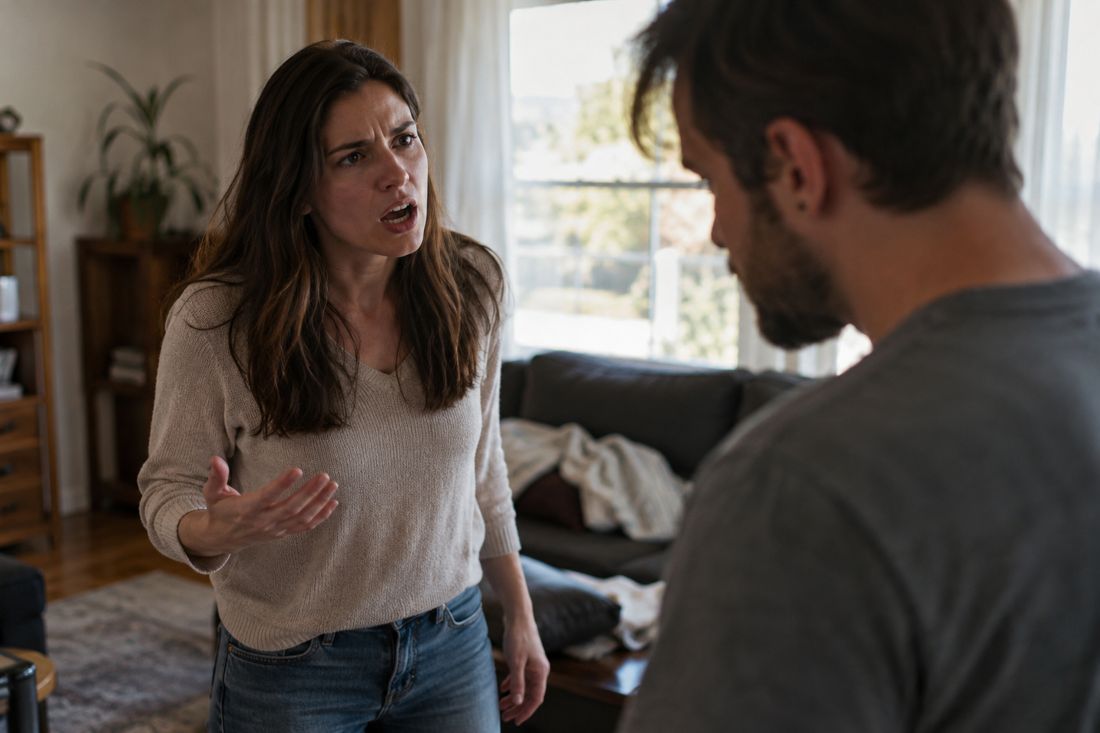
“QUIT LOOKING AT ME THAT WAY.”
I held her gaze across the gloom.
“Looking at you in what way?”
She allowed the strap of the heavy sack to slip from her hand, letting it crash against the hardwood beneath the hall table.
THUD.
“As though I’m required to deliver a sworn statement the second I step foot inside.”
My eyes dropped toward the cold plate sitting opposite my chair.
Then I tilted my chin back toward her face.
“Expecting a wife to return under her own roof hardly seems unreasonable.”
A tendon tightened along Rachel’s jawline.
“You already knew I had a training class booked tonight.”
“A session that began at half past six.”
“And your point?”
“The clock is thirteen minutes away from midnight, Rachel.”
“I got distracted and lost track of the hours.”
“For over five continuous hours?”
A sharp, exasperated hiss pushed past her lips.
“Here begins the lecture.”
I maintained an even, quiet, and deliberate tone.
Strangely enough, my utter lack of shouting seemed to agitate her even more deeply.
“Rachel, I spent my entire evening making an anniversary dinner.”
“I didn't request any culinary production from you.”
“I sent three separate texts trying to reach you.”
“My fingers were wrapped around gym weights.”
“Without a break for five solid hours?”
“I lingered by the reception counter chatting with folks afterward.”
“Chatting with who, exactly?”
She stared straight through my forehead, her eyes turning to flint.
Right then, something fragile in the room snapped clean in two.
Perhaps exhaustion had finally chipped away her remaining defenses.
Perhaps on the long drive back through the darkened suburbs, she had worked herself into a frenzy, composing a defense against an accusation I hadn't even leveled yet.
Or maybe, tucked away in some reckless corner of her spirit, she actually craved the explosion.
Whatever sparked inside her, she let loose the sentence that tore the rest of our night to shreds:
“MAYBE I DREAD COMING HOME TO YOU.”
The air in the room died on the spot.
Instantly, Rachel’s arrogant posture folded.
Her eyes flicked nervously toward the upstairs landing.
Then drifted across toward the polished granite island.
Searching for any inanimate object in the hallway to look at rather than my face.
The only sound left in the house was the faint, monotonous hum of the refrigerator coil.
Steady and unhurried, the wall clock kept time.
Tick.
Tick.
Tick.
I sat completely still, watching the person to whom I had promised my life more than a decade ago.
Then, keeping my voice gentle, I offered the one question that cut to the bone:
“Then whose company would you rather be in?”
Her chin jerked upward as though a physical slap had landed across her cheek.
And in that frozen, suspended beat—
Rachel looked utterly petrified.
Not caught.
Not yet remorseful.
Just thoroughly and genuinely terrified.
And that quiet difference would echo through every trial that lay ahead.
Because what unfolded next wasn't the sudden unmasking of an undeniable affair.
It was the haunting realization that I could no longer tell whether she was having one or not.
And the second that doubt took root in my chest, every tiny oddity I had brushed off across the past four months began clicking into a horrifying pattern.
I am Daniel Mercer.
That autumn had marked my forty-first year.
Rachel was thirty-nine years old.
We had built our home in a quiet suburban neighborhood outside Raleigh, North Carolina—the kind of subdivision filled with neat brick colonials and manicured lawns that broadcasts comfortable success, even when most neighbors on the cul-de-sac are quietly stressing over their revolving credit card balances.
My profession was in commercial risk underwriting.
Rachel’s career was in outpatient physical therapy.
We had one daughter together.
Lucy.
Twelve years of age.
Inquisitive, sharp-witted, humorous, and hopelessly enchanted by planetary astronomy.
A young girl capable of breaking down the rotational mechanics of Saturn's frozen rings for three-quarters of an hour without ever noticing that everyone else in the living room had lost the thread twenty minutes earlier.
To an outsider glancing at our routine, our shared life carried an enviable, peaceful stability.
Two steady paychecks.
A conventional thirty-year mortgage.
The daily afternoon carpool run.
Youth soccer matches that gradually gave way to middle school science exhibitions.
Summer getaways down on the beaches of the Outer Banks.
Christmas mornings celebrated at her parents' house near Charlotte.
Thanksgiving dinner hosted around my family's dining table in Virginia.
Saturday trips to the farmers market and supermarket.
The familiar, domestic bickering over whose responsibility it was to transfer the damp wash into the dryer.
Subtle skirmishes fought over the digital thermostat buttons.
Lighthearted debates regarding whether the decorative accent pillows piled across the bed served any conceivable purpose beyond getting tossed onto the floorboards every night before going to sleep.
We were never an immaculate couple.
Yet up until that specific year, had anyone asked, I would have answered without a shred of hesitation that we were deeply content.
Not the dizzying, breathless infatuation of university sweethearts.
The sturdy, grounded contentment that comes from knowing every single nuance of another person's habits, right down to the precise amount of oat milk they stir into their morning coffee.
Rachel and I first crossed paths back when I was twenty-five.
We were both mingling at a backyard barbecue thrown by a mutual college acquaintance.
Not ten minutes into the gathering, I managed to drop a sizable dollop of coarse mustard right down the front of my light button-down shirt.
Rachel had watched the whole embarrassing blunder from the patio, walked over with a handful of paper towels, and remarked with a smirk:
“Quite an opening maneuver.”
I looked down at the bright yellow stain, dabbed at it helplessly, and said:
“You should see what I can pull off with barbecue sauce.”
She burst out laughing.
And that was all it took to latch our lives together.
There were no lightning strikes or cinematic thunderclaps.
No dramatic swells of movie strings.
Just a warm, effortless conversation that rolled on until our hosts were packing up folding lawn chairs and sweeping paper plates off the porch.
Our courtship stretched over three quiet years.
We exchanged rings when I was twenty-eight and she was twenty-six.
Lucy arrived three years into our vows.
Rachel had always been the spontaneous spirit between the two of us.
I was the methodical planner.
She was the type to purchase weekend flight tickets on an impulse.
I was the one combing through hotel safety ratings and customer feedback.
She would grab concert tickets on a sudden whim.
I was the one scouting out nearby covered parking decks and noting secondary traffic exits.
She could look up on a rainy Saturday afternoon and announce that we ought to drive two hours for authentic pit barbecue.
I was the one who called the restaurant ahead of time to verify their smoked brisket wasn't sold out.
Yet somehow, against the odds, our contrasting personalities dovetailed into something resilient.
It had anchored us for over a decade.
The very first fissure in our marriage opened so quietly that I failed to recognize it as a shift at all.
Rachel purchased an annual pass to an upscale athletic club.
On the surface, nothing about the decision felt alarming.
She had stayed physically active ever since our college days.
We kept a folding treadmill tucked into our damp, unfinished basement, but she absolutely detested using it.
“Staring at stacks of unwashed laundry while running in place isn't wellness,” she used to joke. “It’s domestic punishment.”
The new wellness club sat roughly a fifteen-minute drive from our driveway.
It was an expansive, modern facility.
Top-tier free-weight areas.
Pilates and cycling studios.
A heated indoor lap pool.
A eucalyptus steam bath and aromatic cedar sauna.
At first, she drove over three evenings a week.
Before long, three weekly visits grew into four.
I felt genuinely glad for her.
She seemed to carry a renewed spark of vitality.
She updated her activewear with sleek, matching performance sets.
She began tracking her personal weightlifting milestones inside her digital calendar.
She frequently praised a high-energy coach named Nicole, describing her as “a relentless drill instructor in the absolute best sense.”
There was not a single detail in any of it that raised an alarm.
Why in the world would it?
Then, almost imperceptibly, the length of her workouts began to stretch.
An hour-long group session quietly drifted into ninety minutes.
Ninety minutes expanded into two full hours.
Every so often, she would mention hanging around the cafe area for protein shakes or cold juices with members from her class.
Once again—
It seemed entirely innocent.
Grown adults have every right to build friendships outside their own living room.
A wedding band isn't a digital tracking ankle bracelet.
The absolute last thing I ever wanted to be was the jealous, controlling spouse who interrogates his partner over every unaccounted minute.
So I bit my tongue and let the matter lie.
The next odd shift revolved around her mobile device.
Rachel had never been possessive or guarded about her phone.
Neither of us had ever harbored an urge to dig through each other's text conversations.
We had possessed each other’s four-digit unlock codes for years simply out of household convenience—because everyday domestic reality routinely calls for one spouse to take an incoming call, switch an audiobook while driving, look up driving directions, or pull up a store receipt.
Then came a Tuesday afternoon when Lucy grabbed Rachel's phone off the granite kitchen island to look up some geological facts for her science homework.
Rachel darted across the floor faster than I had seen her move in years.
“Put that down right now and get your own tablet!”
Lucy blinked, startled, letting out an uncomfortable laugh.
“Mine is upstairs plugged into the charger, Mom.”
“I told you to leave it alone and use your own screen!”
The sharp venom in her voice caught both Lucy and me totally unprepared.
Lucy immediately set the phone back on the stone surface.
“Fine. Sorry.”
Almost instantly, Rachel’s stiff posture softened, her tone smoothing out into an apologetic hum.
“I’m sorry, sweetie. I just... I’ve got confidential patient records open from the clinic.”
Lucy simply shrugged and headed down the corridor.
I stayed perched on my kitchen stool.
My gut twisted with a faint, uneasy knot.
Even so, I refrained from pressing the matter.
A couple of weeks later, Rachel changed her access PIN.
I discovered the update purely by accident during an evening drive out toward the highway, when she asked me to select an album through the dashboard Bluetooth interface.
“Remind me of the new code?” I asked, thumb hovering over the screen.
A split-second pause gave her away.
Then her hand reached across the console, smoothly taking the device out of my grasp.
“Don’t worry about it, I’ll find the playlist.”
It felt strange.
Yet it hardly amounted to conclusive proof of anything malicious.
People change passwords all the time.
Healthcare workers are obligated to protect patient records.
Every human being deserves a perimeter of personal space.
I repeated those tidy, rational excuses to myself like a quiet mantra.
Then came the pattern of late returns.
A Tuesday evening.
A Thursday after dark.
Now and then a Saturday afternoon that stretched well past nightfall.
“The circuit training ran long.”
“Nicole stayed late to walk us through advanced movement patterns.”
“A bunch of us went down the street for iced teas.”
“I lost an hour relaxing in the sauna.”
“I had to stop at the pharmacy for toiletries on the way back.”
Taken on their own, every single alibi seemed plausible enough.
Stacked on top of one another over two months, they took on a distinct, hollow ring.
I held back from making accusations.
Instead, I responded the way so many spouses respond when they sense an invisible chasm opening beneath their marriage:
I poured all my energy into redoubling my efforts.
I took over dinner duty four nights a week.
I surprised her by reserving a weekend stay at a private cabin in Asheville.
I managed to secure floor tickets for an intimate acoustic concert by an indie singer-songwriter she had adored since her early twenties.
I suggested we take early Saturday morning walks along the nature reserve trails.
Rachel met some of these gestures with a polite nod.
Others she sidestepped with vague excuses.
Her reaction to the concert tickets was the most unsettling of all.
She had sung this artist's tracks in our bathroom for well over a decade.
When I slid the printed confirmation across the island, I had anticipated a joyous laugh and an embrace.
Instead, she offered a polite, somewhat delayed smile.
“Oh. That was very sweet of you, Daniel.”
Sweet.
Not:
Are you serious?
Not:
How did you ever manage to grab row four?
Just sweet.
Then her brow pinched slightly as she examined the printout.
“Which Friday is this for?”
“The eighteenth of October.”
A subtle shadow drifted across her features.
“Is something wrong?” I asked.
“No, nothing.”
“Are you already double-booked?”
“Possibly.”
“On a random Friday night six weeks away?”
“Well, some folks from the athletic club were talking about scheduling a group dinner around then.”
I let out an incredulous chuckle, honestly believing she was making a dry joke.
Her face remained completely serious.
We ended up going to the performance.
She swayed to the rhythm and clapped between songs.
Outwardly, she seemed engaged.
Yet every fifteen or twenty minutes, her fingers would slide into her jacket pocket to check her phone.
Right in the middle of the singer’s most emotional ballad, her screen illuminated in the dim theater.
From my angle in the seat beside her, I caught a glimpse of a solitary contact letter:
M.
Before my brain could even assemble the thought, Rachel turned the phone face-down against her denim with practiced reflexes.
I stayed silent through the rest of the show and the encore.
Yet that solitary capital letter remained lodged in my subconscious, throbbing like a splinter.
The night the food grew cold happened to be our wedding anniversary.
It didn't mark a landmark decade.
Fourteen years.
Still, neither of us had ever let an anniversary slide by unnoticed.
Over the years, we had marked the occasion in upscale bistros.
On quiet beachside escapes.
One memorable fall, Lucy came down with a vicious stomach bug, and the two of us spent the whole evening sitting on the carpet by her bed, slurping spicy takeout noodles from cardboard boxes while old cartoons flickered on the television.
Even now, that remained one of my most treasured memories with my wife.
On this particular morning, however, Rachel grabbed her gym sack and announced that she had a late clinical evaluation followed by an intense workout.
I paused in the doorway of the pantry.
“On the evening of our anniversary?”
She stopped dead mid-stride.
Her mouth opened in genuine disorientation.
“Oh.”
The blank confusion in her eyes landed like a punch to the solar plexus.
She had wiped the date entirely from her mind.
Then, scrambling to recover, she forced an apologetic grimace.
“Daniel, please forgive me. My head has been completely overloaded with clinic paperwork.”
“Don’t worry about it,” I muttered, feeling drained.
“No, it isn't okay at all.”
She stepped forward, pressing a quick, perfunctory kiss against my jaw.
“Let’s do a cozy dinner right here tonight, just the two of us.”
“Sure.”
“I swear I’ll wrap up my session early and walk through the door by eight.”
I spent the afternoon picking up fresh cuts from the butcher shop.
I minced fresh herbs.
Reduced a rich wine-and-mushroom sauce.
Opened an aged bottle of red to breathe on the sideboard.
Lucy helped set our best ceramic plates with cloth napkins and polished silverware before hugging me goodnight and heading upstairs to finish her school reading.
By seven-forty-two, the meal was resting. I shot her a message:
Plates are ready whenever you get home.
Absolute radio silence.
At eight-eleven:
Is everything okay over there?
No reply came.
At eight-forty-six:
Rachel?
Dead air.
Finally, at nine-oh-three, my phone buzzed against the table runner:
So sorry. Still totally swamped at the clinic. Please don’t wait on me, go ahead and eat.
I typed an immediate reply:
It’s our fourteenth anniversary dinner.
The three gray typing dots pulsed on the screen.
Pulsed across the glass for twenty tortuous seconds.
Disappeared.
Then:
I know. I am truly sorry.
She did not turn the front deadbolt until eleven-forty-seven.
And when she finally stepped into the foyer, she stared me in the eyes and threw out the declaration that perhaps she simply dreaded coming home to me.
“Then whose company would you rather be in?”
Rachel glared at me across the dim entryway, her chest rising and falling.
“What is that supposed to mean?”
“You understand the question perfectly well.”
“No, Daniel. If you have an accusation, have the guts to speak it plainly.”
I pushed myself up from the dining chair, rising to my full height.
“Are you being unfaithful with another man?”
Her expression hardened into cold stone.
“You have completely lost your mind.”
“That isn't an answer, Rachel.”
“You honestly think that just because I don't sprint through the door the minute my shift wraps up, I must be jumping into bed with another man?”
“I never mentioned a bed.”
“Oh, spare me the semantic games!”
She reached down, grabbing the strap of her bag off the hardwood.
I took a slow step forward.
“Who is behind the initial M?”
She froze mid-reach.
And that was the very first slip she made all night.
Not the absurd delay.
Not the biting irritation.
It was that sudden, rigid paralysis.
A hesitation lasting no more than half a second.
Perhaps less.
Yet in the heavy silence of the room, it spoke volumes.
“Who?” she repeated, her pitch climbing.
“M.”
“I have no idea what you’re fabricating now.”
“The contact messaging your screen during the concert.”
She glared at me, eyes flashing with theatrical offense.
“How else would you have seen my notifications?”
“Because the notification lit up four inches from my sleeve.”
“So you were leaning over my shoulder.”
“We were sitting side by side in auditorium seats, Rachel!”
She threw her hands up, letting out a sharp, mocking laugh.
“Unbelievable.”
“What is?”
“The unbelievable paranoia you’ve developed.”
I stood my ground, staring directly into her eyes.
“Give me the actual name.”
She hoisted the gym strap over her forearm.
“I am going upstairs to wash my face and get some sleep.”
“Rachel. Say his name.”
“I am not standing here for an inquisition.”
“Whose initial is M?”
She spun back toward me, her eyes ablaze with defensive venom.
“Maybe if walking through our front door didn't feel like being dragged into a courtroom, I would actually feel an urge to come home!”
A dry, bitter laugh escaped my throat before I could catch it.
“Every arrival?”
“Yes!”
“Rachel, this is the first time in fourteen years of marriage that I have ever asked where you were.”
Her mouth opened to snap back.
Nothing came out.
Because beneath the adrenaline and the outrage, we both knew what I had just said was an absolute fact.
She turned around and climbed the stairs, her sneakers thudding against the carpet runner.
I remained standing in the dining room.
Two chilled plates of congealed chicken.
One uncorked, untouched bottle of wine.
Fourteen years of building a life together, dissolved into hollow quiet.
I wish I could tell you that I found some grand epiphany or noble resolve during those dark hours.
I didn't.
I scraped the cold marsala and limp green beans into glass storage containers.
Placed them in the refrigerator.
Rinsed the saucepans.
Ran a quick cycle on the dishwasher.
Snuffed out the blackened wicks of the candles.
Made sure the front deadbolt was engaged.
Then I walked down the corridor to the small downstairs guest bedroom, pulled back the blankets, and lay in the dark.
At six-twenty the following morning, a gentle knock sounded against the doorframe.
“Dad?”
I blinked open my eyes.
Lucy was standing in the doorway, dressed in her flannel pajama bottoms and an oversized NASA hoodie.
“Why did you sleep down here?”
I rubbed my palms over my face.
“Your mother was snoring loudly last night.”
Rachel didn't snore.
Lucy had lived in our home for twelve years; she was well aware of that truth.
She held my gaze for several quiet seconds.
Then her shoulders sank, and she gave a slow, hesitant nod.
“Okay.”
Children always have an uncanny knack for spotting the polite fabrications adults construct to protect them.
Rachel had left the house before Lucy and I even came down to pour cereal.
Nothing written on the message pad.
No word before departing.
At eight-fourteen, my phone chimed on my desk at work:
We need to talk tonight.
I sent back a single word:
Yes.
Within three minutes, her phone buzzed again:
Not in front of Lucy.
Obviously.
After that, dead silence.
I spent that entire workday staring blankly at commercial risk spreadsheets without processing a solitary row of figures.
I didn't call a private investigator.
I didn't follow her car.
I didn't call the front desk at the athletic club.
I didn't install spyware on her computer.
For a brief, desperate twenty minutes, I considered logging into our online bank portal to audit our recent card transactions.
Then a wave of deep shame swept over me for even thinking of it.
Followed instantly by a flare of anger that I was the one feeling dirty.
That is the psychological trap of infidelity:
If you seek out the truth, you become the suspicious, unhinged spouse.
If you look away, you remain the naive fool.
That evening, after arranging for Lucy to stay overnight at a classmate’s house for a science project, Rachel sat across from me in our living room.
She wore faded denim and an oversized knit sweater.
No workout tights.
No gym sack hanging from her frame.
No ready escape hatch waiting by the front door.
She spoke first, her tone subdued:
“What slipped out of my mouth last night was over the line.”
“Which part, exactly?”
“Don't pretend you don't know which phrase, Daniel.”
“Humor me. Say the words out loud.”
She pressed her palms against her temples, letting out a long breath.
“Telling you that I loathed walking through our front door to face you.”
“Was it true?”
“I was exhausted and angry.”
“Your anger doesn't tell me if it was the truth, Rachel.”
She dropped her eyes, staring down into the knit of her sweater.
“At times.”
The words struck like an iron weight against my ribs.
A slow, heavy nod was all I could offer.
“Okay.”
“Daniel, please—”
“I’m listening. Go on.”
She drew a shuddering breath, struggling to find her phrasing.
“I feel completely trapped inside this house.”
I looked around our warm, familiar living room—at the family photos arranged on the mantle, the stacked bookcases, the peaceful home we had spent over a decade building.
“What does trapped mean to you?”
“It means every single hour of my life is chained to an obligation.”
“That is the nature of family life and marriage sometimes.”
“I’m not blind to that, Daniel!”
“Work. Parenting Lucy. Cleaning. Paying bills. Making dinner.”
“I know all of that!”
“Then explain what feels like a trap.”
A flash of irritation tightened her jaw once more.
“You always have this clinical need to categorize every feeling.”
“I definitely do. Especially when my wife of fourteen years announces that our home feels like a prison.”
Rachel rose from the sofa.
She walked over to the bay window, gazing out into the dark front lawn.
When she spoke again, her voice had dropped to a quiet murmur:
“I look in the mirror and I have no idea who I am anymore.”
That sentiment was something I could comprehend.
Or at least, I thought I could.
She was already holding a baby in her arms before she hit thirty.
She bore the physical and emotional burdens of her patients at the clinic.
She managed household routines.
She was standing on the doorstep of forty.
It is entirely normal for human beings to face an identity crisis as midlife approaches.
My internal guard softened slightly.
“All right,” I said softly. “Tell me.”
She turned, resting her back against the windowsill.
“When I walk into that wellness center, nobody is asking me for anything.”
I tipped my chin in understanding.
“I can understand that.”
“Inside those doors, I can just be Rachel.”
“Okay.”
“I’m not a parent. I’m not somebody’s wife. I’m not the family manager scheduling dentist visits.”
“I follow what you're saying.”
A visible wave of relief washed over her features. Her shoulders sank an inch.
Then I leveled the question she thought she had danced around:
“Who goes by M?”
Any easing in her posture dissolved in a heartbeat.
Snuffed out like a candle in a gale.
“Can you really not let that go?”
“Not a chance. Because you keep throwing up smoke screens around it.”
She pressed her lips into a tight, pale seam.
“Mark.”
The syllable dropped into the room like a stone.
“Mark who?”
“Mark Ellison.”
The name registered immediately.
He was a licensed sports rehabilitation specialist who occasionally consulted with Rachel’s practice on difficult joint cases.
I had crossed paths with him maybe twice at annual clinic holiday gatherings.
Mid-forties.
Lean and athletic.
Divorced, if I remembered right.
An easy, polished smile.
Charismatic in that effortless way that either puts you completely at ease or sets your teeth on edge.
Had he crossed boundaries when we shook hands back then?
I couldn't say.
Memory becomes a treacherous, warped lens once the acid of suspicion is poured into it.
Suddenly, every casual chuckle and polite nod from two years ago seems calculated.
“What does Mark have to do with your athletic club?”
“He works out there.”
“On what schedule?”
“I’m hardly keeping a log of his schedule, Daniel.”
“Rachel. How frequently are you around him?”
She glanced up at the ceiling. “Maybe three, maybe four sessions a week.”
“With you?”
“We’re in the same building.”
“Does Nicole the trainer actually exist?”
Her eyes flashed with indignation.
“Of course Nicole is a real person!”
“I needed to be sure.”
“Nicole coaches my morning circuits. Yes, she’s a real person.”
“Does Mark train with you?”
“Sometimes we use the free weights at the same time.”
“Do you leave the facility together?”
“A group of us grab iced coffee or smoothies after workouts.”
“A crowd? Or just the two of you?”
Her eyes flicked toward the carpet.
That tiny, betraying twitch.
I kept my voice remarkably calm:
“Were the two of you ever unaccompanied?”
“Yes.”
“Where?”
“Getting coffee.”
“Anywhere else, Rachel?”
She locked her eyes onto mine and replied with lightning speed:
“No.”
Too fast.
I caught the lie the instant it hit the air.
And the slight flush warming her throat told me she knew I had caught it.
My head moved in a slow, mournful shake.
“Try answering that one more time.”
Her chin lifted defensively. “What are you getting at?”
“You answered before the sentence even finished leaving my mouth. You had it loaded.”
“I answered you directly!”
“Have you ever been in a private space with Mark Ellison outside of a crowded coffee shop?”
The living room fell into a suffocating, unbearable stillness.
Seconds stretched out like wire.
Finally, barely louder than a whisper:
“His vehicle.”
My stomach went cold.
“Doing what?”
“Talking.”
“Parked where?”
“In the lot behind the building.”
“Once the training sessions wrapped up?”
“Yes.”
“For what length of time?”
“I don't sit there checking my watch.”
“Ten minutes?”
“Sometimes.”
“A full sixty minutes?”
She stared down at the baseboard, silent.
“Rachel. An hour?”
“On occasion.”
I pushed myself up so abruptly my knees caught the corner of the low table.
She stepped toward me with trembling hands.
“We never did anything physical, Daniel! I swear on Lucy’s soul, it never went there!”
I turned away from her, walking into the kitchen archway simply to put space between our bodies.
“Daniel, please, face me!”
I stopped on the tiles, turning back around slowly.
“Nothing happened,” she repeated, her eyes begging.
“Then why have you spent three solid months lying to my face about where you were?”
“I wasn't trying to deceive you—”
“You looked me in the eye and claimed you were doing extended workout drills, when in reality you were sitting in the dark inside another man’s car!”
“It was just decompressing after a tough day!”
“Decompressing until midnight on our wedding anniversary?”
Her chin sank toward her collarbone.
The silence that followed was louder than any confession she could have spoken.
I didn't yell.
I wish I could say my composure was born of maturity or deep grace.
It wasn't.
I was simply too numb with shock.
There is a bizarre, clinical stage in the early hours of discovering a betrayal, before the volcanic fury breaks through the surface.
Your mind becomes an audit team.
You want dates.
Specific times.
Receipts.
Mileage.
You desperately try to measure and catalog the damage.
“When did these private conversations start?”
“Nothing started, Daniel!”
“When did you start sitting in his car?”
“A few months ago.”
“Give me an exact count. How many months?”
“I don't recall the exact date.”
“A couple? Or a quarter of a year?”
“Three, maybe.”
“So you were sitting in his vehicle before we went to Asheville?”
A quiver shook her voice as she paused.
“Yes.”
“Prior to me booking those arena seats?”
“Yes.”
“Before you suddenly changed your phone code?”
A spark of defiance flared across her eyes.
“My passcode is my own private boundary!”
A dry, hollow laugh broke from my chest.
It was the first time I had laughed since walking into the dark dining room the night before.
Not because anything was funny.
“You’re entirely right,” I said.
She looked baffled by the concession.
“You are a hundred percent correct, Rachel. Your phone is your personal property. But whether my wife is quietly building an emotional romance with an outside man while inventing alibis about her evenings? That directly concerns my life and my marriage.”
She sank onto the couch, pressing her palms against her eyes.
“This wasn't an illicit romance, Daniel. We’re just friends.”
“Are your other buddies kept under lock and key?”
“No.”
“Do you sit alone in Nicole’s car in the dark until midnight?”
“No.”
“Did you blow off our fourteenth anniversary dinner because you were caught up talking to Nicole?”
A fresh flood of tears broke across her cheeks.
“I already apologized about forgetting the date.”
“You told me you were sorry you forgot,” I countered, my voice hardening. “You left out the part where you forgot while sitting two inches away from Mark Ellison.”
She wiped frantically at her cheeks.
“I knew how you’d react if I told you the truth.”
That single sentence made whatever warmth remained in my chest turn to ice.
“Rachel, withholding the truth because you know your spouse would be devastated by your actions doesn't make the deception reasonable. It makes it deliberate.”
She squeezed her eyes shut, unable to look at me.
I drew a slow breath, forcing myself to ask the questions that turned my gut inside out.
“Did his mouth ever touch yours?”
“No. Never.”
“Has he tried to kiss you?”
“No.”
“Was there any physical contact between you?”
“What kind of contact? What are you implying?”
“You know exactly what it means.”
“No, Daniel!”
“Has he told you that he has feelings for you?”
Dead, suffocating stillness blanketed the room.
And right there was the confirmation.
I closed my eyes against the stinging behind my lids.
“Give me the truth, Rachel.”
“He... he said he cares about me deeply.”
“In what setting would he say that?”
“I can’t pinpoint—”
“Don't lie. Those words are etched into your memory.”
A ragged sob broke from her throat.
“He told me that he thinks about me constantly. That I’m always in his head.”
I felt physically sick, a cold ache settling deep in my stomach.
“And what did you say to that?”
“I replied to him... I told him things were complicated.”
Not:
I am married.
You have stepped over a boundary.
I am deeply committed to the man I married.
Things are complicated.
I lowered myself slowly into the dining chair I had occupied twenty-four hours earlier.
Rooted right opposite the woman I loved.
The ruined plates were gone from the table, but the wreckage remained.
“Does he occupy your mind?”
She gave no answer.
I nodded slowly, letting the silence answer for her.
“Okay.”
“Daniel—”
“Without dodging, Rachel: does he cross your thoughts?”
She swallowed hard, her chest trembling.
“Yes.”
A single word.
A whisper.
Brutally, undeniably true.
Finally.
And somehow, that solitary truthful admission cut deeper than every calculated lie that had come before it.
I spent that night in the guest bedroom again.
Upstairs, Rachel wept into her pillow in the empty master bedroom.
At one in the morning, my eyes were wide open, staring at the textured ceiling plaster.
At two.
At three.
Around three-thirty, a cold truth crystallized in the dark:
Whether Rachel had crossed a physical line was no longer the primary issue.
She had built a secret emotional life with another man and locked me out of it.
She anticipated his attention.
She lingered in dark parking lots just to extend her time in his presence.
She completely changed how she guarded her digital life.
She let our anniversary vanish from her mind.
And when confronted with why coming home felt unbearable, the very first gravitational pull her instincts tilted toward was Mark Ellison.
Yes, physical infidelity matters profoundly.
Yet it does not represent the full measure of marital betrayal.
The next morning, we gathered in the kitchen with Lucy, sharing only the barest framework:
“Mom and Dad are going through a very tough stretch right now, sweetie.”
Lucy set her spoon down into her cereal, looking back and forth between our drawn faces.
“Are you getting a divorce?”
A fresh wave of tears welled in Rachel’s eyes.
I reached across the table, speaking carefully:
“We honestly don't know what the road ahead looks like yet, honey.”
A flash of raw fear crossed Lucy’s face.
It tore me apart.
Yet I refused to feed her a false, comforting promise I had no power to keep.
“Did somebody do something bad?” she pleaded, voice fracturing.
Rachel looked at me, eyes pleading for a lifeline.
I kept my focus steady on my daughter’s eyes.
“This is an adult problem between your mother and me. None of it is your fault, and both of us love you with everything we have.”
Lucy held her composure for another moment, gave a stiff nod, and carried her bowl over to the sink.
Moments later, the muffled sound of her bedroom door closing upstairs echoed through the house.
Rachel pressed her trembling fingers against her mouth, whispering:
“She knows.”
“She knows the foundation is shaking,” I said.
“I can't stand the thought of her being terrified in her own home.”
“That makes two of us.”
“Daniel, where do we even begin to fix this?”
For the first time in four grueling months, Rachel sounded like the partner I had known for fifteen years.
The defensive sneer was gone.
Her brittle hostility had completely dissolved.
All that remained was a frightened, humbled woman.
I looked at her across the island:
“First, the lying ends right now.”
Later that afternoon, the rest of the story began trickling out.
Not in a sudden, dramatic flood.
Truth in these situations almost always arrives in cautious increments.
That is the natural instinct of someone who has spent months protecting a double life.
Mark had initially struck up casual conversation by the hydration stations in May.
His own divorce had been finalized the prior autumn.
He was lonely and seeking connection.
Rachel was feeling restless and taken for granted.
Their chatter had drifted from treatment plans to past relationships.
Then to the unraveling of his marriage.
And eventually—
To the private state of ours.
That particular detail ignited a sharp, burning anger in my chest.
“You discussed our marriage with him?”
“It happened,” she breathed softly.
“What specifics did you share?”
“That our spark had faded and we felt like strangers. That the spark had gone flat.”
“Did you ever think to mention that disconnection to me?”
She stared at the wood, unable to speak.
“No.”
That carried a unique sting.
She had handed an outside spectator an all-access pass to an intimacy void in our marriage—a void I was never even given the chance to address.
Mark had told her repeatedly that she was an exceptional woman who deserved to feel “seen.”
I grew to despise that specific word over the months that followed.
Seen.
It sounds so tender, so enlightened, so harmless.
Yet it’s remarkable how much illicit emotional trespassing can hide behind therapeutic vocabulary.
Rachel admitted she had told him she felt invisible in our home.
I looked at her, searching her eyes.
“Did I treat you like a ghost in your own home?”
“Sometimes, Daniel. That's honestly how it felt.”
“When? Give me a concrete example.”
She struggled to produce a specific incident.
That didn't mean her hurt wasn't real.
Emotions don't operate like courtroom evidence.
Yet if we were going to rebuild anything from the rubble, I needed ground truth, not poetic fog.
Silence stretched between us before she quietly admitted:
“Every single conversation between us became transactional.”
She was entirely right about that.
I couldn't argue it.
Our daily interactions had slowly deteriorated into operational updates for Mercer Family Operations.
Who was taking Lucy to her orthodontist appointment?
Did we need more laundry soap?
When was the property tax bill due?
What were the travel dates for Thanksgiving?
How much was the roofer charging to repair the garage shingles?
I had fallen completely into that trap.
And my wife had wandered right into the very same routine.
Then Rachel added, her voice heavy with grief:
“Mark actually listened to me.”
“I was right here to hear you out, Rachel.”
“No, Daniel. You would have tried to fix it.”
“Maybe I would have.”
“You always try to engineer an answer.”
I sat back, letting that hit home.
She wasn't wrong.
Whenever Rachel came home stressed or overwhelmed, my default instinct was to map out a troubleshooting diagram.
A difficult coworker at the clinic?
Here is the professional email structure you should use.
Feeling worn down?
Let’s rework our evening routine to optimize sleep.
Tired of family obligations?
I’ll draft a polite boundary message to your sister.
Often, she didn't want a spreadsheet.
She simply wanted her husband to sit with her in the frustration, hold her hand, and tell her that life felt heavy.
I could own that blind spot completely.
Yet owning my communicative failures did not mean I was responsible for her deceit.
Those two painful truths could occupy the same air without one diminishing the other.
I leaned forward, looking her dead in the eye:
“I can fully accept that I wasn't the attentive, tuned-in husband you needed.”
Tears slid down her cheeks.
“But you do not get to use my flaws as an excuse for your deception.”
“I’m well aware of that, Daniel.”
“Do you? Really?”
“Yes.”
“Because every time Mark Ellison’s name comes up, your first move is to hand me a laundry list of what was missing between us.”
She hung her head.
“Our distance explains why attention from a charming acquaintance felt flattering,” I told her quietly. “It provides zero justification for looking straight into my eyes and weaving falsehoods for three straight months.”
She offered a weary, subdued inclination of her head.
That was the first moment in the entire nightmare where I felt a faint, fragile spark of hope that our marriage might survive the blaze.
And then—
She admitted that they had held hands.
It had happened in his car.
A mere twenty days prior to our ruined dinner.
Rachel had been crying over a minor disagreement she and I had had that morning about whether we were going to her nephew’s birthday party.
I barely even recalled the dispute.
Mark had reached across the console.
Slipped his fingers into hers.
And not once did she slide her fingers out of his grip.
“For what length of time?” I asked, my voice barely carrying across the table.
“I can't say for sure.”
“Just a passing touch?”
“It went on much longer.”
“Did you crave that contact?”
She shut her eyes, letting out a ragged breath.
“Yes.”
I looked away, staring at the floorboards.
The words landed like a blow to the ribs.
Yet at least it was an honest admission.
“What else happened in that car, Rachel?”
“Nothing.”
I kept my eyes locked on her face, letting the weight of the silence hang between us.
She swallowed, then added:
“He hugged me once.”
“When?”
“A different night. Before I walked to my car.”
“What kind of hug?”
A flicker of frustration crept back into her voice.
“What do you want me to say? It was a hug!”
“You know exactly what I’m asking.”
“We just put our arms around each other, Daniel!”
“A quick pat on the back? Or a tender, private embrace?”
Her eyes dropped toward her knees.
“It lingered.”
I nodded slowly, feeling the frost spread through my chest.
“Did anything else happen?”
“No.”
I let the room sit in silence. Five beats. Ten beats.
“No, Daniel. That was all.”
I sat there, gripped by the gnawing suspicion that she was still keeping some vital piece of the truth to herself.
I had no way to know for sure.
And that uncertainty became the next heavy obstacle in our path.
Because trust doesn't suddenly rebuild just because the person who betrayed you insists, That is the whole story.
Rachel suddenly pulled her phone from her pocket and slid it across the table.
“Here. Go through every conversation.”
I surprised both of us by shaking my head and keeping my hands still.
“No.”
She stared at me, bewildered. “What do you mean, no?”
“Because I’m not going to be your probation officer.”
“Daniel, you obviously don't believe anything I’m saying.”
“How could I possibly take you at your word?”
She flinched as if struck.
“If this marriage has any prayer of working,” I said, “it has to be because you choose honesty on your own, not because you got backed into a corner by evidence.”
“I’m telling the absolute truth!”
“You’ve said that four different times over the last twenty-four hours, Rachel.”
She turned her face toward the floor, fresh tears hitting the carpet.
The next afternoon, she placed the unlocked phone directly beside my laptop anyway.
Not every message had survived.
Several gaps in the conversation history made it obvious that threads had been purged.
That alone sent a fresh spike of adrenaline through my veins.
Yet enough remained to paint an unmistakable portrait.
There were no graphic photos.
No explicit sexual proposals.
No calendar holds for weekend hotel rooms.
No outright declarations that they had kissed.
What was there was deep, unguarded emotional intimacy.
Mountains of it.
From Mark:
Can’t get you off my mind today.
Hated having to say goodbye so early.
Watching your car leave the lot is the worst part of my week.
You deserve someone who reminds you how beautiful and valued you are every single day.
And Rachel’s sent messages:
I feel like I’m losing control of everything.
I know I shouldn’t look forward to our talks after workouts this much, but I do.
I just wish things weren’t so complicated.
And then came the message that nearly shattered our marriage on the spot.
From Mark:
If that ring weren’t on your finger, would you give us a real shot?
And Rachel’s reply:
You already know the answer to that.
I laid the glowing screen face-down on the wooden desk.
Rachel was standing by the door, watching me with wide, terrified eyes.
“Daniel...”
I stood up, my voice flat and dead.
“You gave him a yes.”
“I never said yes!”
I looked straight into her eyes.
“Don't insult my intelligence, Rachel. You effectively gave him your consent.”
She buried her face in her hands, collapsing into sobs.
I stepped out through the front door into the dusk.
There was no grand theatrical exit.
No slamming suitcases into the trunk.
I simply got behind the wheel of my sedan and pulled out into the evening traffic.
I drove aimlessly for more than two hours.
No destination.
No plan.
Eventually, I pulled into the parking lot of a massive home improvement warehouse on the edge of town, cut the engine, and sat there staring at a row of metal shopping carts.
A contractor in worn work boots was loading sheets of plywood into the back of an old truck.
A woman was wheeling a bright green garden hose toward the exit doors.
The ordinary machinery of the world kept turning, completely uninterrupted, while the entire landscape of my life had just collapsed into ash.
That is perhaps the most disorienting part of deep grief:
The traffic lights still turn from green to red.
Strangers keep buying drywall screws and comparing paint samples.
The universe remains totally, brutally indifferent to the disaster unfolding in your chest.
I pulled out my phone and called my older brother, Steven.
He lived three states away outside Knoxville.
I had kept this entire nightmare locked inside my head for days.
He picked up after three rings, greeting me casually:
“Dan, what's happening?”
My vocal cords tightened into a knot.
Not a whisper escaped my lips.
His tone sharpened instantly:
“Dan? Are you on the line?”
“Rachel is having an affair,” I managed to force out.
A heavy silence fell over the line.
Then:
“Is anyone threatening your safety?”
The question caught me off guard.
“No.”
“Is Rachel unharmed?”
“Yes.”
“Lucy?”
“Lucy is fine.”
“Good. Breathe.”
No furious profanities erupted toward my wife.
No smug declarations of I never trusted her.
No toxic advice to empty our bank accounts or burn her clothes on the lawn.
Only a calm, steady lifeline:
“What can I do for you right at this second, little brother?”
And right there, sitting in my car in a hardware store parking lot at forty-one years old, I broke down.
I pressed the heels of my hands against my eyes and wept like a child.
Steven stayed on the line, listening to my ragged breaths for fifteen unbroken minutes.
He asked if I wanted him to catch a flight down to Raleigh, or if I wanted to pack a bag and drive to Tennessee for a week.
At first I refused.
Five minutes later, I changed my tune and said yes.
Then I changed my mind again.
Finally, Steven offered a piece of perspective that probably saved me from destroying myself:
“Dan, hear what I'm telling you. You do not have to figure out the rest of your life tonight.”
His reminder lifted the suffocating pressure of having to decide everything immediately.
Intense emotional pain creates a frantic panic that demands immediate resolution.
Toss your clothes into a trunk.
Retain a divorce attorney.
Throw her out.
Confront the other guy in a parking lot.
Tell all your mutual friends what she did.
Do something drastic.
Yet the wisest, most disciplined choice you can often make when you are bleeding inside is to refuse to make permanent decisions while you are in shock.
I pulled back into our driveway around nine that night.
Rachel was sitting on the middle step of the stairs, elbows on her knees.
As my key turned in the brass cylinder, she sprang to her feet.
“I ended it, Daniel.”
I paused in the foyer, studying her.
“Ended what?”
“All contact with Mark.”
“At what point?”
“About an hour ago.”
“How?”
“I called his cell.”
“What did you say?”
“I told him that I couldn't see or speak to him again outside of unavoidable clinic business, and that I would be submitting an immediate request to transfer our mutual patients.”
“And what did he say?”
“He said he understood completely.”
I nodded slowly, letting the facts settle into the air.
Then I fixed my eyes squarely on her face:
“In your heart, was ending it what you wanted, Rachel?”
Her breath caught, and tears spilled down her cheeks.
That momentary hesitation was more devastating than any excuse could have been.
I stepped into the living room, keeping my voice steady:
“If you are ending this solely because your husband caught you, we are completely finished.”
“I’m fully aware of that,” she wept.
“I really don't think you do,” I replied. “Because there is no way on earth I can compete with a fantasy. In that parked car, he gets the polished, witty, unburdened version of you. He doesn't carry the mortgage, the parenting stress, the dirty dishes, or the daily exhaustion.”
She looked up at me with red-rimmed eyes.
“He gets to play the sensitive romantic hero whispering sweet things in the dark,” I continued. “While I get to be the boring roommate asking if Lucy finished her homework and whether the water heater is leaking.”
She pressed her fingertips to her lips, whispering:
“That isn't a fair comparison.”
“No, Rachel,” I said softly. “There is zero fairness in it.”
We had our first session with a marriage counselor three days later.
We didn't seek out counseling because therapy is some magic guarantee for a broken marriage.
It isn't.
Our therapist, a sharp woman in her late fifties named Dr. Evelyn Brooks, shattered any easy illusions within our first ten minutes together.
“I want to be clear with both of you,” she said, resting her hands on a legal pad. “My job in this room is not to keep your marriage together at all costs.”
Rachel swallowed, her fingers tightening around her purse strap.
Dr. Brooks spoke with measured poise:
“My job is to help you see the truth of what broke between you, figure out whether genuine trust can realistically be rebuilt, and ensure that whatever path you take is chosen with total clarity and intention.”
I appreciated her blunt honesty immediately.
Rachel took much longer to warm up to her.
Those first three or four appointments felt like dragging ourselves across broken glass.
Rachel’s instinct was to dive straight into our history of emotional distance.
My instinct was to dissect every text, every parking spot, and every conversation with Mark Ellison.
Dr. Brooks listened carefully, but she quickly set down the ground rules.
Facing Rachel, our therapist stated firmly:
“Daniel has no ability to look constructively at the weaknesses of the prior marriage while he still feels your betrayal is being excused or minimized.”
Rachel broke down into tears, lowering her head.
Then Dr. Brooks turned her attention directly to me:
“And by the same token, Daniel, you cannot use Rachel’s breach of trust as a club to declare that every problem before that affair was entirely in her head.”
That hit hard.
Yet the fact that it made me defensive was the clearest sign that I needed to hear it.
Under Dr. Brooks’ direction, we began sorting through the rubble piece by piece:
What had deteriorated in the everyday rhythm of our marriage?
What independent choices had Rachel made outside of those marital issues?
What did real accountability look like for her?
What boundaries were necessary if we were going to attempt reconciliation?
And what information did I, as the wounded spouse, genuinely need in order to heal?
That last question was much harder than I expected.
In the initial shock of discovery, I thought I needed an exhaustive inventory of every single interaction.
What was she wearing that night in the car?
Which row of the parking lot was he parked in?
How many seconds did that hug last?
Which hand did he take across the console?
During one particularly heavy session, Dr. Brooks stopped me:
“Daniel, ask yourself honestly: will the answer to that question help you decide the future of your marriage, or is it just giving your brain another painful image to obsess over at three in the morning?”
I hated the question at the time.
Yet it saved me from drowning in my own obsessive misery.
By our sixth week of counseling, Rachel confessed that she had often fantasized about what it would feel like to kiss Mark.
Yet she held firm that their physical boundary had never crossed beyond that long embrace and holding hands.
In the end, I chose to believe her.
Not because I had definitive proof to back it up.
I chose to believe it because reconciliation is impossible if the betraying partner is forced to prove a negative against endless suspicion.
At some point, if a couple is going to rebuild, the injured party has to either accept the disclosure or decide the lack of trust is fatal and walk away.
I looked across the room at my wife and laid down my one non-negotiable term:
“If I find out six months, a year, or ten years from now that this disclosure was another sanitized half-truth, our marriage is over that very day.”
Rachel met my gaze, her eyes steady through her tears.
“I get it. That's the whole reality, Daniel. There are no other secrets.”
Without any demands or ultimatums from me, Rachel canceled her athletic club membership.
She signed up at a municipal community center across town instead.
On top of that, she went to her clinic director and formally requested that all joint cases with Mark Ellison be permanently reassigned.
She took both of those steps entirely on her own initiative.
I valued those independent choices far more than if I had forced them in an argument.
You cannot rebuild a marriage by turning your home into a prison.
I had no interest in staying with a wife who remained faithful only because I had surrounded her with cameras and rules.
I wanted a partner who chose our marriage when I wasn't looking.
Mark tried to break the silence about three weeks after she cut contact.
A single message popped up on her phone:
Hope you’re hanging in there. I really miss our talks.
Rachel walked straight into my office, handed me the unlocked phone, and showed me the text without a word.
Then, right before my eyes, she pulled up his contact and hit block.
No hesitation.
No secret reply.
No scrambling to delete it.
That simple, transparent choice did more to mend our foundation than a thousand apologies ever could.
Yet the actual day-to-day work of rebuilding was anything but cinematic.
Healing isn't a straight line upward; it’s an exhausting, unpredictable zigzag.
We would have three or four peaceful, tender days, only for a tiny trigger to set off an explosion in my chest.
Rachel casually mentioning:
“I’m heading out to the gym.”
A knot would instantly tighten in my stomach.
Her phone buzzing on the side table.
A text about a late patient review.
A random fitness commercial on the television.
One rainy Saturday, a traffic detour took us right past the street where her old gym was, and an icy silence fell over me that lasted for twenty miles.
Rachel kept both hands on the wheel, completely aware of the shift.
Neither of us said a word.
The process of putting things back together lacks romance.
The journey proved bitterly monotonous.
My wife had her own agonizing triggers.
Whenever I retreated into my own head, she would start to panic.
“Daniel, what are you thinking about right now?”
Sometimes I’d give a tired shrug:
“Nothing.”
Her voice would tighten with fear:
“Please don't do that.”
“Do what?”
“Vanishing from the room while sitting right next to me.”
I had to admit she was right.
Over those volatile months, my withdrawal had slowly turned into a weapon.
At first, it was just the numbness of grief.
Later?
If I was being honest with myself, it carried a touch of punishment.
Dr. Brooks called me out on it during a session:
“Daniel, you have every right to take time to process your feelings. But you need to communicate that need clearly. Don't leave Rachel suspended in terror, wondering if you quietly ended the marriage in your head ten minutes ago while folding laundry.”
The criticism was fair.
Being hurt doesn't give you a blank check to be cruel.
Lucy absorbed much more of our struggle than we realized.
She was thirteen by then, observant and sensitive.
One Sunday evening while helping clear the dinner dishes, she looked directly at Rachel and asked:
“Mom, were you seeing someone behind Dad’s back?”
The air left the room in an instant.
Rachel froze, a plate in her hands, her eyes flying to mine.
I deliberately stayed silent, refusing to jump in or provide a script.
Rachel set the plate down, dried her hands on a towel, and sat down beside our daughter.
“Lucy... I let myself get emotionally close to someone else in a way that was wrong and crossed the boundaries of our marriage.”
Lucy’s brow furrowed skeptically.
“Were you kissing him?”
“Did you two ever kiss?”
“No,” Rachel answered, her voice trembling. “Nothing like that ever took place.”
“Then why do adults say you were cheating?”
Rachel turned her eyes back toward me.
I remained leaning against the counter.
Rachel turned back to Lucy, speaking with deep gravity:
“Because your dad and I both consider what I did to be a profound betrayal of the promises we made to each other.”
Tears gathered in Lucy’s eyes, running down her cheeks.
“Are you leaving?”
“No, sweetie. Never.”
“Is Dad leaving?”
Lucy’s mother bowed her head, words wavering:
“I honestly don't have the answer to that, Lucy.”
Hearing that honesty spoken aloud in front of our daughter was agonizing.
Yet it was infinitely better than making a hollow promise we might break a month later.
I walked over and pulled out a chair beside Lucy, placing a hand on her shoulder.
Lucy turned her wet face to me:
“Dad? Are you still in love with Mom?”
“Without question,” I told her on the spot.
Not a second of hesitation.
Rachel let out a soft, trembling breath, tears streaming down her face.
Lucy looked genuinely confused:
“Then why are you talking about leaving?”
And right there stood the core dilemma.
The fundamental puzzle that adults struggle with just as much as kids.
I gently squeezed her fingers:
“Because loving someone and trusting them with your heart are two entirely different things, Lucy.”
She looked at me, taking in the words.
“Do you think you’ll ever trust her again?”
“I hope so, honey. We’re working very hard every single day to get there.”
Rachel reached across the table and placed her trembling hand over mine.
And for the first time in months, I allowed our fingers to stay intertwined.
Later that night, after Lucy had turned off her light, Rachel stood in our bedroom doorway:
“You didn't have to tell her you still loved me, Daniel.”
“I owed her the truth.”
“Why?”
“Because it’s the truth.”
A sudden flicker of hope appeared on her face.
I stepped forward and extinguished it before it could turn into comfort.
“Love isn't the final answer, Rachel.”
Her face fell.
“What settles things, then?”
“The answer is whether this relationship can ever be safe, equal, and healthy again.”
She nodded quietly.
That was perhaps the most important lesson the ordeal taught me:
Love often outlasts relationships.
The simple survival of affection is never, on its own, proof that staying together is the right or healthy choice.
Three months after that awful night of cold food, Rachel and I found ourselves at the very same dining table.
This time, the bowls of garlic pasta were steaming hot.
No anniversary.
No melting candles.
Lucy was away at a weekend science workshop.
Rachel took a sip of water, then said softly:
“I think I finally realize why I let myself get pulled into that fantasy.”
I set my fork down and listened.
She went on, her voice steady:
“I got addicted to being wanted by someone who didn't know any of my flaws.”
I narrowed my eyes, watching her.
She explained:
“Daniel, you’ve seen me at my absolute worst. You held my hair when I had terrible morning sickness. You watched me fall apart for six months after my mom passed away. You saw me fail my licensing exam the first time. You’ve seen me gain weight, lose it, get passed over for clinic director, lose my temper, and be completely unreasonable. You know every rough, imperfect edge of who I am.”
“And Mark?” I probed in a low murmur.
“Mark only saw the polished, best version of me,” she admitted, looking down. “And worse—I got to play that charming, effortless character whenever I was with him.”
It was one of the most painfully honest things she had ever said.
“He found me fascinating,” she added with a sad smile, “only because he never had to actually live with me.”
I gave a quiet, rueful smile:
“If it matters to you at all, Rachel... I still find you fascinating.”
“I believe you,” she whispered. “Now. But back then, I forgot how rare and precious it is to be truly, completely known by someone.”
Her words hung in the quiet room.
Because long-term marital devotion always faces an unfair contest against romantic novelty:
Novelty has not yet had the opportunity to become routine.
I had my own hard truths to put on the table that night.
Over the previous five years, I had stopped actively dating my wife.
Not because she meant less to me.
Quite the opposite—because her presence felt completely permanent in my life.
And when people treat something as permanent, they inevitably take it for granted.
The foundation of your house.
Your physical health.
The partner sleeping beside you every night.
You assume everything will keep running until water starts leaking through the ceiling.
I had assumed Rachel knew she was cherished simply because I had loved her on Monday, and Tuesday, and for fourteen years straight.
I had become very good at providing security, logistics, and stability, while becoming totally mediocre at expressing desire.
That failure was entirely mine.
I owned every bit of it.
Yet I had also learned the strength to set this boundary out loud:
“My complacency was a real marital flaw. But it didn't cause your affair, Rachel.”
Rachel met my eyes and answered without a pause:
“I understand that completely, Daniel.”
No excuses.
No lingering defensiveness.
And that lack of rationalization was the true turning point.
Six months passed.
Then nine.
We didn't throw an elaborate vow renewal on an island beach.
We didn't go on an overwrought second honeymoon.
We certainly didn't post performative essays about marriage on social media.
Instead, we focused on the quiet details of daily life:
A quiet Wednesday morning breakfast at a local diner before work.
A strict rule against phones at the dinner table.
A single weekend getaway to a quiet country inn whenever Lucy stayed with her grandparents.
Deliberate talks that weren't allowed to touch on household chores, bills, or clinic schedules.
Rachel learned to speak up the second she felt disconnected or lost.
I learned to say my sudden spikes of suspicion out loud, rather than retreating into the dark to build a case against her.
Plenty of those conversations went poorly.
Old defenses would flare, voices would rise, and we’d have to take a breath and try again twenty minutes later.
Around our tenth month of therapy, I finally worked up the courage to ask the question I had dodged for nearly a year:
“Rachel... do you still find yourself longing for him?”
She looked surprised, blinking across the couch.
Then she took a moment to really think before answering:
“At times.”
The truth stung my pride.
Yet I was grateful she chose uncomfortable honesty over an easy lie.
“What do you miss?”
“The feeling,” she said softly.
“Not the actual person?”
She shook her head.
“I don't know Mark Ellison well enough to genuinely miss him as a human being, Daniel.”
That was a huge distinction.
What she had craved was the excitement.
The thrill of being pursued.
The escape from everyday reality.
The sparkling illusion of potential.
She had nearly thrown away fourteen years of real history for a projection.
I pressed on:
“If I had handed you divorce papers that first night, would you have ended up with him?”
Her eyes dropped to the floor.
“Probably.”
A familiar tightness gripped my chest.
Her voice continued quietly:
“And I know for a fact it would have fallen apart within a year.”
“What makes you so certain?”
“Because eventually, real life would have shown up, and I would have had to be a flawed human being again.”
A quiet laugh escaped my lips.
She smiled faintly through her tears:
“Piles of laundry. Morning breath. Money stress. Bad moods.”
“Decorative throw pillows,” I suggested dryly.
“Don't you dare come for my pillows, Daniel Mercer.”
And just like that, for the first time in what felt like forever, we laughed together about our marriage, instead of dissecting its corpse.
A full year after that cold meal, our anniversary rolled around again.
I very deliberately did not cook chicken marsala.
Rachel noticed the change the second she walked into the kitchen:
“Lingering trauma?”
“A hundred percent,” I replied immediately.
We ordered takeout noodles from the neighborhood Thai spot—Lucy’s choice.
She ate with us at the table, talked about her school schedule, and went upstairs to do homework.
Rachel reached across the table and handed me a small, flat box.
Inside was a simple, elegant stainless-steel watch.
No grand inscription on the back.
No theatrical promises of forever.
Just a solid, well-made timepiece.
I gave her a first-edition biography she had been wanting for months, along with passes for a weekend cooking workshop in the mountains.
She grinned, looking down at the voucher:
“Are you subtly insulting my cooking?”
“I signed myself up right beside you, Rachel.”
“Ah, so you’re insulting both of our kitchens at once.”
“Exactly.”
After clearing the takeout boxes, Rachel stayed seated.
She traced the dark wood grain with her finger.
Then she looked up, her expression turning serious:
“Do you remember where we were sitting on this exact night a year ago, Daniel?”
“Every detail.”
“My heart still aches over what I put you through.”
“I know your remorse is real, Rachel. We’ve fought through the hardest terrain.”
“You're missing my point,” she breathed, shaking her hair. “You haven't grasped what I'm confessing. I don't mean a general apology.”
A sudden hush fell over the room. I waited.
“I mean I’m sorry for leaving you sitting here in the dark.”
I looked at the empty chair across the table.
She took a shaky breath, her fingers trembling against the wood:
“You cooked a special dinner, and I knew you were waiting for me.”
I stared at her, my focus sharpening.
That was a detail she had never mentioned.
“You knew?”
“Yes.”
A cold, familiar knot formed in my stomach.
“Rachel... you told me you completely forgot the date until my nine-oh-three text.”
“I remembered the second your first message came through at seven-forty-two.”
“Then why didn't you get in your car and come home?”
Tears filled her eyes, slipping down her cheeks:
“Because Mark was sitting right next to me in the car.”
Some delayed truths hit like an explosion, ripping open wounds you thought had started to heal.
Her late admission landed like a mortar blast.
I stood up so fast my chair scraped violently across the floor.
Her voice cracked with sheer terror:
“Daniel, I swear, nothing physical happened!”
“That is not what’s going through my head right now!”
“I understand... I understand.”
“You knew,” I said, the words coming out in a harsh whisper. “You sat two feet away from him, watching the clock tick past eight, past nine, past ten, fully aware that your husband was sitting alone by two plates on your anniversary.”
“Yes.”
I turned and walked straight out of the room, pacing into the kitchen.
My wife remained where she was, letting me go.
For that, at least, I was grateful.
It took ten minutes of leaning over the sink, gripping the counter until my knuckles turned white, before my breathing slowed.
I stepped back out into the dining area.
“Why are you telling me this tonight, of all nights?”
Her face was pale and streaked with tears:
“Because every time you forgive me for ‘forgetting’ our anniversary, I have to live with the sickening knowledge that I let you forgive an easier, sanitized version of my cowardice.”
“You knew the date all along.”
“At seven-forty-two.”
“And you actively chose to stay in that car with another man rather than walk through our front door.”
“Yes.”
I nodded slowly, bitterness thick on my tongue:
“That cruelty runs far deeper than simple distraction, Rachel.”
“I know it does,” she sobbed softly.
I spent that night in the guest room again.
One whole grueling year of hard emotional work, honest disclosures, and rebuilding—
And in thirty seconds, I was staring at the exact same ceiling in the dark.
I lay there seriously considering packing my bag and calling a lawyer in the morning.
Not because of what happened twelve months earlier.
Because my wife had kept a calculated secret throughout dozens of therapy sessions where we were supposed to be laying down total transparency.
When the sun came up, I walked into the kitchen and laid it out plainly:
“This might be the end, Rachel.”
She didn't argue. She just nodded, tears slipping down her cheeks:
“I accept that it might be.”
“Why now? Why didn't you tell me in Dr. Brooks’ counseling room three seasons back?”
“Because I was a coward, Daniel.”
Simple.
Unvarnished.
No excuses.
We were back in Dr. Brooks’ office two days later.
Our counselor didn't tell me to forgive her.
She didn't congratulate Rachel for finally coming clean.
Instead, Dr. Brooks validated exactly what I was feeling:
“Delayed disclosure is uniquely devastating because it hits the reset button. It forces the betrayed spouse to re-evaluate every single conversation and milestone they thought they had resolved over the past year.”
That was precisely the agony I was living in:
I felt completely reset.
For the next six weeks, I lived in total limbo.
I didn't know if I had the strength or the desire to keep fighting for our marriage.
And during those six weeks, Rachel’s behavior was remarkable.
She put zero pressure on me.
There was no whining: Look at how much progress I’ve made.
No defensive outbursts: Are you going to punish me forever?
She simply woke up each morning, packed Lucy’s lunch, worked her shifts, went to counseling, and loved me with quiet, humble consistency, without demanding a deadline for my decision.
That quiet patience spoke louder than any dramatic display ever could.
If her reformed behavior had been an act to guarantee I’d stay, my uncertainty would have cracked her facade within two weeks.
She held her ground with quiet grace.
One quiet evening on our back porch, while crickets sang in the yard, I looked over at her:
“If I walk out the door next week and call it quits, will you wish you'd kept that night a secret?”
“Not for a second,” she murmured.
“Really?”
“I will regret until the day I die that I was too cowardly to tell you a year ago,” she said, her voice clear. “But if our marriage only survived because I let you build your peace on a lie, then we were never truly healed in the first place.”
That was the exact moment I decided to keep trying.
Not a promise that we’d make it fifty years.
A conscious resolve to stay in the ring.
There is a massive, life-altering difference between those two things.
By the time our sixteenth anniversary arrived, the trust between us was nothing like the naive, unexamined optimism of our twenties.
It was completely different.
Less innocent.
Far more deliberate.
I lived with the clear knowledge that the woman I loved was capable of deceit.
And she moved through our days with the humbling reality that I had witnessed her worst.
To an outsider, that might sound cold or sad.
In reality, it had the opposite effect:
We completely abandoned the fairy-tale belief that love automatically protects against moral failure.
We stopped taking our marriage for granted.
We became extraordinarily careful, tender caretakers of our relationship.
Lucy turned fourteen, and then sixteen.
She never asked about the details of that dark autumn.
One lazy Sunday while we were washing the car in the driveway, she leaned against the hood and remarked quietly:
“You and Mom seem really happy these days, Dad.”
“We’ve found real joy, Lucy. Truly.”
“Are you guys going to stay married forever?”
I wiped suds off the glass, smiling at her:
“That’s the operational plan.”
She rolled her eyes dramatically:
“Unbelievable, Dad. Truly a romantic poet.”
“I spend forty hours a week calculating liability risk, Lucy.”
She laughed, dropping the sponge into the bucket:
“Fair enough.”
Rachel eventually left the outpatient practice entirely.
Not as an emergency move to avoid Mark Ellison—by then, that chapter was long buried.
She was offered a leadership role at a pediatric clinic five minutes from our house.
She kept up her workouts at the community center.
During those early years, she would text me compulsive updates: Leaving parking lot at 7:14 PM.
Eventually, I sat beside her on the sofa and gently asked her to stop.
She looked surprised:
“Why? Does it bother you?”
“Because I’m not going to build the rest of our marriage on a digital parole system, Rachel.”
“Are you sure you’re ready for that?”
“Yes. If a workout runs late, text me because it’s polite, not because you’re checking in with an officer.”
A soft, affectionate smile touched her lips:
“Just basic, considerate marital respect?”
“That’s the goal.”
The first real test of that freedom arrived on a rainy Tuesday in November.
She was nearly an hour late from the gym without a single message.
Inside my chest, the old embers of panic flared up.
My heart raced.
Then the front lock clicked, and Rachel walked in carrying two paper bags of groceries.
“Daniel, my phone battery died as I was leaving the parking deck! I deeply regret that night!”
I stood in the kitchen doorway, frozen.
The second she saw my posture, she set the groceries down carefully.
“Daniel, please look at my eyes.”
I forced a deep, steady breath into my chest.
She reached into her coat, pulled out the dead phone, and held it out to me without hesitation.
I looked at the blank screen, then up at her face.
I didn't take it.
“Next time your phone dies and you’re running late,” I said quietly, “go into the lobby and use their desk phone for thirty seconds.”
“I give you my word,” she choked out through tears. “I cross my heart I will.”
Then, side by side in the warm kitchen, we put away the groceries in comfortable silence.
To anyone watching, it was the most ordinary domestic chore imaginable.
Yet inside that room, a massive, quiet victory had just been won.
Rebuilding trust consists of thousands of small, uncelebrated choices.
That is why true reconciliation rarely looks exciting on screen.
Five years after that cold anniversary dinner, Mark Ellison’s name came up for the last time.
We were attending an annual healthcare gala downtown.
While standing near the dessert table, a surgeon from Rachel’s old network mentioned him casually:
“Did you hear Mark Ellison moved his entire practice down to the Gulf Coast of Florida last month?”
Rachel’s wine glass stopped halfway to her lips.
“Ah,” she breathed. “That's news to me.”
Not a syllable more.
Her voice never wavered.
Her skin never flushed.
During the quiet drive home, I rested my hand on her knee:
“Did you know anything about his move?”
“Not a thing,” she said, eyes on the dark road ahead.
“How does that feel?”
She thought about it for almost a mile before answering:
“Strange.”
“In what respect?”
“Like reading an article and finding out someone moved away from a house you used to drive past in college,” she said softly. “A house tied to a completely distant lifetime.”
That was all the reassurance I needed.
Our vows held fast.
Not merely due to romantic sentiment.
I loved Rachel with everything I had, but love alone has never been enough to hold a shattered marriage together.
We made it because Rachel stopped expecting love to give her an easy, frictionless pass for the pain she caused.
And I made it because I stopped using her betrayal as a permanent weapon in every disagreement.
She took back her right to personal privacy.
Not secrecy.
There is a world of difference between those two things.
And I regained the ability to trust my wife.
Not blind, foolish trust.
A conscious, grounded commitment between two adults.
Decades later, on a warm summer evening, Rachel and I were sharing a bottle of wine on our back porch.
Lucy had graduated, married, and was living in Chicago.
The house had settled into an empty-nest quiet that felt both peaceful and a little lonely.
Out of the blue, she shifted against the wicker frame and spoke:
“Daniel... what would have happened if I had kept lying to you that first night?”
I looked out across the dark grass, listening to the wind in the trees.
“I don't know the exact timeline,” I admitted.
“The truth would have caught up to me eventually, right?”
“Inevitably.”
“Would you have left?”
“I have no doubt I would have.”
She nodded in the dim light.
Then she probed further:
“What if I had told you Mark’s name the second you asked?”
“It wouldn't have erased the betrayal,” I answered. “But it would have shown that you cared more about the truth than protecting yourself.”
She watched the fireflies near the tree line.
“I thought telling you the truth would guarantee I lost you.”
“Rachel,” I remarked gently, “hiding behind fabrications was what brought us to the edge.”
“I recognize that now,” she murmured. “Every single bit of it.”
She smiled faintly, tracing the rim of her glass:
“Do you still remember what you asked me in the hallway?”
“Which question?”
“Right after I said that terrible thing about hating coming home.”
I could still hear every echo of that night as if it had happened yesterday.
“I asked: Then whose company would you rather be in?”
She let her eyelids fall, releasing a slow, shuddering breath:
“I felt like all the air left my body.”
“You looked terrified, Rachel.”
“My blood turned completely cold.”
“Of getting caught?”
“Only partly.”
“What was the rest of your panic?”
She leaned forward, taking my hand in hers:
“I was paralyzed by the thought of being forced to make a choice, Daniel.”
And that unvarnished truth laid everything bare.
The fundamental truth that had taken me years to fully understand:
Abandoning our family was never Rachel's true objective.
Yet she didn't want to give up the intoxicating attention of Mark Ellison, either.
She wanted both worlds to exist side by side:
Our home.
Our marriage.
Our daughter.
The years of shared memory we had built.
The absolute safety.
And alongside it—
The flattery.
The novelty.
The stolen excitement.
The fantasy version of herself with no domestic burdens.
My blunt question in the dark foyer had violently forced those two worlds into the same room.
Whose company would she choose?
She couldn't answer without admitting that her heart was looking for an escape outside our front door.
I looked at her across the candlelit table:
“Why did you say that specific sentence, Rachel? Why I dread coming home to you?”
She looked down at our hands, her voice quiet and raw:
“Because I wanted to hurt you.”
Even after all those years of healing, the raw honesty caught me off guard.
“What made you want to wound me like that?”
“Because of the posture you held sitting there, Daniel.”
“Beside the table?”
“Beside those two cold plates,” she said, her eyes glistening. “You were seated there so silently, enduring the dark with unbelievable patience.”
“I can't follow that logic.”
“I was already drowning in guilt on the drive home,” she explained softly. “And when I walked in, I was braced for you to scream at me, slam doors, and call me names. Yet all I found was my husband seated peacefully in the shadows, simply anticipating my return.”
“And seeing that provoked you?”
“It made my guilt unbearable,” she confessed. “And my instinct was that if I could make you scream at me, then you’d become the villain.”
“So you could justify what you were doing.”
“Yes.”
Ugly.
Brutal.
And deeply human.
“If you had exploded,” she continued, “I could have gone back to Mark the next day and said: See? Look at how controlling and angry my husband is. Who could fault me for seeking a breath of fresh air?”
I stared at her, the final pieces of that ancient night clicking into place.
“Yet you never stepped into that trap,” she reflected in a low whisper. “You held your ground, locked eyes with me, and simply wanted to know where I had been.”
She squeezed my fingers tightly:
“Daniel, I needed you to be unreasonable so I could keep pretending I was reasonable.”
That single sentence explained the mindset of betrayal better than any psychology book I had ever read.
People who stray often pick fights with the spouse they are hurting, because an angry spouse provides convenient moral cover.
If the faithful partner can be provoked into screaming and lashing out—
Then the betrayer can rewrite their choices as a bid for survival rather than a selfish act of sabotage.
I hadn't followed her script.
And so, trapped by her own guilt, she had pulled the pin on the grenade:
Maybe I dread coming home to you.
I let out a slow breath into the evening air:
“That’s why you kept claiming I was interrogating you.”
“Yes.”
“Even though my voice stayed calm the entire time.”
“Yes, Daniel.”
I leaned back, shaking my head with a faint smile:
“Human psychology is a strange maze, Rachel.”
Her lips curled in a bittersweet chuckle as she wiped her cheek:
“Completely and utterly strange.”
By that point in our lives, we could look back at our darkest chapter without the ceiling caving in.
Time doesn't make betrayal a good thing.
What time does is change your relationship to the scar.
The mark on your skin never disappears.
Yet you stop bleeding every time you touch it.
Rachel and I celebrated our twenty-fifth anniversary in Charleston.
No wellness complexes.
No congealed chicken.
No scripted vow renewal under an arch.
Just walking until our legs were tired.
Eating incredible local seafood.
Bickering good-naturedly over confusing one-way streets.
She bought a large ceramic centerpiece for the table that I insisted we had no room for.
Marriage.
Real, everyday marriage.
At dinner that night, she raised her glass in the candlelight:
“A quarter century together, Daniel.”
I clinked my glass against hers:
“To twenty-five.”
She paused, her smile turning tender:
“Minus one terrible year.”
I shook my head:
“No.”
“Why not?”
“Because that year belongs to our story, Rachel.”
“Why should it?”
“Because it happened,” I told her gently. “We don't get to erase the storm just because we survived the crossing.”
She looked at me, a profound peace settling over her face.
“To every single one of those twenty-five years,” she conceded softly.
“All twenty-five.”
Lucy got married at twenty-eight.
In the quiet hour before the ceremony, while her dress was being arranged, she turned to me in the bridal room:
“Dad?”
“Yeah, honey?”
“How do you really know if someone is safe to marry for the rest of your life?”
A quiet laugh escaped me:
“You waited until twenty minutes before the music starts to ask for the manual?”
“I’m serious, Dad.”
I looked at my daughter, beautiful in her lace gown, and then out toward the garden where the guests were arriving.
“You never get a guarantee of certainty, Lucy.”
“That’s not very comforting,” she quipped.
“You don't look for guarantees,” I told her gently. “You look for patterns.”
“Like what?”
“How they handle an uncomfortable truth. How they carry themselves when caught in a total mistake. Whether they respect your boundaries when nobody is watching. Whether they can apologize without turning it into an excuse. And most of all—whether you can bring them hard news without being terrified that they’ll punish you for it.”
Lucy listened quietly, letting the words sink in.
Then she inquired:
“Did Mom live up to those standards?”
I knew exactly what time in our lives she was thinking of.
“Eventually,” I told her with a smile.
A gentle look washed over my daughter's face:
“That’s not a neat fairy-tale answer, Dad.”
“No, it’s not.”
“Does a perfect love story actually exist?”
“Not anywhere on this earth that I’ve seen.”
Her arms locked around my shoulders in a fierce embrace:
“I’m so grateful you decided to stay, Dad.”
I held her close, kissing her forehead:
“I share that gratitude, darling. More than words can hold.”
Then I stepped back, looking her in the eyes:
“Just remember, Lucy: my choosing to stay doesn't mean staying is the right answer for every marriage.”
She nodded: “I know.”
That distinction was crucial to me.
I never wanted our survival to be turned into some rigid moral rule.
Some relationships survive betrayal and grow stronger.
Some shouldn't even try.
And some simply can't bear the weight of the damage.
Our marriage surviving didn't mean anyone else had an obligation to walk through the same fire.
Rachel had caught the final words of our talk outside the doorway.
Later that night, during a break in the dancing, she joined me by the balcony:
“I really appreciate what you said, Daniel.”
“For what?”
“For not telling our daughter that love means staying no matter what.”
“I don't believe that,” I said.
“I used to harbor that illusion,” she whispered.
I tilted my head: “Is that right?”
A wry smile touched her lips as she gazed into her flute:
“Do you know what I was thinking on that terrible anniversary night?”
“I remember.”
Beneath all her defensiveness back then, an arrogant assumption had driven her:
Daniel's love is unconditional.
He’ll never walk away.
Our home will stay rooted right here.
I can play with fire without losing the roof over my head.
She had been completely wrong.
Love alone had no power to save us.
It was her willingness to drop the lies and embrace real, painful accountability that decided whether our marriage survived.
At sixty-two, I stumbled across a faded snapshot tucked into the corner of a cedar drawer.
The picture dated back to the afternoon of our fourteenth anniversary.
Earlier that afternoon.
Lucy had snapped the shot on an old compact camera just before Rachel departed for the office.
The photograph captured our dining area:
The pair of porcelain dinner plates.
The two tall tapers.
Me leaning beside the wooden chairs in an apron, holding a wooden spoon with a grin.
Rachel had already stepped out of view.
I looked at the picture for a long, quiet minute.
Footsteps approached, and Rachel stopped beside me:
“What did you find?”
I passed the glossy square into her hands.
Recognition washed over her face in an instant.
“Dear God,” she murmured.
A heavy silence settled in the kitchen.
Finally, she let out an uneasy sigh:
“That snapshot still makes my stomach turn.”
I smiled softly: “I feel differently about it.”
She looked at me, puzzled:
“How can you look at that without feeling sick?”
“Because I know the rest of the story.”
“That’s why it hurts!”
“Quite the contrary, Rachel,” I replied softly, touching the edge of the photograph. “I don't just mean the midnight arrival or the car. I'm speaking of the full arc. Dr. Brooks’ office. The gut-wrenching talks on the porch. Rebuilding our trust. Watching Lucy graduate, walk down the aisle, and have her own kids. A quarter of a century of grace layered over one awful night.”
She understood.
The photograph didn't end at 11:47 PM anymore.
Rachel pulled out a stool and sat down beside me.
“The cold brass of that entryway handle is still etched into my hand from that night.”
“I remember every sound as well.”
“You looked terrifying sitting there in the dark, Daniel.”
A low laugh broke from me: “Frightening? I was an insurance guy guarding a plate of cold chicken.”
“You were sitting in complete silence,” she murmured. “Do you know how terrifying stillness is when your conscience is screaming that you’re living a lie?”
“I imagine it’s pretty bad,” I agreed.
She took the photograph gently from my hand:
“I remember barking at you: Quit looking at me that way.”
“You were very dramatic.”
“I was a coward panicking in the headlights.”
“I know.”
She quoted her next panicked defense:
“As if I owe you an accounting.”
“To which the truthful reply was: yes, you certainly did.”
“Undeniably,” she admitted with a soft laugh.
Her smile faded slightly as the next memory surfaced:
“And then you said expecting a wife to come home was an ordinary baseline.”
I nodded: “A pretty standard assumption.”
Her gaze dropped, her voice softening into a whisper:
“And then I dropped the bomb.”
I finished the recollection:
“Maybe I dread coming home to you.”
She shut her eyes against the sting of that ancient insult:
“What an inexcusable thing to hurl at someone.”
“It cut deep, Rachel.”
“I’m truly sorry, Daniel.”
“I know. You’ve demonstrated that across decades.”
Looking straight into my eyes, she asked:
“What went through your head the second those words came out of my mouth?”
I took a moment to remember that younger man sitting in the gloom.
Not the older man standing in the kitchen twenty years later.
The wounded forty-one-year-old.
“My first thought was that there was someone else.”
“And there was,” she said quietly. “In my mind.”
“And my second thought was that our fourteen years of marriage had ended months ago, and nobody had bothered to tell me.”
Rachel took my hand across the counter:
“It hadn't ended, Daniel.”
“It was clinging to life on a stretcher.”
“Truly,” she breathed. “It hovered by the edge.”
She paused, watching my face:
“Do you remember the expression you caught on my face when you countered: Then whose company would you rather be in?”
“Every line of it.”
“What stood out to you?”
My mind conjured the younger version of my wife:
Thirty-nine.
Standing in the foyer in workout clothes with her heavy gym bag on the floor.
Trapped.
Restless.
With one foot in our marriage and the other in a fantasy she hadn't dared to name.
“Absolute panic,” I answered.
She nodded: “I felt like the floor had opened up beneath me.”
“Frightened of the consequences?”
“That was only the outer layer.”
“What sat beneath the fear?”
She squeezed my hand:
“I was terrified of having to admit that I was destroying my own life.”
That was the heart of it.
Rachel had never wanted to leave our home.
Yet she desperately wanted the flattering escape of Mark Ellison.
She wanted both:
The sanctuary of our hearth.
The family.
The deep roots.
The unwavering safety of a faithful husband.
And out in the dark—
The excitement.
The thrill of being chased.
The illusion of a self free from domestic chores.
My blunt question in the hallway had shattered the wall between those two lives.
Whose company would she choose?
There was no way to answer that without admitting she was starving her family to feed a fantasy.
I picked up the old photograph again.
Two plates.
Two melted candles.
A husband waiting patiently for his wife.
For the first five years after that crisis, whenever that memory returned, I felt an intense wave of embarrassment.
I saw that man as a pathetic fool.
A husband sitting faithfully in an empty house while his wife sat two feet from another man in a dark parking lot.
With time, though, my perspective completely shifted:
That man wasn't a fool.
He was a husband who loved his wife enough to honor his promises.
Trusting your partner isn't stupidity just because they choose to betray that trust.
He bought groceries.
He cooked an anniversary dinner.
He tended the hearth with care.
He had the quiet dignity to expect that the woman wearing his ring would walk through the door and choose their life together.
There was zero shame in that.
The shame belonged entirely to the lie.
It took me ten years to truly understand that.
Rachel seemed to sense the shift in me.
She rested her temple against my shoulder:
“You were never a fool, Daniel.”
I met her eyes: “I felt like one for a very long time.”
“I know. Because you blamed yourself for not seeing the clues sooner.”
She brought her other hand up to my cheek:
“Daniel, you weren't supposed to be running surveillance on your wife.”
Her words brought a deep, quiet peace.
Her observation struck true.
A healthy marriage should never require someone to act like a detective.
I hadn't failed our marriage because I missed subtle schedule changes.
Rachel had failed our marriage by abusing the trust I gave her.
And later, she spent twenty-five years earning every shred of it back.
That was the only reason we were still sitting together under the same roof.
I slipped the photograph back into the drawer.
Rachel looked at me with an amused glance:
“You’re keeping it?”
“Of course. It’s part of our story.”
She let out an exaggerated groan:
“Could you at least slide it under something so I don't see it every time I need tape?”
I placed the glossy print beneath a stack of takeout menus:
“Better?”
“Much better.”
That evening, I made dinner on the stove.
Nothing fancy.
Pan-seared salmon, rice, and roasted broccoli.
Rachel took a bite and informed me that I had left the fish in the pan thirty seconds too long.
I told her she was welcome to take over the stove on Thursday.
She said she gladly would.
I told her that sounded like a threat.
She laughed and tossed a cloth napkin right at my chest.
Ordinary.
Wonderfully, beautifully ordinary.
Even now, after decades of life together, my mind sometimes goes back to the silence of that first night.
11:47 PM.
The click of the deadbolt.
Rachel stepping through the door in athletic clothes.
The heavy thud of the gym bag.
“QUIT LOOKING AT ME THAT WAY.”
“Looking at you in what way?”
“AS IF I OWE YOU AN ACCOUNTING.”
Me looking at the cold plate across the table:
“Expecting a wife to return under her own roof hardly seems unreasonable.”
And then the toxic grenade meant to provoke a fight:
“MAYBE I DREAD COMING HOME TO YOU.”
The suffocating stillness that fell over the room.
Her eyes darting into the shadows.
Me realizing that beneath her anger was sheer terror.
And lingering under that fright—
A hidden interest.
So I looked her in the eyes and asked the question that cut through the illusion:
“Then whose company would you rather be in?”
Her eyes locking onto mine, completely frozen.
And for the first time in months, Rachel Mercer was out of excuses.
If this were a sensational story written for internet clicks, that is the moment where the fireworks would have started.
I would have gone on a rampage.
Emptied the bank accounts at dawn.
Thrown her clothes in garbage bags onto the lawn.
Sent a formal complaint to Mark Ellison’s clinic.
Served divorce papers over breakfast while our daughter watched.
Walked away into the sunset while she begged on her knees.
Yet real marriages don't exist for an audience.
I had no interest in revenge.
What I wanted was to understand what had broken in our life.
And then decide if that life was still worth saving.
That work took years.
It took far more effort.
And it required something much harder than anger:
Total, unsparing honesty.
My wife had dealt a devastating fracture to our sacred commitments.
Yet our partnership had also drifted into emotional neglect.
Both of those things were true.
One did not erase the other.
My complacency didn't cause her affair.
And her betrayal didn't mean I had been a perfect husband.
She owned her choices.
I owned mine.
Setting that boundary saved us from spending the next thirty years fighting over who was more justified in being hurt.
Trust returned to our home slowly.
Not because I forgot what happened.
Because Rachel became someone worthy of trust.
That contrast changes the entire equation.
She volunteered hard truths before I discovered them.
She accepted the aftermath without demanding that I heal on her timetable.
She stopped putting her pride ahead of our family.
And whenever an unexpected trigger brought a shadow over my face, she stopped getting defensive:
Are we really bringing this up again?
Instead, she would sit with me, take my hand, and ask:
“Daniel, what do you need from me right now?”
Sometimes I needed to talk.
Sometimes I needed a hug.
And sometimes I just needed ten minutes of quiet.
I had my own work to do.
I learned that stability is not the same as romance.
That paying bills on time isn't the same as cherishing your partner.
That solving your spouse’s problems isn't the same as listening to them.
That your wife shouldn't have to create an emotional crisis just to get your full attention.
And most of all—
I learned those truths without taking the blame for her affair.
Walking that line took years of work.
We never called that chapter “the gym incident.”
Rachel tried to use that phrase early on.
I stopped her gently:
“No.”
“Why not?”
“Because that gym was just concrete and weights, Rachel. The gym didn't make any choices.”
She smiled sadly:
“Point taken.”
Eventually, we both simply called it:
“That year.”
Two words.
And we both knew every inch of what they meant.
That year brought our marriage to the edge of the cliff.
Yet it also tore down a whole set of comfortable illusions that needed to go:
The illusion that love automatically prevents failure.
The illusion that good marriages run on cruise control.
The false belief that unfaithfulness only exists when bodies collide.
The illusion that forgiveness instantly wipes away pain.
The illusion that walking away is always weak.
The illusion that staying is always strong.
None of those clichés hold up in reality.
Sometimes real strength means walking out the door.
And sometimes real strength means rolling up your sleeves and rebuilding from the ashes.
The hard part is having the wisdom to know which path you’re on—
And making sure you’re walking it for the right reasons.
I stayed because, over time, I saw that Rachel wasn't asking me to accept the reckless person she had been in that car.
She was working hard to become someone new.
And because I wanted the chance to become better, too.
Not out of rivalry with another man.
Not out of fear of being alone.
Because fourteen years of history deserved either an honorable healing or an honest end.
Together, we chose to heal.
We renewed that dedication with every dawn.
Over and over.
For decades.
And that’s why, all these years later, whenever Rachel’s car pulls into the driveway in the evening, I still sometimes feel the faint echo of that night.
Without lingering dread.
Without anger.
With grounded clarity.
A home isn't just a building someone owes you their presence in.
Marriage isn't ownership.
You cannot force another person to choose you.
Yet you have every right to expect absolute honesty about whether they are choosing you at all.
That was the question sitting on the table beside those two cold plates.
Not:
Where were you?
Not:
Who is Ellison?
Not even:
Did you take him to bed?
The question went infinitely deeper:
Are you still choosing to walk through this life with me?
Rachel was incapable of answering that night.
With time, mercifully, her courage returned.
Yet only after looking into the terrifying abyss of almost losing everything.
The last time we ever spoke about that night, we were sitting in our dining room.
The old table was long gone.
Lucy was raising our grandkids in another state.
Rachel had retired from the clinic.
I was still doing part-time risk consulting because stopping completely made me restless.
She looked across the table at me, a smile touching her lips.
“What?” I questioned with an answering grin.
“You have that exact expression on your face, Daniel Mercer.”
For half a second, everything paused.
And then both of us burst into laughter.
The exact same words.
Spoken after all those decades.
I tilted my head back with a broad grin:
“Looking at you in what way?”
She shook her head, laughing until her eyes watered:
“Don't you start.”
“Like you owe me an accounting, Rachel?”
“Daniel, stop!”
“Maybe you just dread coming home to me.”
She grabbed her linen napkin and threw it across the table.
I caught it cleanly in my hand.
Then the laughter faded, and she looked at me, her eyes clear, soft, and peaceful.
“Walking through that door to you is the sweetest part of my day, Daniel.”
I met her gaze, warmth spreading through my chest:
“I know it is.”
“It took me far too long to understand what a gift that is,” she murmured.
She reached across the wood, taking my hand in hers.
I squeezed her fingers, looking around the quiet, sunlit house we had almost destroyed so long ago:
The framed family photos on the mantle.
The scuffed floors where Lucy took her first steps.
Lucy’s old school picture still held to the fridge by a little magnet.
Thirty-five years of real, imperfect life built on top of one awful night.
“It took both of us a long time to understand what coming home really means, Rachel.”
She smiled, nodding in the light.
And standing there in the sun—
Neither of our hearts looked toward any other horizon.



COMMENTS
Loading…