My Wife Came Home With a Diamond Necklace—Then I Noticed the Marks on Her Neck
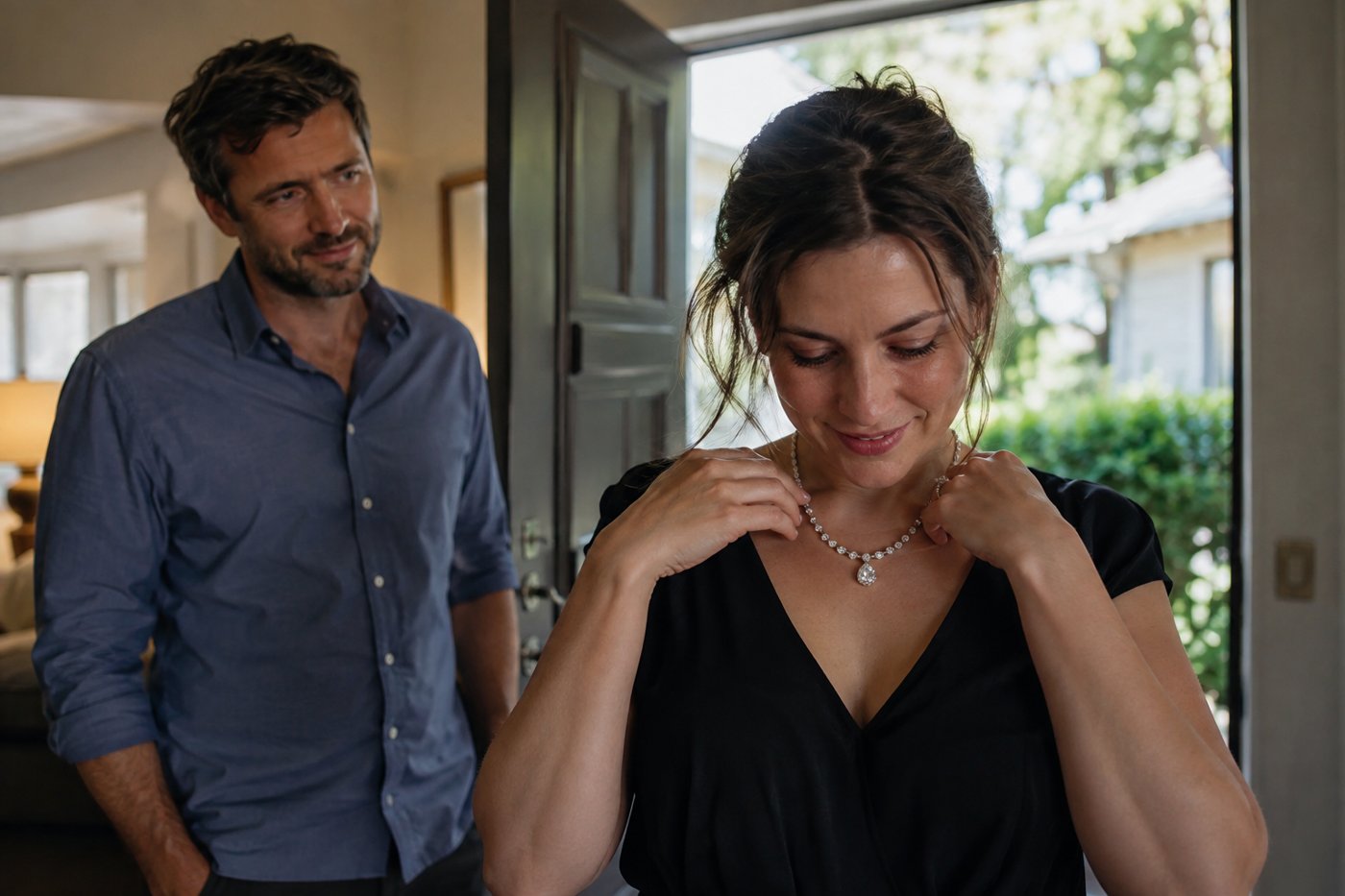
A blinding sliver of refracted light struck the white subway tile of the kitchen backsplash before I had even turned from the sink.
My wife, Audrey Bennett, had barely crossed the threshold from the garage mudroom when an unfamiliar collar of diamonds flared against the dark fabric of her evening dress.
I froze, the ceramic mug in my grip still dripping beneath the steady rush of the faucet.
Audrey wasn't someone who gravitated toward fine jewels.
She didn't possess an heirloom jewelry box filled with precious gems.
And certainly nothing in her modest collection could produce the museum-grade fire of stones cut for a private showroom display.
Her black leather purse hit the polished countertop with a dull thud.
“Hey.”
I couldn't peel my gaze away from the icy brilliance encircling her throat.
“Is that new?”
Her right hand snapped upward in a heartbeat.
It was a jagged, involuntary recoil.
A desperate attempt to shield what was in plain sight.
“MY BOSS GAVE IT TO ME.”
For a split second, I genuinely convinced myself that the hiss of the running tap had scrambled my hearing.
“Your supervisor?”
“Yes.”
“For what?”
Audrey let out a sharp, brittle exhale of exasperation.
“FOR DOING MY JOB WELL.”
The justification fell apart the instant it hit the air.
Yet before I could assemble another syllable, she reached up and brushed a thick lock of dark hair back over her bare shoulder.
That was the precise second my focus plummeted lower.
Nestled right against the hollow above her left clavicle was an unmistakable cluster of faint, purplish-red discolorations.
They weren't jagged abrasions.
There was no broken skin, no swelling or blood.
Yet the dark, mottled bloom of those marks sent a sickening surge of vertigo straight through my chest.
I stared, completely rooted to the spot.
Audrey caught the exact direction of my eyes.
Her open palm slammed flat against her chest, smothering the skin beneath.
The panic in her movement was impossible to mistake.
“IT’S NOTHING.”
I reached over, twisted the brass knob to shut off the stream, and set the wet mug into the basin.
“What are those marks, Audrey?”
“I told you, it’s nothing.”
My voice dropped down to a quiet, dangerous hush.
“Did your boss hand you those as well?”
Audrey turned into stone.
Her fingers remained pressed tight against her collarbone, digging into the tender, discolored flesh.
A suffocating, arctic silence settled across the kitchen. Neither of us seemed capable of drawing breath.
Then, her lips parted around a faint, shuddering whisper:
“Evan…”
I remained motionless, waiting for the rest.
Her eyes darted nervously toward the shadowed hallway leading to the foyer.
Then her attention whipped back, locking onto my face.
Instead of answering my question, she dropped eight words that pulled the floor right out from beneath my feet:
“You weren’t supposed to be home yet.”
My name is Evan Bennett.
I was forty-one years old on the evening that single sentence shattered the life we had spent over a decade building.
Audrey had celebrated her thirty-eighth birthday that past May.
Our marriage had crossed the eleven-year milestone.
We lived in a quiet cul-de-sac on the outskirts of Charlotte, North Carolina—a traditional two-story brick home we had stretched our finances to purchase six years earlier, finally moving on after years of convincing ourselves that narrow townhouses had character.
We had two kids sleeping beneath our roof.
Molly, our nine-year-old daughter.
And Jack, who had recently turned seven.
On that particular Thursday evening, however, neither of them was upstairs in bed. Both had stayed over at my sister Rachel’s house across town, organized days in advance because my travel schedule was supposed to keep me out of state until Friday afternoon.
That single detail made everything infinitely heavier.
It altered the entire architecture of what was unfolding in front of me.
My career sits within the commercial construction industry.
It isn't glamorous work.
My days are consumed by procurement logistics, sub-trade bidding, and managing supply contracts for large-scale urban developments.
Earlier in the week, project requirements had sent me down to Atlanta for vendor reviews.
The concluding progress review set for Friday morning had fallen apart late Thursday afternoon when the site engineers rescheduled.
Rather than lingering in a bland business hotel for another empty night, I rushed to the terminal and managed to get moved onto an earlier flight.
I decided against calling Audrey from the airport gate.
I wasn't trying to pull off some theatrical, romantic surprise.
I was simply exhausted, stiff from hours of travel, and wanted nothing more than to sleep in my own bed.
My flight landed in Charlotte around seven fifteen.
I tracked down my truck in the long-term parking lot.
I made a quick detour by the supermarket to pick up fresh fruit and milk for the morning.
By eight forty-three, I was slipping my key into the deadbolt of our front door.
The downstairs was dark and peaceful.
Nothing about the quiet house raised an alarm.
Audrey had mentioned days earlier that she had an executive dinner on her calendar for Thursday night.
She was the senior marketing director at Halcyon Medical Systems, a regional healthcare software firm that had been rapidly scaling.
According to her, the dinner was an official corporate celebration honoring her team for steering a grueling, multi-quarter platform rollout across the finish line.
Leaning over the island counter, I tapped out a short note:
Landed early. Take your time. Kids are still safe with Rachel.
The messaging app marked the text as delivered.
Minutes drifted by with no reply.
Then, at nine twenty-seven, the low hum of the motorized garage door vibrated softly through the floorboards.
Three minutes later, Audrey walked into the kitchen.
A glittering collar of flawless diamonds.
A sleek black sheath dress.
Faint, fresh bruises blossoming across her neck.
And those eight chilling words that paralyzed the air:
You weren’t supposed to be home yet.
Whenever catastrophe strikes without warning, the mind instantly scrambles to assemble harmless rationalizations.
Maybe the discoloration was contact dermatitis from a new cosmetic or a harsh fabric.
Maybe those sparkling stones were high-grade zirconias picked up at an outlet boutique.
Maybe when she said “boss,” she meant the executive leadership committee handing out a standardized company milestone gift.
Perhaps it was a recognized incentive bonus.
Maybe a heavy handbag strap had pinched the delicate skin near her clavicle.
Maybe she had caught herself on an awkward dress zipper.
Maybe every ugly suspicion was a cruel trick of paranoia.
Then the colder, unyielding machinery of logic forces you to confront reality.
The way Audrey’s hand still clutched her throat like a shield.
The sharp, defensive defiance ringing in her voice.
The visible wave of sheer terror that had washed over her features when she found me standing near the counter.
The silence that had followed my text from the kitchen.
Within seconds, every comfortable excuse evaporated like smoke.
“What did you mean by that?” I demanded, keeping my voice level.
Audrey offered a tense, frantic shake of her head.
“It didn’t mean anything.”
“You looked directly at me and said I wasn’t expected home.”
“Because you told me you were staying in Atlanta until tomorrow!”
“My schedule cleared up early.”
“Then why are you treating me like I committed a felony?”
I stared at her in utter disbelief.
“Treating you like what?”
“Ambushing me with questions the second I walk into my own home!”
“You just crossed this threshold wearing thousands of dollars in fine diamonds that your supervisor supposedly handed you.”
“He did give it to me!”
“And there are fresh bruises all over your collarbone.”
Her fingers pressed into her flesh with renewed force, trying desperately to blot them out.
“They have nothing to do with whatever disgusting story you’re inventing in your head.”
“Then educate me, Audrey. What am I inventing?”
She looked down at the hardwood floor, refusing to hold my gaze.
That silence was more damning than any defense she could have offered.
I stepped back from the island, giving myself enough room to draw breath.
“Who purchased that necklace?”
“I already told you.”
“Give me his name.”
Her eyes rose back to mine, brimming with nervous defiance.
“Richard.”
The name landed with the weight of an anchor.
Richard Hale.
Forty-six years old.
Executive vice president overseeing commercial growth at Halcyon.
He had been Audrey’s direct operational superior for roughly eight months.
I had encountered the man twice before.
Once at an elaborate holiday corporate gala downtown.
Later that spring at an upscale charity fundraiser for pediatric oncology.
He was tall, silver-haired, impeccably tailored.
A gold wedding band sat neatly on his ring finger.
He possessed that polished, frictionless executive charisma that allowed him to recall every spouse’s name and hobby, dispensing warmth like a carefully budgeted corporate asset.
His wife was Camille Hale.
They had three school-aged children together in a gated community south of the city.
“Richard Hale bought you a diamond necklace?”
“Yes.”
“Those are real stones?”
“Yes.”
“Did he present it to you privately?”
Audrey flinched, her breathing shallow.
“Evan, please don't do this—”
“Was it given in private?”
“Yes.”
“Tonight?”
Another suffocating second ticked past on the kitchen wall clock.
“Yes.”
I locked eyes on the glittering band around her neck.
“What did he spend on something like that?”
“I have no idea.”
“You didn’t ask?”
“No!”
“Your corporate boss drops a diamond collar into your hands and you don’t even wonder about the price tag?”
“You are deliberately twisting this into something grotesque.”
“Then explain the clean version to me.”
Her composure cracked, giving way to profound exhaustion—or pure panic.
Likely both, fighting for space behind her eyes.
“Our division smashed every benchmark for the quarter. Richard wanted to make sure my leadership was recognized.”
“By draping you in fine jewelry?”
“It was a gift of appreciation.”
“Given exclusively to you?”
“Yes.”
“Paid for out of his own pocket?”
“Yes.”
“So this wasn't an official company recognition package approved by Halcyon?”
Her jaw hardened into a rigid line.
“Why do you have to dissect every single syllable like a prosecutor?”
Because when a story changes every time you breathe on it, the individual syllables are the only evidence left standing.
I pointed a steady finger toward her throat.
“And the marks on your neck?”
Her response came without a second’s hesitation:
“I scratched myself.”
I stared back at her, incredulous.
“Scratched yourself with what?”
“The fastener on the chain.”
“The chain you supposedly put on just a couple of hours ago?”
“Yes.”
“Since when do jewelry clasps leave soft-tissue suction contusions?”
“They aren't contusions!”
“Then what are they, Audrey?”
“I don’t know!”
“Then why did your hand fly to your throat to hide them the instant you saw me?”
A dark, burning flush crept up her cheeks.
“Because I knew the exact poisoned conclusion you’d jump to!”
“You aren’t doing much to steer me away from it.”
“Drop it, Evan!”
“Not until you tell me the truth.”
Her temper broke, and she shouted back at the top of her lungs:
“NOTHING HAPPENED!”
That was her very first outright denial of the night.
The sickening part was that I hadn’t even voiced the accusation yet.
The room went dead silent.
Audrey caught the mistake the second the words left her mouth.
Her gaze drifted anxiously toward the stairs.
She shut her eyes tight, her chest rising and falling beneath the dark silk of the dress.
“Can we please not tear our lives apart tonight?”
A dry, bitter rasp broke from my throat.
“When would you prefer to pencil it in?”
“I am completely drained, Evan.”
“I’ve had a pretty demanding day myself.”
“I’ve been working under pressure for fourteen straight hours.”
“And capped off the night accepting precious gems.”
“Stop it.”
“I am standing here waiting for an explanation that makes an ounce of sense.”
“I gave you one!”
“No, you’ve fed me three separate lies that contradict each other.”
She snatched her leather purse off the granite.
“I am going upstairs to take a shower.”
I took two steps to the side, completely clearing the doorway to the hallway.
I had no desire to corner her or block her exit.
“Go ahead.”
She slipped past me, her entire frame trembling with tension.
Just as her foot met the first riser of the stairs, I called out into the hallway:
“Were you alone with Richard tonight?”
Her silhouette froze on the staircase.
Her spine went rigid. She didn't turn around.
For five agonizing seconds, nothing moved in the hallway.
Then, barely louder than a whisper:
“Yes.”
And she fled up the stairs.
That single word shattered whatever was left.
The jewelry was offensive, but it was just cold metal and polished carbon.
The true poison was whatever Audrey was holding behind her clenched teeth.\n\nI didn't rush up the staircase after her.
Instead, I pulled out one of the heavy wooden chairs at the kitchen table and collapsed into it.
Audrey had taken her handbag upstairs, but her damp black trench coat still hung over the back of the neighboring chair.
My smartphone sat beside my elbow on the wooden surface.
I pulled up our text message thread.
At five twelve that afternoon, I had drafted a message:
Meeting wrapped up early. Looking into standby flights home.
That message had failed to transmit while I was stuck in the underground airport tram tunnel.
Then, at six zero-eight:
Boarding the 6:25 flight. Coming home to sleep in my own bed.
The network timestamp indicated it had reached her device at seven fifty-one.
At eight forty-nine:
Landed early. Take your time. Kids are still safe with Rachel.
Delivered without a hitch.
She hadn't acknowledged either of them.
It was entirely conceivable that she hadn't checked her screen during a busy corporate event.
Completely plausible on the surface.
Then a contradictory detail jumped out at me.
At six thirty-one, Audrey had sent me a brief update:
Dinner is just kicking off. Will likely wrap up around 10. Love you.
I sat there in the silence of the kitchen, staring at those twelve words.
Dinner is just kicking off.
If their formal celebratory banquet hadn't even begun until half past six, how had she managed to commute back to our suburban driveway before nine thirty?
Under normal circumstances, ducking out early from a business dinner wouldn't raise an eyebrow.
Except for the stark terror that had drained the blood from her face the second she saw me standing by our sink.
Roughly twenty minutes passed before the floorboards upstairs groaned, and Audrey came back down.
The diamond strand was gone from her neck.
She had stripped out of the black evening dress, replacing it with an oversized heather-gray fleece pullover and a pair of faded cotton sweatpants.
Her dark hair fell in damp strands around her shoulders.
The thick ribbing of the crewneck collar rose high enough to conceal the bruising along her collarbone.
She dragged out the chair directly opposite mine and sat down.
“I don't want us screaming at each other, Evan.”
“Neither do I.”
“Then please, just let me explain.”
“I’ve been sitting here doing nothing else.”
She intertwined her fingers on the wood, her knuckles turning pale.
“The necklace is an achievement recognition.”
“Twenty minutes ago you claimed it was a gift.”
“It functions as both.”
“Billed to Halcyon's corporate accounts?”
“Richard paid for it personally.”
“Using discretionary executive funds?”
“I don't know what ledger he used.”
“Did any other project lead on your launch receive fine jewelry?”
Her breath caught in her throat.
“No.”
And there it was.
The very first thread snapping under tension.
“Why were you singled out?”
“Because the entire rollout sat squarely on my shoulders.”
“Did he present diamond collars to the male directors who hit their quarterly targets?”
“I don’t know what he gave them.”
“Did he present it to you at the table in front of the rest of the team?”
“No.”
“Where did he give it to you, Audrey?”
Her eyes dropped, fixating on her tightly locked fingers.
“Up in his suite.”
A thick, icy dread flooded through my chest.
“His hotel suite?”
“Evan, please hear me out—”
“You went into your male boss's private hotel room at night?”
“It wasn't what it looks like.”
“Why on earth would you step foot inside Richard Hale’s hotel suite?”
“A few of us went upstairs for a quick debrief after the meal.”
“Who else went up there?”
Silence filled the space between us.
I nudged my chair back slightly, the wood scraping against the tile.
“Who was in that room with you, Audrey?”
“When we first walked through the door?”
That single qualifier shredded whatever fragile calm I had managed to maintain.
“Yes. When you first walked through the door.”
“Three people.”
“Give me their names.”
“Richard. Naomi Keller. And me.”
Naomi was a director over in clinical strategy.
“And what happened after that?”
“Naomi said she had an early morning and left.”
“Leaving you behind.”
“Yes.”
“By yourself.”
“Yes.”
“Alone in a hotel room with your direct supervisor.”
“It was an executive suite, Evan.”
I stared at her, stunned by the sheer absurdity of the distinction.
“Is that honestly the technicality you’re clinging to right now?”
“No.”
I dragged both palms down over my face, trying to scrub away the numbness.
“How long did you remain in that room after Naomi left?”
“Maybe forty minutes.”
“Doing what?”
“Talking through next quarter’s strategy.”
“Professional strategy?”
“Yes.”
“For the entire forty minutes?”
She slowly lifted her chin, her eyes glistening with tears as they met mine.
“No.”
The pattern was identical to before.
Surrendering a solitary grain of truth at a time.
Only when I backed her into a corner with the precise question she couldn't evade.
“What else took place in that room?”
Audrey shoved her chair back and stood up abruptly.
“I knew this was how you'd react!”
“How I'd react?”
“You're convicting me before you even let me tell you what happened!”
“I haven't convicted anyone of anything! I have no idea what happened because I have to pry every single syllable out of your mouth with a crowbar!”
“I did not sleep with him!”
The words echoed off the kitchen walls, leaving a ringing emptiness in their wake.
Once again, she had leaped ahead to deny something I hadn't yet spoken into the room.
I stared at her.
The realization of what she had betrayed washed over her expression like an icy draft.
“Evan…”
“Did he kiss you?”
A suffocating, unbearable silence hung in the air.
“Audrey. Did Richard kiss you?”
Her chin began to tremble, and a fresh wave of tears tracked down her face.
The silence carried the answer long before she found the courage to speak.
“Yes.”
I don’t recall pushing my chair back from the table.
One instant I was sitting; the next I was gripping the edge of the kitchen countertop by the sink, leaning forward with white knuckles.
I kept my voice quiet.
The total absence of shouting seemed to rattle her far more than an explosion would have.
“Where did he kiss you?”
“Evan, please don't do this to us—”
“Where on your skin did he put his mouth, Audrey?”
Her eyes dropped to the floor once again.
“On my neck.”
The reddish-purple marks.
I shut my eyes tight, the cold stone pressing into the palms of my hands until it hurt.
When I finally forced myself to look back at her, she had collapsed into open weeping.
“How many times?”
“I don’t know.”
“You don’t know?”
“Everything was moving so fast.”
“Did you push him away?”
A hesitation hung between us.
That tiny fraction of a second cut deeper than the admission itself.
Finally, in a broken whisper:
“Not immediately.”
I turned my back to her, staring blankly at the dark window above the sink.
“God damn it, Audrey.”
“I stopped it, Evan! I pulled back!”
“At what point?”
“After just a few seconds.”
“A few seconds.”
“Yes.”
“Did you kiss him back?”
“I…”
Her throat constricted around the syllable.
I stood there, waiting for the rest of the truth to surface.
“I didn't shove him away right when it started.”
“That wasn't what I asked you.”
“Evan…”
“Did you participate, Audrey?”
“Just for a second.”
And with that, the remaining pieces of the puzzle fell into place.\n\nI walked out of the kitchen and into the living room.
I desperately needed physical space between us before my composure completely evaporated.
Audrey trailed behind me, hesitating near the arched entryway.
“We didn't go to bed together, Evan. I swear to God, I swear on our children's lives.”
I swung around to confront her.
“Stop holding that up like a trophy that makes tonight acceptable!”
“I am being completely honest with you!”
“Now you are.”
She flinched as if struck.
That single syllable landed like a physical blow.
Now.
Because not one scrap of reality had been offered freely.
Every single fact had been dragged into the light kicking and screaming, surrender by reluctant surrender, as each successive alibi crumbled beneath its own weight.
The diamonds around her throat.
Her executive supervisor.
The hotel bedroom.
Being left behind alone.
His mouth against her neck.
Allowing it to happen.
Each layer peeled back only after the previous deception gave way.
I forced air into my lungs, trying to steady the tremor in my chest.
“How long has this been going on between the two of you?”
“Tonight was the only time anything physical ever happened, Evan. The only time.”
“Audrey. That wasn't my question.”
Her defensive posture slowly withered away.
“How long?”
She sank onto the arm of the sofa, staring down at her slippers.
“About three months.”
A hollow, sickening ache settled in my gut all over again.
“Three months of what?”
“Talking.”
“You interact with your manager every working day.”
“Not like this. Not in this way.”
I nodded slowly, bracing myself for the impact.
“Start from the beginning.”
Sitting with her elbows resting on her knees, she unspooled the chronology.
It had taken root during the early phases of the new software deployment.
Eighty-hour work weeks.
Midnight strategy calls across time zones.
Richard had begun showering her with praise.
In the beginning, it was dressed up as high-level professional appreciation.
He praised her as the sharpest analytical mind in the entire commercial wing.
He claimed the executive suite had routinely overlooked her executive leadership.
He began bringing her into closed-door board sessions that sat well above her official title.
He sought out her private counsel on organizational restructuring and delicate personnel dilemmas.
Then the late-night personal messages started trickling in.
At first, they were framed around impending release deadlines.
Soon, the boundaries between corporate goals and personal intimacies blurred away.
He started prying into her marriage.
Did she harbor regrets about giving up her promising marketing career in New York to follow me down south?
Did she feel truly celebrated and recognized in her own home?
Was she genuinely content with the life we had built?
“And you actually entertained those questions?” I asked, my voice tight.
“Yes.”
“What did you tell him about me?”
She couldn't bring herself to meet my gaze.
“That we felt disconnected.”
I started to interrupt, then swallowed the words down.
I needed to hear every bitter piece of it.
“I told him you were on the road constantly. That when you were home, we operated like two exhausted logistics managers dividing up child duties and domestic chores.”
“Was that an accurate summary?”
“In some respects.”
And she wasn't entirely wrong.
My construction travel obligations had surged throughout the past twelve months.
Our day-to-day existence had settled into a relentless, unthinking conveyor belt.
Pack school lunches.
Morning carpool.
Interstate commute.
Endless job site meetings.
Pick up the kids.
Throw dinner together.
Supervise third-grade homework.
Pass out from exhaustion.
Start again at dawn.
A lengthy marriage can run with such ruthless mechanical efficiency that you wake up one morning and discover you haven't truly looked into each other's eyes in half a year.
That domestic fatigue helped explain her vulnerability.
It did not grant a hall pass for betrayal.
Both truths inhabited the exact same room.
Audrey continued quietly.
Richard had confided that his own marriage had become a hollow shell.
The most pathetic, well-worn cliché in the entire corporate handbook.
He claimed Camille was cold, distant, and completely disengaged.
They lived under the same suburban roof as glorified acquaintances.
He swore Audrey was the solitary soul who truly understood his ambitions.
And Audrey felt seen, intoxicatingly elevated by his attention.
Before long, their communications migrated off official corporate channels.
There was nothing overtly explicit at first.
Subtle flirtations.
Private inside jokes.
And then, scrubbing the message histories.
I cut in right there.
“You were systematically deleting your conversations with him?”
“Yes.”
“Why would you do that?”
Tears tracked down her cheeks once more.
“Because I knew reading them would break your heart.”
“People don't erase messages to protect their spouse's feelings, Audrey.”
She looked up at me through swollen eyes.
“Then why do they delete them?”
“Because they know they've crossed into territory that makes them guilty.”
She had no counter to offer.
“Give me your phone,” I said evenly.
Her eyes went wide.
“You’re going to comb through everything?”
“No.”
“Then what are you going to do?”
“I want you to sit right beside me and show me the correspondence you just described.”
“I wiped large parts of the threads.”
“All of them?”
“No.”
“Unlock it and pull them up.”
Her thumb hesitated over the glass for a heartbeat.
That brief pause told a story all its own.
“Audrey. Hand it over or open it.”
“There are things on here you are going to despise, Evan.”
“I’m already living inside a nightmare I despise.”
She tapped her passcode into the screen.
Navigated to her regular messaging app.
Richard’s contact didn't appear anywhere in the recent list.
Instead, she opened a secondary encrypted messaging utility that their field operations division utilized for emergency server outages.
I had no clue the platform even had a private direct-chat feature.
Dozens of exchanges sat archived in the application cache.
Some were routine operational check-ins.
Many were distinctly something else.
I didn't need to pore over every single paragraph to get the picture.
A brief perusal was plenty to make the blood run cold in my veins.
From Richard:
You were an absolute force during the board presentation this afternoon. None of those suits realize how much of this enterprise rests entirely on your shoulders.
Audrey's response:
You pay far too much attention to me.
Richard:
Perhaps the people around you don't pay nearly enough.
From another late evening:
Wish you were sitting across the table from me right now instead of another tedious quarterly financial review.
Audrey:
You’re playing with fire.
Richard:
You know you prefer it when I don't play it safe.
There was no visible reply beneath that line.
Erased?
Without question.
And then, a text sent earlier that very week:
Make sure you wear that black dress on Thursday. Trust me on this.
Thursday.
Tonight.
My gaze drifted toward the hallway where her outerwear and that dark garment were resting.
The sleek black sheath.
“You wore the dress he picked out for you.”
She buried her face in her hands, her shoulders shaking.
“I know.”
“Did you buy that dress specifically for tonight?”
“No, it was already hanging in my closet.”
“That wasn't what I asked, Audrey.”
She pulled her hands away, revealing her blotched, tear-streaked skin.
“I pulled it out of the closet tonight because he asked me to wear it.”
Whatever fog of ambiguity had remained was vanishing into thin air.
I scrolled further up the cached history, stopping abruptly on an exchange from three weeks prior.
Richard had written:
I can't stop replaying what nearly happened between us in Chicago.
I froze, looking up from the phone screen.
“Chicago?”
Audrey turned the color of chalk.
The national healthcare software symposium in Illinois.
Three weeks ago.
She had spent four nights downtown at the convention hotel.
“What nearly happened in Chicago, Audrey?”
“Nothing.”
I held her gaze, refusing to blink, until the facade fractured.
“We almost kissed.”
“Almost?”
“Yes.”
“Where were you?”
“Down in the hotel lounge.”
“Just the two of you?”
“Yes.”
“What stopped it?”
“One of our regional account reps walked through the entrance.”
A dry, bitter laugh escaped my chest.
“So you didn't stop it. You were interrupted.”
Her weeping turned into a ragged, helpless sob.
“Yes.”
I set the smartphone face down onto the glass coffee table.
The fundamental narrative had shifted beneath our feet.
Tonight wasn't an unfortunate, alcohol-fueled lapse in judgment.
Tonight was the culmination of a weeks-long, deliberate escalation.
That distinction changed everything about the betrayal.
I looked at her, searching her face for any trace of the woman I thought I knew.
“Did you know Richard was planning to give you that necklace tonight?”
“No. I swear I had no idea.”
“What did he say when he produced it?”
“He said I deserved to wear something that matched my value to him.”
“Were those his exact words?”
“Almost word for word.”
“Did he fasten it around your throat?”
Audrey squeezed her eyes shut.
“Yes.”
I tilted my head back toward the ceiling, swallowing down a wave of nausea.
Of course he had.
“Before or after he kissed you?”
“Before.”
“He stood behind you?”
“Yes.”
“His hands on your shoulders?”
“Yes.”
“And then?”
“He leaned in and whispered that it looked incredible on me.”
“And then what, Audrey?”
“He leaned down and kissed my shoulder.”
“Did you tell him to take his hands off you?”
“Not immediately.”
“And then?”
“He turned my head and kissed my neck.”
The purplish marks.
She didn't need to walk me through every graphic millisecond.
The reality was nauseatingly clear.
“You stood there and permitted it.”
“For a few seconds.”
“Why?”
She choked back another sob, shaking her head violently.
“I don't know.”
“Don't give me that cowardly answer. You know exactly why.”
“Because I liked the attention!”
Finally.
A pure, unvarnished truth.
No legalistic parsing.
No corporate euphemisms.
No hiding behind 'it wasn't what it sounds like.'
She stared back at me with raw, inflamed eyes.
“I liked feeling desirable, Evan! I liked feeling seen!”
The admission felt like a serrated knife twisting in my ribs.
Yet for the first time since she had walked through the back door, I believed she was telling the truth.
I lowered myself back onto the opposite cushion of the sofa.
“What broke the trance?”
She wiped her damp cheeks with the oversized sleeve of her fleece.
“My phone lit up on his desk.”
“With the text that I had landed early?”
“Yes.”
My message:
Landed early. Take your time. Kids are still safe with Rachel.
A fresh wave of sickness swept through my gut.
“You saw it right then.”
“Yes.”
“While you were standing in his hotel suite?”
“Yes.”
“That was why you looked like you’d witnessed a ghost when you walked into our kitchen.”
She nodded in miserable silence.
“Did you tell Richard that I was home?”
“I told him immediately.”
“How did he react?”
“He told me not to panic. He told me to stay.”
I stared at her, completely floored by the man's audacity.
“He knew your husband had unexpectedly returned from out of state, and he pressured you to remain in his hotel room?”
“Yes.”
“And what did you do?”
“I grabbed my coat and purse and walked out.”
That detail carried weight.
It didn't undo what had happened in that suite.
Not by a country mile.
Yet it demonstrated that she had pulled back from the absolute brink.
“What about the necklace?”
“I tried to take it off and give it back to him.”
“Tried?”
“He told me I was being melodramatic.”
A sharp, incredulous sound broke from my throat.
“The man fastens an eight-thousand-dollar piece of jewelry around your neck after kissing your skin, and accuses you of being dramatic when you try to take it off?”
“Yes.”
“Then why on earth did you wear it all the way home around your throat?”
She dropped her face back into her hands.
“I don't know, Evan. I honestly don't know.”
“Audrey. Think.”
“I think… I think part of me was desperate to pretend it was just a bonus. Just an award for my hard work.”
There it was.
It wasn't rational.
It was flawed, terrified human psychology.
She wanted the shiny physical trinket to represent something harmless so she wouldn't have to confront the moral catastrophe attached to it.
“Has he ever touched you physically before tonight?”
“Never.”
“Kissed you?”
“Never.”
“Did you meet him outside of business hours?”
“Yes.”
“On how many occasions?”
“Four.”
My chest seized up again.
“Doing what?”
“Coffee twice. A drink after work once. And dinner once.”
“Did I know about any of those meetings?”
“No.”
“Did his wife know?”
“I doubt it.”
“Were you going on dates with him, Audrey?”
“No.”
She caught herself before the lie could settle.
“At least… not officially.”
I let out another hollow, humorless laugh.
“What does 'not officially' mean?”
“It means we both lied to ourselves and called them work sessions.”
That was likely the most brutally honest sentence she had spoken all night.
That night, I grabbed my pillow and retreated to the guest bedroom at the far end of the hall.
Audrey didn't argue or try to follow me.
By two seventeen in the morning, my eyes were still wide open, watching the dark blades of the ceiling fan rotate in slow circles.
At three zero-four, the faint creak of floorboards downstairs signaled that she was awake and pacing.
At three nineteen, the screen of my phone lit up on the nightstand.
A text from Audrey:
I just sent a formal email to Richard. I stated that all personal communication between us must terminate immediately. I stated that the necklace will be surrendered to Human Resources on Monday morning. I blind-copied my personal email address. I will show you the entire thread when you come downstairs.
I stared at the glowing blue screen, typing nothing in return.
Seven minutes later, another notification flashed:
I know an email doesn’t undo what I’ve done. I am so sorry, Evan.
I turned over and buried my face in the pillow, letting the screen go dark.
Friday morning arrived without either of us having slept a single second.
The kids were still safe at Rachel's house.
Thank God for that small mercy.
Audrey brewed a pot of dark roast coffee.
Neither of us took more than two sips from our mugs.
She slid her phone across the granite island so I could read the sent message for myself.
It was clinical, unambiguous, and cold.
No gentle qualifiers.
No tentative requests for personal space.
It read:
Our private correspondence and what transpired last night violated professional, ethical, and marital boundaries. Do not contact my private phone or message me outside official channels again. I will be surrendering the necklace to Human Resources on Monday alongside a full disclosure of the circumstances under which it was presented. Any further communication between us must be strictly confined to critical business matters under the supervision of HR.
Richard had fired back an answer at six forty-one that morning:
You are blowing this entirely out of proportion simply because Evan returned home unexpectedly. We both know what has been developing between us over the past several months. Do not turn an intimate personal matter into a corporate catastrophe.
I read his reply three times in absolute silence.
Then I slid the phone back across the counter.
That message was damning evidence.
Not because it itemized every physical touch.
Because Richard himself had committed to writing that something intimate had been “developing” between them for months.
Audrey took a steadying breath.
“I am going to report everything to HR.”
“Why?”
She seemed taken aback by the question.
“Because he crossed an unforgivable line.”
“You crossed that line right alongside him, Audrey.”
“I know that.”
“Are you planning to disclose your own culpability to them?”
“Yes. Completely.”
That response carried real significance.
Then I raised the question that had been gnawing at the back of my skull since midnight.
“Where did he get that necklace?”
“I told you what he said.”
“No, you told me he handed it to you. Where did it come from?”
“I don't know.”
“Was it billed to a vendor allocation fund?”
“I don't think so.”
“Did he run it through Halcyon's expense ledger?”
“I have no way of knowing that.”
“Did he buy it with his own money?”
“I assume so.”
“Stop guessing.”
The jewelry was no longer merely a monument to marital betrayal.
An executive vice president presenting fine diamonds to a direct subordinate was a catastrophic corporate liability, entirely independent of our domestic crisis.
Audrey was finally beginning to grasp the legal and professional gravity of what had happened.
She took high-resolution photographs of the necklace from multiple angles under bright light.
She placed it carefully into a velvet presentation box.
She never put it around her neck again.
Then, sitting at the kitchen table, she dialed the confidential ethics compliance hotline for Halcyon Medical Systems.
I didn't listen in on the conversation.
I stepped out onto the back patio into the cool morning air.
It was her career.
Her confession.
Her burden to carry.
She remained on the line with the corporate compliance attorney for forty-five minutes.
When she finally pushed open the patio door, her face was completely devoid of color.
“They are placing me on paid administrative leave starting Monday morning while an internal investigation is conducted.”
“And Richard?”
“They wouldn't tell me.”
“Did you tell them about your own actions?”
“Every single detail.”
“Everything?”
“Yes.”\n\n“The near-miss in Chicago?”
“Yes.”
“The archived messaging threads?”
“Yes.”
“The off-the-books dinners and drinks?”
“All of it.”
She nodded in exhausted confirmation.
That was the first moment all weekend I allowed myself to consider that she might be genuinely committed to confronting the truth, rather than merely performing damage control to stave off an immediate divorce.
Those are two entirely different motivations.
We drove across town to pick up Molly and Jack later that afternoon.
They were completely oblivious to the earthquake that had just fractured our home.
And we were fiercely determined to shield them from the fallout.
Young children don’t require the sordid specifics of adult betrayal to instinctively sense when the emotional ground beneath them is shifting.
We told them Mom had an urgent, stressful issue she had to untangle for work, and Dad was running on fumes after an exhausting week on the road.
That was enough to settle their questions.
Audrey moved her clothing and essentials down the hall into the guest bedroom.
I remained in the master bedroom.
It wasn't done out of cruelty or spite.
I simply could not endure the thought of lying in the same bed with her.
First thing Monday morning, Halcyon’s chief corporate legal counsel phoned Audrey directly.
The company instructed her to hand over the diamond necklace via a certified courier service, delivering it straight to an external employment law firm retained by the board of directors.
The retention of outside legal counsel caught both of us off guard.
Why bring in a prominent outside firm for an internal personnel dispute?
Because a second, independent formal complaint had landed on their desks over the weekend.
It hadn't originated from Audrey.
It had come from Naomi Keller.
The very colleague who had been present in Richard’s hotel suite earlier that Thursday evening.
Naomi had contacted the corporate compliance director on Sunday afternoon after rumors circulated that Richard’s enterprise network credentials had been revoked.
She reported that Richard had previously presented luxury personal gifts to at least one junior marketing associate.
She also provided documented records of inappropriate late-night messages and persistent pressure to meet for private drinks off-site.
None of that erased Audrey’s betrayal.
It didn't excuse her deceit or lessen her culpability.
Yet it fundamentally transformed the broader context of the corporate environment she had been navigating.
Richard Hale wasn't stumbling into accidents; he was executing a practiced, predatory routine.
Audrey surrendered her mobile device and account logs to the independent legal investigators.
Even though she had systematically wiped several conversational threads from her handset, Halcyon’s digital forensics team extracted the complete server archives directly from their enterprise communications backbone.
That was a technical reality Richard had clearly failed to anticipate.
Deleting an exchange from the glass of an iPhone does nothing to erase it from centralized corporate cloud backups.
The scope of the corporate probe widened within hours.
A few days later, the formal appraisal report for the necklace came back.
The certified replacement retail value was documented at $7,850.
Nearly eight thousand dollars.
A stunned, hollow silence enveloped the room when Audrey showed me the paperwork.
Nearly eight grand.
This wasn't a corporate service pin.
It wasn't a crystal commemorative paperweight.
It wasn't a bouquet of congratulatory lilies.
It was an exquisite cascade of genuine, high-grade diamonds.
Audrey looked as though she was going to be physically sick.
“I assumed it was maybe twelve or fifteen hundred dollars.”
The bitter retort rose instantly to my tongue:
And you honestly believed an executive giving you fifteen hundred dollars in jewelry was appropriate?
I bit the comment back, keeping the silence.
The jeweler’s sales receipt surfaced shortly after.
Richard had paid for the piece using his personal credit card.
He had finalized the purchase three full days before the launch dinner took place.
That paper trail shredded any remaining claim that the gift was an impromptu impulse sparked by the celebratory energy of the evening.
He had planned the entire maneuver well in advance.
The jeweler's digital records revealed he had visited the downtown boutique twice.
First to inspect and select the stones.
Then to retrieve the boxed necklace after the clasp had been adjusted.
Once again, that calculated premeditation didn't excuse Audrey’s willingness to accept it.
However, it obliterated any lingering delusion that this was merely an awkward misunderstanding between colleagues.
Two days later, my phone buzzed with an unfamiliar local number.
The caller was Camille Hale.
Richard’s wife.
My immediate reflex was to tap decline.
When she stated her name, my stomach tied itself into a knot.
“I believe it would be in both our best interests to speak, Mr. Bennett,” she said with quiet composure.
“I’m really not convinced that’s a good idea,” I countered.
“Please. Just thirty minutes.”
We agreed to meet forty-eight hours later at a bustling breakfast diner near the interstate.
A bright, crowded, neutral venue.
No quiet corners.
I made sure to inform Audrey before I backed out of the driveway.
Camille looked thoroughly exhausted by the world.
She didn't display the hysterical rage I had mentally prepared myself to face.
Her flat, steady composure was far more disarming than screaming would have been.
She laid her smartphone face-up on the Formica tabletop.
“I know what took place with Audrey,” she stated without preamble.
I offered a tight, solemn nod.
“I am also aware of Naomi Keller’s filing.”
I hadn't yet learned the exhaustive contents of Naomi's report.
Camille continued in the same calm, matter-of-fact tone.
“And I am intimately acquainted with what occurred with a young financial analyst at his previous firm in Richmond.”
The boundaries of his behavior expanded once again.
She hadn't arranged the meeting to castigate my wife.
Nor was she interested in handing her an easy pardon.
“I don’t view your wife as an innocent bystander in this,” Camille said.
“Neither do I.”
“But my husband is a master at orchestrating this exact dynamic.”
She slid her phone across the table, showing me historical messages from years past.
No lurid photographs.
No crude profanity.
Just the methodical, calculated blueprint of emotional seduction.
No one at home appreciates what I’m building.
You possess an extraordinary mind.
They take you for granted here.
You deserve someone who sees your true brilliance.
Stick close to me and I will elevate your career.
The phrasing was hauntingly identical to the messages Audrey had shown me on her own device.
Camille leaned back against the vinyl booth.
“He hones in on ambitious women who feel slightly invisible or overlooked.”
I remained silent, listening.
“He weaves professional elevation and personal adoration together until the target can no longer tell where one ends and the other begins.”
“Are you suggesting Audrey had no choice in the matter?” I asked.
“Not for one second.”
I respected her fierce honesty.
“I’m telling you that my husband understands precisely which psychological levers to pull.”
That was a vital distinction.
Predatory manipulation and individual agency can occupy the exact same square foot of space.
One person can cynically exploit another’s emotional insecurities.
The other person still chooses whether or not to open the door and step through.
Camille explained that she had confronted Richard two years earlier over an intense emotional entanglement with an associate at his former employer.
At that time, he had adamantly insisted no physical boundaries were ever crossed.
They had spent months in marriage therapy.
He had promised total transparency.
And then he had relocated to Halcyon and deployed the exact same playbook from page one.
She had already retained a divorce attorney.
Her marriage was over.
Sitting across from her, I felt entirely hollow. No vindication, no triumph.
Two families, and five innocent children between them, were being torn apart at the seams.
Nobody wins a prize in the wreckage of a collision like that.
When I returned home and shared the substance of the conversation with Audrey, she broke down in tears.
It wasn't because Camille had attacked her.
It was because Camille hadn't.
“It would honestly feel easier if she hated me,” Audrey whispered into the quiet kitchen.
“Why would you wish for that?”
“Because then I could feel like a victim. I could pretend I was being persecuted.”
Instead, she was forced to confront something far more excruciating.
Camille saw Richard’s predatory grooming with crystalline clarity.
And she still expected Audrey to take absolute responsibility for her own moral failures.
The formal corporate investigation lasted six grueling weeks.
Richard defended himself aggressively.
He claimed every single interaction had been an entirely mutual, consensual flirtation between consenting adults.
In Audrey’s case, certain elements undeniably were.
He insisted the diamond necklace was simply an extravagant personal gift between close friends.
He claimed Audrey’s ethics filing was an act of retaliatory panic after her husband unexpectedly caught wind of their mutual interest.
That was his legal defense.
The independent corporate attorneys were entirely uninterested in romantic rhetoric; they followed the forensic paper trail.
Company records confirmed that Richard had personally influenced Audrey’s formal performance appraisals and had lobbied for substantial executive compensation increases on her behalf.
That documented supervisory power dynamic elevated the entire relationship into a catastrophic corporate liability.
Regardless of whether Audrey believed she was acting out of genuine personal interest, the organizational hierarchy made the dynamic an intolerable conflict of interest.
The review also established that Richard had directly violated company policies regarding executive conduct and fraternization.
Furthermore, glaring discrepancies in his corporate travel ledgers and entertaining expenses were uncovered.
I never asked to see the final, itemized report.
I had no desire to read it.
Halcyon terminated Richard Hale for cause.
It wasn't because I marched into their executive suites demanding justice.
I never dialed their corporate offices a single time.
It wasn't because Audrey was my wife.
It wasn't because Camille threatened litigation.
The corporation conducted an objective audit and executed a calculated legal move to insulate itself from liability.
Audrey retained her job.
However, the professional repercussions were severe and immediate.
She was transferred to a completely separate division under a rigorous, no-nonsense female vice president.
She was stripped of her leadership on the flagship rollout portfolio.
Her pending nomination for an executive promotion was shelved indefinitely.
She accepted every disciplinary sanction without a syllable of pushback.
The diamond necklace was returned through the outside legal firm.
Richard initially refused to sign for the parcel.
Eventually, legal channels compelled him to take possession of it.
I never laid eyes on that black velvet box again.
Good riddance.\n\nOur home life was an entirely different battlefield.
There were no corporate ombudsmen to arbitrate our grief.
There was no employee policy handbook.
There was no human resources representative who could calculate the appropriate penalty for eleven years of marriage weighed against three months of calculated deception.
I had to figure out what I could realistically endure.
Audrey had to figure out whether she possessed the endurance to undertake the grueling, agonizing work of repairing what she had demolished.
Neither revelation arrived quickly.
We initiated weekly sessions with a licensed marriage counselor named Dr. Elaine Foster.
Our first appointment was an unmitigated catastrophe.
Audrey wept without stopping.
I sat in the armchair opposite her with my arms folded and my jaw clenched, barely offering a single sentence.
Dr. Foster studied me for a long moment before asking what I needed to even engage in the room.
“Unfiltered facts,” I replied.
Audrey glanced up, her eyes pleading.
Dr. Foster leaned forward.
“Do you feel you don't possess the facts, Evan?”
“I feel that I possess only the specific facts for which I have managed to engineer the exact right question.”
That was the foundational trauma of the entire ordeal.
It wasn't merely the physical kiss on her neck.
It wasn't merely the bruises above her collarbone.
It wasn't merely the eight-thousand-dollar diamond collar.
It was the agonizing poison of trickle-truth.
The horrific realization that every single truth had been concealed behind an earlier lie, only surrendered when denial became mathematically impossible.
Dr. Foster turned toward Audrey and asked if there were any remaining secrets she had withheld.
Audrey swore on everything she held sacred that there was nothing else.
A dry, cynical laugh escaped my lips.
Dr. Foster caught it instantly.
“What prompted that reaction, Evan?”
“Because I have heard that exact sentence after every single layer of this nightmare collapsed.”
Audrey looked crushed.
Yet trust cannot be rebuilt on the currency of someone else's tears.
Dr. Foster suggested an exercise that initially made my stomach turn.
A comprehensive, written timeline.
Not graphic descriptions of physical intimacy.
A forensic chronology.
Dates.
In-person encounters.
Every off-channel message or unscheduled phone call.
Every deleted thread.
Every crossed emotional boundary.
The full truth of what occurred in Chicago.
The exact play-by-play of the hotel suite the night she brought the necklace home.
And any other encounter that Audrey knew, deep down, would influence my decision to stay or walk away.
One exhaustive, unvarnished disclosure.
An end to the endless, exhausting interrogation.
Audrey spent three days secluded in the guest bedroom drafting the document.
When she finished, it filled eight handwritten pages.
I placed the sealed manila envelope on top of my bedroom dresser and let it sit there for an entire week before I found the stomach to break the seal.
There were two specific disclosures inside that I had known nothing about.
The first:
Richard had taken her hand in the back of an Uber following their private dinner six weeks earlier.
She had allowed her fingers to remain intertwined with his for the entire twenty-minute ride across town.
The second:
Following the close call in the hotel lounge in Chicago, after the colleague had interrupted them, Audrey had returned to her hotel room and texted Richard:
I wish we hadn't been interrupted.
That single sentence nearly destroyed our marriage on the spot.
Not because it was physically worse than the marks on her neck.
Because it provided incontrovertible evidence of her own conscious desire before anything physical had ever taken place.
I packed a suitcase that evening.
Audrey didn't attempt to stand in my way.
I stayed in the guest bedroom at my brother's house for twelve days.
I made sure to see Molly and Jack every single afternoon after school.
We told the children that Dad needed some quiet time to work through complex adult challenges.
Molly looked up at me during one visit, her brown eyes wide with fear, and asked:
“Are you and Mom getting a divorce?”
Hearing that question from my nine-year-old daughter ripped me to pieces.
I chose my words with agonizing care.
“Your mother and I are working through some very difficult grown-up problems.”
“Do you still love her?”
“Yes, I do.”
That answer was completely honest.
My love for her had never vanished.
The question was whether trust could ever be resurrected.
Throughout those twelve days of separation, Audrey didn't bombard my phone with frantic apologies.
Dr. Foster had strictly counseled her against emotional smothering.
She sent straightforward, practical updates regarding the children's school projects and doctor appointments.
Only once did she send something personal, late on a Tuesday night:
I completely understand why that text from Chicago changed everything for you. I will not make excuses for it. I wanted him in that moment. What I am desperate to understand now is why I allowed myself to cultivate a secret life while lying to myself that it wasn't real. You take all the time you need to decide. You do not owe me an easy path.
I read those words a dozen times under the dim lamp.
It stung like hell.
Yet there was genuine integrity in the complete absence of self-defense.
Eventually, I agreed to return to Dr. Foster's office.
Not because I had decided to preserve the marriage.
Simply because I wanted to discover whether saving it was even a human possibility.
Dr. Foster forced us to dissect the state of our relationship in the years leading up to Richard Hale.
At first, that approach infuriated me.
It felt dangerously close to distributing the blame for Audrey's infidelity across both partners.
Dr. Foster dismantled that misconception immediately.
The systemic vulnerabilities within our marriage belonged to both of us.
Audrey’s deceit, secrecy, and infidelity belonged entirely to Audrey.
They were distinct categories that could never be merged.
Hearing that distinction clearly articulated was what kept me in the room.
We had undeniably drifted apart.
My work travel had become a convenient escape from domestic monotony.
Audrey had quietly stopped voicing her loneliness, burying it beneath corporate achievement.
I had mistaken quiet stability for marital fulfillment.
We had stopped courting each other.
Stopped engaging in affectionate, casual touch.
Stopped asking questions that didn't pertain to carpools, utility bills, or calendar logistics.
Those were real marital failures.
Yet none of those cracks required Audrey to invite another man into her emotional life.
Understanding the context did not mean excusing the betrayal.
That fundamental clarity saved our counseling.
Audrey began individual therapy on her own.
She uncovered some ugly truths about her own psychology.
Her craving for external validation was far more compulsive than she had ever acknowledged.
Her father had been a cold, demanding perfectionist.
Love had to be earned through stellar report cards and prestigious accolades.
A mistake was met with chilling silence.
Richard Hale had recognized that emotional hunger almost instantly.
His lavish praise had acted like a narcotic because it paired professional elevation with intoxicating personal adoration.
Again:
An explanation.
Never an excuse.
I had my own destructive defenses to confront.
Whenever I felt emotionally battered, I retreated into total, icy withdrawal.
I could weaponize silence for weeks, convincing myself that I was simply “processing” when I was actually punishing the other person.
Dr. Foster called me out on that behavior directly.
I hated hearing it.
Yet she was dead right.
If reconciliation was going to work, I had to learn to speak my reality aloud:
“I am furious right now.”
“I don't believe what you just said.”
“I need you to give me space.”
Rather than vanishing behind an emotional fortress while sitting in the same room.
Three months after the night of the necklace, Audrey and I sat on the back deck after the children were asleep.
She looked at me and asked:
“Do you want to end this? Do you want a divorce?”
I took a breath.
“I don't know yet.”
She swallowed and nodded.
“Do you need me to move out of the house?”
“I don't know that either.”
Another slow nod.
Then, her voice cracking:
“Is there anything you are certain of right now?”
I stared out at the yard for a long moment.
“Yes.”
“Tell me.”
“I refuse to make a permanent decision about our family while I'm still trapped in the shock of that night.”
That became our operational agreement.
No artificial ultimatums.
No empty promises that reconciliation was guaranteed.
No packing a suitcase every time a therapy session became excruciating.
Just patience and time.
Six months crawled by.
Then nine months.
Trust did not arrive like a sudden revelation; it returned in small, cautious increments.
When Richard attempted to reach Audrey through a former colleague six months later, she didn't reply.
She brought her phone directly to me and showed me the message before taking any action.
Later that year, her new division assigned her to an industry summit in Chicago.
She came to me and offered to decline the travel assignment if it triggered my anxiety.
I thought about it and said:
“No. You should go.”
She was visibly taken aback.
“Are you sure that won't tear you up?”
“It will bother me,” I admitted.
“Then why tell me to go?”
“Because if this marriage only survives by me acting as your parole officer, then the marriage is already dead.”
She boarded the plane.
She checked in from her hotel room that evening.
Not because I demanded a check-in.
Because she genuinely wanted to connect with me.
A subtle difference on the surface.
A monumental difference in reality.\n\nExactly twelve months after she had walked through the mudroom carrying that diamond necklace, we went out to dinner together.
The reservation happened to fall on the exact same date on the calendar.
Audrey realized the coincidence before I did.
She suddenly grew quiet, her fingers tracing the rim of her water glass.
“What's going through your mind?” I asked gently.
“Do you realize what today's date is?”
I performed the mental calculation, and the weight of the realization settled into my chest.
“Oh.”
“Would you rather we pay the bill and head home?” she murmured.
“No.”
She looked up at me, surprised.
“I have no intention of letting Richard Hale own this date on our calendar for the rest of our lives.”
She held my gaze across the table, her eyes glistening.
“Neither do I.”
We finished our meal in quiet comfort.
On our walk back toward the parking garage, our path took us past an upscale jeweler's display window.
Halogen spotlights beat down on platinum and diamond strands draped across black velvet busts.
Audrey stopped dead in her tracks.
For a second, I worried the sight was going to drag her into another spiral of remorse.
Instead, a wry, rueful grimace crossed her mouth.
“I have developed a permanent, visceral hatred for necklaces.”
A sudden, unprompted laugh broke from my chest.
It was the very first genuine, unburdened laugh we had shared about any facet of that entire nightmare.
“You still have three pendants sitting in your jewelry tray at home,” I pointed out.
“None of them are diamonds.”
“Let's keep it that way.”
She reached out and threaded her fingers through mine.
That simple, unscripted gesture carried infinitely more authentic intimacy than an eight-thousand-dollar collar of diamonds ever could.
Not because our marriage had been miraculously healed overnight.
Because her hand wasn't trying to hide anything anymore.
Camille Hale finalized her divorce from Richard later that winter.
Word reached us through mutual acquaintances in the healthcare community.
I never initiated contact with her after our second coffee meeting.
Six months after her decree was entered into the court records, a brief message from her landed in my inbox:
I hope your family has found a path toward healing and peace. Thank you for extending basic decency to me when both of our worlds were falling to pieces.
I sent a short reply that afternoon:
I wish you and your children that exact same peace.
That was the end of it.
Some people cross your path only during a catastrophe.
They don't need to stay once the smoke clears.
Audrey eventually parted ways with Halcyon.
Not immediately.
She remained with the company for two more years to completely rebuild her professional reputation through unassailable performance.
Then she accepted an executive vice president role at a competing healthcare technology enterprise.
During contract negotiations, she insisted on rigid corporate governance structures and transparent oversight protocols.
She never shared the underlying history with her new executive peers.
She had no obligation to.
As our children matured into young adults, they gradually realized that a massive crisis had once shaken our household.
They didn't know the sordid particulars.
When Molly turned twenty-one, she sat with both of us on the back patio and asked bluntly whether someone had been unfaithful.
Audrey glanced across at me.
I held my silence, allowing her to lead.
“Yes,” Audrey answered quietly.
Tears welled up in Molly’s eyes.
Audrey didn't attempt to sugarcoat the truth.
She didn't shift the blame onto my shoulders.
She didn't point fingers at Richard.
She looked her adult daughter straight in the eyes and said:
“I crossed lines with someone I worked with, kept it hidden from your father, and violated our marriage vows. Afterward, both of us chose to do the agonizing work of putting our family back together.”
That honest admission was enough.
Later that same weekend, Jack pulled me aside by the grill and asked quietly:
“Did you truly forgive Mom, Dad?”
Audrey was standing near the sliding glass doors, watching my expression.
I gave him the only honest answer I possessed.
“Forgiveness isn't a light switch that you flip on once and leave untouched forever.”
He furrowed his brow, trying to grasp the concept.
“I stopped wishing to punish your mother long before I fully trusted her again.”
That was the truest reality I could offer him.
Audrey and I remain husband and wife today.
Twelve years have elapsed since the evening of the diamond necklace.
That outcome frequently catches people off guard.
Some assume I will recount this journey as a triumphant romance where love conquered all odds.
I refuse to package it that way.
Remaining married isn't inherently a moral victory.
Walking away would not have been a shameful defeat.
We stayed because, through painstaking labor across thousands of quiet days, we discovered that the foundation beneath the rubble was still solid enough to rebuild upon.
Another couple, facing the exact same circumstances, might choose divorce—and their decision would be entirely justified.
The trust we share today looks nothing like the trust we possessed before that night.
And that is probably for the best.
Our original trust was constructed on naive, unexamined assumptions.
I assumed Audrey was fundamentally incapable of deception.
She assumed our marriage could run on domestic autopilot without slowly starving to death.
We don't rely on unexamined assumptions anymore.
We evaluate trust based on continuous, transparent actions.
It sounds considerably less poetic.
Yet it is infinitely more resilient.
Richard Hale vanished from our lives permanently.
I have no idea where he works today.
I don't look him up.
I don't give a damn.
For a long time, I entertained elaborate mental fantasies of confronting him face-to-face.
What would I have shouted at him?
You tried to seduce my wife?
You bought her diamonds?
You manipulated her ambition?
He could have looked me dead in the eye and countered:
She welcomed it.
And a sickening, undeniable part of that response would have been the absolute truth.
There was no physical or verbal confrontation with that man that could have healed what was broken between Audrey and me.
So I let him rot in the past.
To anyone viewing this story from the outside, the diamond necklace is the sensational headline.
The eight-thousand-dollar appraisal.
The glittering jewels.
The executive hotel suite.
The subordinate employee.
The corporate scandal.
Yet the necklace was never the most lethal poison Richard injected into our marriage.
The real poison was the flattery.
And even that realization demands ruthless honesty.
Because Audrey leaned into it.
She encouraged it.
She matched it.
She craved it.
And then she convinced herself that playing with fire wasn't really infidelity.
That is how fidelity actually dissolves.
Not through a sudden, cinematic leap off a cliff.
Through a hundred tiny compromises that feel harmless in the moment until you're standing on the precipice.
Grabbing coffee isn't a date.
It’s just professional networking.
A private drink isn't an affair.
We’re just decompressing from launch stress.
Wiping a chat thread isn't lying.
I’m just avoiding an unnecessary misunderstanding at home.
Wearing the dress he requested isn't betrayal.
It’s just clothing.
Stepping into his hotel room isn't dangerous.
We’re reviewing departmental strategy.
Letting him clasp diamonds around my neck isn't intimate.
It’s just an expression of gratitude for my performance.
Allowing him to kiss my neck isn't cheating.
Nothing really happened.
Until your husband is standing by the kitchen sink, staring at the discolored skin above your collarbone.
And every single self-serving delusion shatters into dust in an instant.
Years after the fact, Audrey confessed that her most terrifying memory from that night had nothing to do with Richard touching her.
It was the moment she pushed open the mudroom door and saw me standing in the kitchen.
Knowing, in a fraction of a second, that the private fantasy she had been cultivating had violently collided with reality.
She said:
“When you asked me about that necklace, I had roughly ten seconds to decide whether to lay out the truth or double down on the lie.”
“You made the wrong choice,” I noted.
“I made the worst choice imaginable,” she replied with a faint, sorrowful smile.
“And I spent the next twelve months trying to undo those ten seconds.”
Not quite.
She spent the next twelve months undoing three months of deceit.
Yet I understood what she meant.
The physical marks on her neck have grown hazy in my memory.
They faded away within a week.
Physical bruises always do.
The emotional fallout lingered for years.
Seven days later, her collarbone looked entirely pristine.
Our marriage was still in the intensive care unit.
That is why physical clues should never be mistaken for the whole truth.
Those purple marks proved an event had occurred.
They didn't reveal the timeline.
They didn't tell me whether they had gone to bed together.
They didn't explain the close call in Chicago.
They didn't disclose the wiped communications.
They didn't expose Richard’s history of predation.
They didn't tell me whether Audrey would lie, repent, run away, or fight for our family.
A clue merely forces a door open.
It does not walk you through the house.
The diamond necklace functioned the same way.
Initially, my conclusion was simple:
Expensive jewelry from the boss equals a full-blown sexual affair.
The ground truth was vastly more complicated.
Yes, there had been a profound emotional betrayal.
Yes, physical boundaries were violated.
No, they had not had intercourse.
No, the necklace wasn't corporate compensation.
Yes, Richard had coldly orchestrated the gift.
Yes, Audrey had willingly accepted it.
Yes, she eventually surrendered it.
Yes, Richard had run similar grooming routines on other women.
Yes, Audrey retained complete agency over her choices.
Multiple, uncomfortable truths can occupy the exact same space, even when our instincts beg for a tidy villain and a blameless victim.
Accepting that complexity was what made restoration possible.
Audrey had to stop leaning on Richard as the sole villain of the story.
I had to stop pretending he was an irrelevant detail.
He mattered.
His predatory manipulation mattered.
His structural authority over her career mattered.
His rehearsed playbook mattered.
Audrey’s selfish choices mattered just as much.
And our neglected, emotionally bankrupt marriage was the soil in which the whole catastrophe took root.
None of those realities canceled out the others.
On our twentieth wedding anniversary, Audrey handed me a small, wrapped box across the breakfast table.
I eyed it with an arched brow.
She laughed immediately.
“Don't panic. It's not diamonds.”
Inside was the framed photograph from our morning at the county courthouse twenty years ago.
We looked impossibly young.
Completely broke.
My hairline was an inch lower.
Audrey wore an off-the-rack white sundress.
No jewelry.
No elaborate reception.
Just our immediate family and burgers at a local diner afterward.
On the cardboard backing, she had written:
Still choosing this.
I looked at the handwriting for a long time.
Then I uncapped a pen and wrote directly beneath her words:
Me too.
That framed photo sits on our nightstand today.
Not as a monument to an unblemished fairy tale.
Nothing in real life remains unblemished.
It stays there as a reminder that a durable marriage isn't forged in a single, emotional vow on a wedding day; it is built through thousands of unglamorous choices made in the decades that follow.
Some choices are noble.
Some are catastrophic.
And some represent the grueling labor of repairing what earlier choices broke.
If you had pulled me aside the morning after I discovered that necklace and asked if we would reach twenty-three years of marriage, I would have laughed in your face.
If you had asked Audrey, she would have told you she wasn't worthy of being saved.
Neither of us had the vision to look that far ahead.
Acute agony shrinks your perspective.
It tricks you into believing that the suffocating agony of tonight will be your permanent state of existence forever.
That is rarely the case.
That doesn't mean every wounded marriage ought to be preserved.
It simply means that when circumstances permit, life-altering choices deserve more grace than the burning temperature of a single awful night.
Even now, I can recall that initial confrontation with terrifying precision.
The steady hum of the refrigerator motor.
The light patter of rain against the windowpane.
My half-rinsed coffee mug resting in the sink basin.
Audrey's black handbag hitting the granite island.
The blinding flare of diamonds catching the light.
My first question:
“Is that new?”
Her nervous fingers reaching for her throat.
“MY BOSS GAVE IT TO ME.”
“For what?”
Her defensive, hard-edged reply:
“FOR DOING MY JOB WELL.”
Then my gaze sliding an inch lower.
The faint, unmistakable discolorations near her collarbone.
Her palm snapping up to conceal them.
“And what are those?”
“IT’S NOTHING.”
Followed by the quietest, most devastating sentence I uttered all evening:
“Did your boss hand you those as well?”
Her absolute paralysis.
The tears springing to her eyes.
And finally, the admission that broke the dam:
“Yes.”
Not all at once.
Not without deceit and resistance at the start.
Yet the truth arrived.
The diamond collar had been his.
The marks on her skin had been his.
The moral failures that permitted both inside our home belonged entirely to her.
What happened next belonged to both of us.
And that precise distinction—the chasm between what another person inflicts upon your life and what you resolve to build out of the truth afterward—is the reason that horrifying evening became a dark chapter in our history, rather than the final line of the book.



COMMENTS
Loading…