I Ambushed My Wife In Room 214 With Red Roses-Then My Mother Answered The Door
The notification buzzed against my thigh at exactly 7:14 PM.
I didn't need to look at my phone to know what it said. I had memorized the exact rhythm of the vibration, the sick drop in my gut that came with it, and the string of characters waiting on the glowing screen:
Chase Fraud & Activity Alert: Card ending in 4108 charged $168.40 at PINE CREST MOTOR LODGE - RM 214.
It was Tuesday. It was always Tuesday.
For twelve straight weeks, that exact charge hit our joint credit card like a sledgehammer. Twelve weeks of watching my wife, Natalie, pack an oversized duffel bag, kiss my cheek with cold lips, and tell me she had to supervise the late-night logistics audit for the county medical transport division.
"Don't wait up, Jules," she would whisper, adjusting her scarf and avoiding my eyes. "The state dispatch logs are a mess. I won't be back until two in the morning."
Then she would climb into her silver Civic and pull away into the dark, leaving me standing under the flickering porch light of the small ranch home we had spent five years fixing up together.
At first, I told myself there was an explanation. We had been married since we were twenty-five. Natalie wasn't a liar. She managed regional non-emergency transit—wheelchair vans and shuttle routes for low-income seniors and dialysis patients. She was the kind of person who cried at stray dog commercials and packed extra lunches for unhoused people at bus stops.
When the charge first appeared three months ago, I casually brought it up over breakfast.
"Hey, Nat," I had said, sliding my phone across the counter. "Looks like our card got compromised. Some dive on Route 9 charged us a room fee."
The wooden spoon froze in her hand. Her shoulders stiffened beneath her flannel shirt before she forced a quick, brittle laugh.
"Oh... that's weird," she mumbled, keeping her back to me. "Actually, don't dispute it, Jules. One of our drivers broke down near the county line and their corporate gas card failed. My supervisor asked me to cover the emergency motel room. I submitted the expense voucher Wednesday. It'll get reimbursed next week."
I believed her. Why wouldn't I? I loved her. I spent sixty hours a week running an independent metal restoration and ironwork shop, coming home with calloused fingers and soot in my hair, proud that we were finally saving enough to build a nursery.
Then came the second Tuesday.
Then the third.
The reimbursement never showed up. When I logged into our online banking, the charges stayed settled. Worse, another pattern began: every Tuesday morning at 8:15 AM, an ATM withdrawal of exactly $200 cleared from the drive-through on Fourth Street.
Two hundred dollars in cash. One hundred and sixty-eight dollars and forty cents for Room 214.
Every single week.
The silence in our house became deafening. Natalie stopped leaving her phone on the coffee table. The screen stayed turned face-down or hidden under pillows. When a message arrived, her eyes would flick toward me before she snatched the phone away, thumbing replies with frantic speed.
When she came home at two in the morning, she didn't greet me. She slipped into the bathroom in pitch darkness, locking the door. She showered for forty-five minutes. When she finally crept into bed, she didn't smell like whiskey or men's cologne, but she didn't smell like herself, either. She smelled of harsh hospital disinfectant, lavender skin ointment, and an overwhelming, hollow exhaustion.
Whenever I tried to hold her, she flinched.
"I'm just exhausted, Julian," she would whisper, pulling the duvet over her shoulders. "Work is drowning me. Please, I just need space."
By the ninth week, I was unraveling. I couldn't sleep. I couldn't eat. I ruined a four-thousand-dollar wrought-iron banister at the shop because my hands shook so badly I torched straight through the scrollwork.
My buddy Mark, who owned the auto garage next door, saw the hollow shadows under my eyes and told me what any guy would tell his friend.
"A roadside motel, Jules? Every Tuesday, cash withdrawals, showers in the dark, and phone locked?" Mark said grimly, wiping grease from his hands. "Come on, man. You know what happens in highway motels on Tuesday nights. You're getting played."
I wanted to hit him. But the venom was already in my head. Every time Natalie smiled at me, all I could picture was another man touching her in some stained, wood-paneled room off the highway. A coworker? An old flame? Some executive from the medical transit board?
The final fracture happened two Sundays ago at my older sister Kendra's house.
Kendra was six years older than me, an estate wealth manager married to a smug corporate accountant named Brad. They lived in a gated hillside enclave in a massive glass-and-stone house that looked down on the rest of the town.
To Kendra, I was always the family failure—the kid who chose welding torches over business school. But the real nightmare started three years ago, when our father died of a sudden aneurysm.
Dad left behind our seventy-two-year-old mother, Eleanor, our childhood home, and a substantial life insurance policy. Immediately after Dad's funeral, Kendra took control. She declared that Mom had severe vascular dementia with violent paranoia. Kendra produced medical evaluations, seized power of attorney, and barred me from Mom's life.
She claimed Mom had developed a vicious delusion about me and Natalie, insisting we were thieves and screaming at the sight of my face. Kendra said that to prevent Mom from suffering a psychotic break, she had admitted her to "The Willows"—a high-end, closed-door psychiatric sanitarium ninety miles north.
"If you attempt to visit her, you will trigger an episode," Kendra had told me coldly on her front steps three years ago. "The specialists were clear, Julian. You stay away, or I file an emergency restraining order. If you actually care about Mother, let the professionals handle her."
Kendra locked Mom behind nondisclosure agreements and private facility gatekeepers. And then came the financial squeeze: Kendra insisted that Mom's specialized care exceeded the estate trust, demanding I pay $950 every month toward her medical fees.
"It's the least you can do, little brother," Kendra would sneer. "Since you contribute nothing else to this family."
For thirty-six months, I paid that $950 without fail. Natalie and I cut our grocery budget, delayed having children, and bought second-hand clothes so my mother could have a clean room, even while my heart broke every single day knowing Mom allegedly hated me.
Two Sundays ago, I went to Kendra's house to drop off the monthly check. Natalie stayed in the car.
Kendra took the envelope, counted the bills, and tossed it onto the kitchen counter. Then she leaned against the marble island, a malicious grin spreading across her face.
"By the way, Julian... I saw your little wife's Civic last Tuesday night. Parked outside the Pine Crest Motor Lodge on Route 9 around eight o'clock."
My chest tightened. "You're full of it."
"Am I?" Kendra chuckled, taking a slow sip of wine. "Brad and I were driving back from dinner. I'd recognize that dented bumper anywhere. Tell me, what kind of 'transit audit' takes place under a neon vacancy sign? Or did she finally get tired of being married to a grease monkey?"
I walked out without another word. The rage in my veins was so hot it felt like molten lead.
That was ten days ago.
And now, here I was.
Tuesday, 7:14 PM.
The notification glowed on my dashboard: PINE CREST MOTOR LODGE - RM 214 - $168.40.
I sat in the cab of Mark's borrowed F-150, my hands trembling against the steering wheel. I had borrowed his truck so Natalie wouldn't spot my Subaru if she glanced in her mirrors.
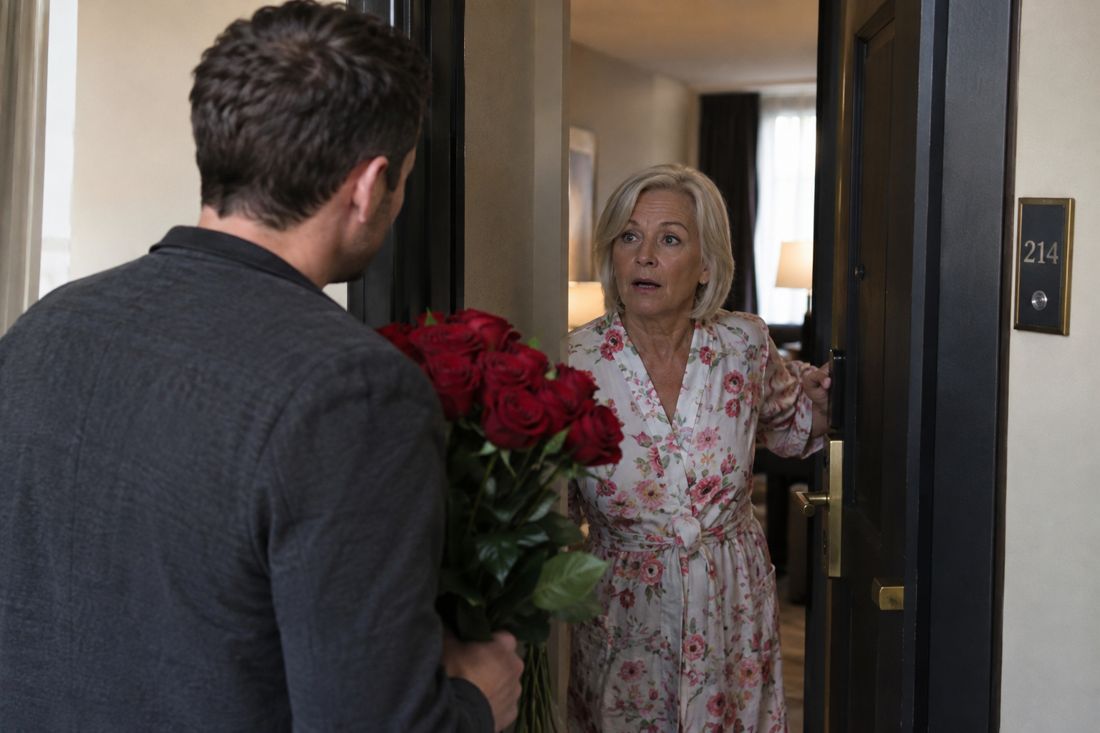
On the passenger seat lay a bouquet of two dozen blood-red roses, wrapped in thick black craft paper.
I had bought them an hour earlier at a flower shop downtown. I had written the card myself in thick black marker:
To Room 214:
Happy twelve-week anniversary.
Keep the room. Keep the change. You can keep her, too.
—Julian.
I slammed the truck into drive and headed out toward Route 9.
A steady October rain began to fall, turning the highway into a slick black ribbon of reflected taillights. The Pine Crest Motor Lodge sat two miles past the county line, sandwiched between an abandoned diner and a dark wall of dripping pines.
It was a decaying, two-story motel with peeled turquoise paint and an amber neon sign buzzing violently in the wet air: P I N E C R S T M T E L.
I rolled into the gravel lot with my headlights off, tucking the truck beneath an overgrown maple near the edge of the woods.
And there it was.
Parked directly beneath the exterior stairs was Natalie's silver Honda Civic. Rain steamed off its warm hood.
My vision went red.
Five years of love. Five years of working until my knuckles bled to give her a life. The IVF treatments, the late-night talks, the promises.
All of it, thrown away in a cheap highway motel.
"You coward," I whispered to the empty truck, my voice breaking.
I grabbed the roses. The thorns punched straight through the black paper, drawing blood on my palm. I barely felt it. I kicked open the door and stepped into the rain.
Water soaked through my jacket as I strode across the gravel. I skipped the front office; I didn't care about a key. I wanted to catch them red-handed. I wanted to see the sheer terror in their eyes when the door blew open.
I took the rusted metal stairs two at a time. The iron treads groaned under my work boots.
Second floor. Room 210... 212...
Room 214.
A warm, yellow glow seeped through the drawn curtains.
I pressed my ear against the damp, chipped wood of the door.
Inside, I didn't hear clinking glasses or heavy breathing.
I heard the scratchy, faint sound of an old transistor radio playing 1950s jazz—Glenn Miller's "Moonlight Serenade."
And then, a voice.
A soft, patient woman's voice: "...just lean forward a little, sweetheart. I've got the warm compress. The swelling looks so much better this week, doesn't it?"
And then, another voice replied.
A voice so frail, so thin and cracked, it sounded like dried leaves blowing across concrete.
"You're an angel, child," the voice wheezed, followed by a dry cough. "Julian would... Julian would love this soup. Did you put the fresh dill in like I showed you?"
My breath caught in my throat.
The corridor seemed to spin.
That voice.
I knew that voice better than my own name. It was etched into the marrow of my bones.
It was my mother.
The bouquet of roses felt like lead in my hands.
My mind shattered into total chaos. The jealousy, the fury, the three months of sleepless torment vanished in an instant, replaced by cold, breathless terror.
Mom?
Mom was supposed to be in a closed-door psychiatric sanitarium ninety miles away. Kendra had the medical charts. Kendra collected my checks. Kendra swore Mom was violent and deranged.
What was she doing in Room 214 of a roadside motel?
My fist struck the wooden door before I could even think.
BANG. BANG. BANG.
The music inside cut off instantly.
A heavy, terrified silence fell over the room.
"Who is it?" Natalie's voice called out, sharp and trembling. "Maria, is that you? Did you forget your clinic keys?"
I couldn't breathe. I hammered the wood again.
"Natalie," I croaked. "Open the door. Open the damn door."
A loud gasp came from inside. Hurried footsteps scrambled across the floor. The safety chain rattled, the deadbolt snapped open, and the door swung wide.
Natalie stood in the doorway.
She wasn't wearing lingerie. She was wearing an oversized gray sweatshirt stained with bleach, faded blue scrub pants, and yellow rubber kitchen gloves. Her hair was jammed into a messy bun held by a pencil. Her face was gray with exhaustion, her eyes rimmed in red.
In her hands, she held a plastic washbasin filled with steaming suds that smelled of medical disinfectant and epsom salts.
She stared at me. Her gaze dropped to the two dozen red roses in my hand, and then to the card taped to the black paper: Happy twelve-week anniversary. Keep the change.
Natalie's face went completely bloodless.
"Julian..." she breathed, her voice cracking. "Oh God... Jules..."
From the back of the room, a raspy voice drifted forward.
"Natalie? Who is that, sweetheart? Is it the clinic driver? Tell him my ankles are much better today..."
I shoved past Natalie into the room.
The bouquet slipped from my fingers. It hit the stained carpet with a soft thud, the black paper tearing open, blood-red petals scattering across the floor.
The room was lit by a single bedside lamp.
Sitting in a faux-leather armchair by the window was an elderly woman.
She wore a faded yellow knit cardigan three sizes too large for her tiny frame. Her silver hair was cropped short and uneven. Her feet were propped on a small footstool, wrapped in thick white surgical bandages.
On the nightstand beside her was a thermos of broth, a stack of crossword books, and a small, worn photograph.
It was a picture of me at nine years old, holding up a birdhouse I built in Dad's shop, with my mother standing behind me, laughing in the summer sun.
The woman in the chair turned her head.
Her pale blue eyes widened. She blinked, her lower lip trembling.
"Julian?" she whispered.
Her frail, spotted hands began to shake against the armrests. A single, heavy tear spilled over her wrinkled cheek.
"Julian? My... my boy?"
A sound ripped out of my chest—a broken, ragged sob.
My knees gave out. I crashed onto the carpet at the foot of her chair. I buried my face in the coarse wool of her yellow sweater, wrapping my arms around her tiny, fragile frame.
"Mom," I wept, clutching her so tightly I feared she might turn to dust. "Mom, it's me. It's Jules. I'm here. I'm right here."
Her frail fingers tangled into my hair. She pressed her face against my neck, her tears hot against my skin.
"They told me you died, Jules," she cried softly into my collar. "Kendra told me you died in a car wreck three years ago... She told me that's why you never came to visit..."
I froze.
Every drop of warmth left my body.
I pulled back slowly, staring into my mother's face. Her eyes were clear. There was no dementia. There was no violent delusion. There was only an elderly mother who had spent three years grieving a son she thought was dead.
"What did you say?" I asked, my voice barely audible.
"Julian, please," Natalie whispered behind me.
I turned around.
Natalie stood by the door, tears streaming down her face.
Sitting at the small laminate desk in the corner was a woman in teal hospital scrubs. Beside her stood a tall, broad-shouldered man in a dark suit with a laminated badge clipped to his pocket: Adult Protective Services - Office of the Attorney General.
"Natalie," I choked out, rising to my feet. "What is this? What is happening?"
Natalie wiped her eyes, taking a ragged breath.
"Three months ago, Jules," she said, her voice shaking. "A dispatch manifest crossed my computer at work. It was an emergency transit request for an indigent patient at an unlicensed boarding home outside the county line. The name on the manifest was Eleanor Vance."
She looked at my mother, her chin quivering.
"I thought it was a mistake. Kendra told everyone Eleanor was in a private sanitarium. But I checked the social security number. It was your mom, Jules."
She stepped closer, taking my cold hands in hers.
"Kendra never put her in The Willows," Natalie said, her voice thick with anger. "The Willows costs six thousand dollars a month. Kendra didn't want to spend Dad's life insurance. She didn't want to spend the money from the house. And she didn't want to lose your nine hundred and fifty dollars a month."
The room seemed to sway around me. "Where was she?"
The man in the suit stepped forward, opening a thick leather briefcase.
"Mr. Vance, I'm Investigator Miller with the State Elder Fraud Task Force," he said quietly. "For the past ten weeks, your wife and I have been building a criminal indictment against your sister, Kendra Holloway."
Miller pulled out a stack of documents and color photographs, setting them on the bed.
"Three years ago, your sister used fraudulent medical affidavits to secure emergency guardianship over your mother," Miller said. "She sold your parents' house, pocketed four hundred and fifty thousand dollars in life insurance, and dumped your mother into an illegal, unlicensed boarding house called Shady Pines—a squalid cash-mill operating out of a converted warehouse."
Miller showed me a photograph. It depicted a dark, windowless room with exposed concrete and a rusted cot.
"Your sister told the operators Eleanor was an abandoned indigent with no family," Miller continued. "She paid them six hundred dollars a month to keep your mother heavily sedated so she wouldn't try to leave or ask questions. Meanwhile, Kendra pocketed Eleanor's pension, your father's union benefits, and the monthly payments she extorted from you."
I felt nauseous. "She kept my mother locked in a warehouse?"
"When Natalie found her three months ago, your mother had lost thirty-five pounds," the nurse, Maria, spoke up gently. "She had stage-three diabetic ulcers on both feet from untreated neuropathy. If Natalie hadn't intervened, your mother would have lost both legs to gangrene within weeks."
"Why didn't you tell me, Natalie?!" I yelled, the agony tearing out of my throat. "Why didn't you tell me three months ago?! I would have torn that place apart!"
"Because Kendra had a legal restraining order against you, Julian!" Natalie yelled back, stepping straight toward me, her eyes flashing through her tears. "Kendra had legal guardianship! The moment she got that order, she filed a preemptive court injunction naming you as a danger to your mother! If you had stormed that place—if you had gone after Kendra like I knew you would—she would have had you arrested for felony interference! You would be in a county jail cell right now, Julian, and Kendra would have moved Eleanor to another state where we would never find her!"
Natalie gripped my arms, her fingers digging through my jacket.
"I had to protect you, Jules! And I had to get your mother out of there legally!"
The truth crashed down on me with crushing force.
"Why Tuesdays?" I asked, my voice cracking. "Why this motel?"
Natalie let out a shaky breath, releasing her grip.
"Because the only hospital in the county with an advanced hyperbaric wound clinic that accepts indigent vouchers is Saint Jude's Metro, right down the road," she explained softly. "The clinic only runs the advanced diabetic program on Wednesday mornings at seven AM."
She gestured toward the small bathroom.
"The boarding home refused to transport her. So every Tuesday evening, I used my transit credentials to check Eleanor out under a medical waiver. I brought her to Room 214. It was the only motel with an accessible ground-floor ramp that allowed direct card payments without corporate paperwork."
Natalie glanced down at the floor.
"I withdrew two hundred dollars in cash every Tuesday to pay Maria for four hours of sterile wound debridement and bandaging. We washed your mom's hair. We treated her feet. We fed her real meals. And while Maria treated her, Investigator Miller gathered evidence, recorded your mother's testimony, and subpoenaed the bank records Kendra thought she had hidden."
Natalie looked at the crushed red roses on the carpet.
"I wanted to tell you every single night, Julian. God, you have no idea how hard it was to watch you look at me with doubt in your eyes. But Investigator Miller warned me that if Kendra suspected anything, she had offshore accounts ready to liquidate. We had to wait for the emergency seizure order."
Investigator Miller snapped his briefcase shut.
"Judge Alvarez signed the warrants at four o'clock this afternoon, Mr. Vance," Miller said, a hard edge in his voice. "Kendra Holloway's guardianship has been terminated by emergency court order. Full conservatorship of Eleanor Vance has been granted to you and your wife. And there is an active bench warrant for your sister's arrest on seven felony counts, including aggravated elder abuse, grand larceny, and perjury."
Miller checked his watch.
"Tomorrow morning at ten AM, your sister believes she is meeting her broker at the First National Bank downtown to finalize the sale of your parents' remaining parcel of land. Two state troopers and I will be waiting inside the conference room."
A profound, suffocating silence settled over Room 214.
I stared at the black florist's paper on the carpet. I stared at the card I had written: You can keep her, too.
A wave of humiliation and shame crashed over me so violently I felt dizzy.
While I was drowning in suspicion—while I was stalking my wife in a borrowed truck, imagining sleazy betrayals and dreaming up ways to hurt her—this woman had been fighting a quiet, desperate war to save my family. She had spent twelve weeks scrubbing infected wounds, hauling washbasins, risking her job, and carrying the crushing weight of this secret alone, all to bring my mother back to life.
I turned to Natalie.
She stood with her head down, her hands clasping her elbows, bracing herself for my reaction.
I crossed the room in two strides.
I pulled her against my chest and held her so tightly the air left her lungs.
I buried my face in the crook of her neck, smelling the sharp hospital soap, the lavender lotion, and the rain. I broke down completely, sobbing against her shoulder like a lost child.
"I'm sorry," I choked out, my voice muffled in her sweatshirt. "Natalie... God, Nat, I'm so sorry. I was so stupid. I was so blind."
Her arms wrapped around my neck, holding me fiercely.
"You don't have to apologize for hurting, Jules," she murmured, kissing my temple as her own tears fell. "You were in pain, and I couldn't tell you the truth yet. But it's over now. She's safe. We brought her home."
From the armchair, my mother let out a weak, tearful chuckle.
"Julian," Mom called softly. "Let that sweet girl breathe and come over here. She made chicken broth with fresh dill, just the way you like it."
The next morning was cold, clear, and bright.
At 9:45 AM, Natalie and I stood across the street from the First National Bank in downtown Oakridge.
A gleaming white Mercedes SUV pulled into the bank's reserved parking space.
Kendra stepped out.
She looked flawless—camel-hair coat, black sunglasses, four-inch designer heels, and a leather briefcase tucked under her arm. Her husband Brad climbed out of the passenger side, straightening his silk tie.
They laughed together as they walked toward the revolving glass doors.
They never stepped inside.
As Kendra reached for the door, Investigator Miller stepped out from the vestibule, flanked by two uniformed State Troopers.
"Kendra Holloway?" Miller called out.
Kendra stopped, lowering her sunglasses with a scowl. "Excuse me? I have an executive appointment."
"You have an appointment with the county jail, ma'am," Miller replied, unfolding the warrant. "You are under arrest for felony elder abuse, financial exploitation, and grand theft."
The color left Kendra's face in an instant.
"This is absurd!" she shrieked, taking a step back. "Brad, call our lawyers! I am my mother's legal guardian! I have the court documents!"
"Your guardianship was terminated yesterday afternoon," Miller said calmly. "And deputies are executing a search warrant on your residence right now."
One of the troopers grabbed Kendra's wrists, turning her around and pressing her against the cold stone pillar of the bank.
Click-clack.
The steel handcuffs snapped shut.
"Get your hands off me!" Kendra screamed, her voice echoing down the street as passersby stopped to watch. "Julian did this! That pathetic little loser! Brad, do something!"
Brad took two steps backward, holding his hands up. "I... I don't manage the family accounts, officer. That's her trust. I have nothing to do with this."
"Brad! You coward!" Kendra shrieked as the troopers guided her into the back of the patrol cruiser.
Before the door slammed, Kendra's frantic eyes locked onto mine across the street.
I stood beside Natalie, holding her hand.
I didn't yell. I didn't smile.
I just held her gaze until her expression crumbled into pure, helpless panic. Then the cruiser door slammed, the siren chirped, and the car pulled away into the traffic.
That afternoon, we checked Eleanor out of Room 214 of the Pine Crest Motor Lodge for the last time.
We didn't take her to a care facility. We brought her home.
The guest bedroom in our ranch house—the room we had kept closed for three years because it reminded me of everything we couldn't have—was filled with warm sunlight.
Natalie had spent weeks getting it ready: a new orthopedic bed, soft fleece blankets, a record player on the dresser, and Dad's entire jazz vinyl collection neatly stacked in a crate.
When Mom walked into the room, leaning on a walker, she stopped and stared at the hallway wall.
Framed photographs covered the wood paneling: Mom and Dad on their wedding day, Mom holding me as a baby, Mom laughing in the garden.
She reached out a trembling finger, touching Dad's smiling face in the glass.
"I thought I would never see these again," she whispered.
"You're home, Mom," I said, kissing her cheek. "You're never leaving."
Later that evening, after the nurse had checked Mom's dressings and tucked her into bed, Natalie and I sat together on the front porch swing.
The autumn air was crisp, carrying the scent of fallen leaves and woodsmoke.
On the glass table beside us was a vase filled with water. Inside were the two dozen red roses from Room 214. I had gathered every single petal from the motel carpet, trimming the stems and placing them in the center of our porch.
The black paper and the bitter card were gone, burned in the woodstove.
"I'm going to spend the rest of my life making this up to you," I said softly, pulling Natalie close.
She rested her head against my shoulder, watching the stars peek through the pine branches.
"You don't have to make anything up to me, Jules," she said, a faint, tired smile playing on her lips. "Just promise me one thing."
"Anything."
She looked up at me, her hazel eyes warm in the porch light.
"Next time you bring me two dozen roses... let's not do it in a roadside motel."
I laughed—a deep, easy laugh that washed away the last three months of darkness—and held her tight as the night settled in.


COMMENTS
Loading…