My Wife Found Her Mother in My Office—Then She Saw the Marks on Her Neck
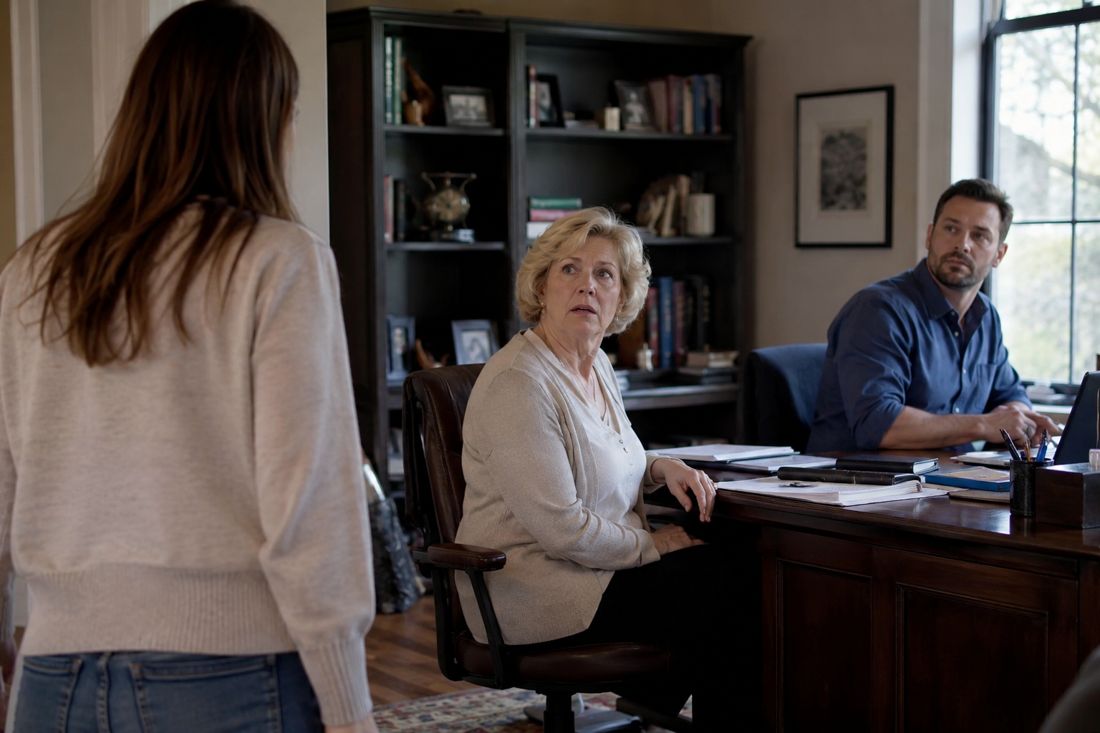
The heavy brass latch to my private suite clicked open at exactly seventeen minutes before midnight on a dreary, rain-soaked Thursday.
Rachel paused motionless in the entranceway, her breath catching.
Standing right beside my mahogany desk was her mother.
Blouse misaligned.
Hair falling in disarray.
Three vivid crimson discolorations trailing down the left curve of her throat.
My wife stood frozen, staring at those marks.
Then her eyes shifted to me.
Then right back to her mother.
“Mom…”
The word came out as an unsteady whisper.
“What on earth happened to you?”
Linda instantly brought a trembling hand up to shield her neck.
“NOTHING.”
Rachel turned slowly toward the leather executive chair where I was sitting.
Every trace of color had drained from her cheeks.
“Why are you here?”
On the surface, it sounded absurd.
It was my personal office.
Yet the darker accusation underneath was unmistakable.
Why was I sitting here—
alone behind closed doors—
in the dead of night—
with her mother looking thoroughly unraveled?
“We were only talking,” I offered.
Rachel's gaze pierced Linda.
“Looking like that?”
Linda’s posture stiffened into brittle defiance.
“DON'T START.”
Rachel stepped across the threshold.
She swung the thick mahogany door closed behind her.
CLICK.
Then her fingers slid the deadbolt firmly into place.
“Then explain those bruises.”
Neither Linda nor I made a sound.
Rachel's eyes locked onto me.
“Daniel?”
Complete silence.
Her stare whipped back to her mother.
“Mom?”
Linda let her hand fall away from her throat, inch by agonizing inch.
Still, the quiet remained unbroken.
Rachel exhaled a short, humorless laugh.
A fragile, stunned sound that caught in her throat before it could finish.
“Dear God.”
“Rachel—”
“Don't.”
Her hand came up, palm outward.
“No. Nobody takes a single step.”
I remained rooted behind my desk.
Linda stood paralyzed near the edge of the leather armchair.
Rachel's finger pointed straight at the exposed marks on Linda's skin.
“I am going to ask you this exactly one more time.”
Her voice shook with barely contained panic.
“What happened to my mother’s neck?”
Linda’s eyes flicked over to me.
It was the most disastrous instinct she could have followed.
Rachel caught that quick glance in a heartbeat.
Her whole body went rigid with dread.
In a breathless murmur, she demanded:
“Why are you looking at my husband before you give me an answer?”
And in that horrifying instant, I realized the secret Linda and I had guarded for the past six hours had mutated into something far more dangerous than the truth could ever have been.
My name is Daniel Reeves.
I was forty-four years old when that living nightmare played out.
Rachel was forty-one.
We had built seventeen years of marriage together.
Her mother, Linda Barrett, was sixty-three.
And before anyone jumps to conclusions about what kind of illicit affair had unfolded behind those walls, you must understand one unshakeable fact.
I loved my wife with every fiber of my being.
I had never once been intimate with Linda.
I had never touched her.
I had never kissed her.
I had never harbored even the slightest romantic inclination toward her.
Yet at 11:43 on that rainy Thursday, a cascade of terrible blunders on my part had handed Rachel every reason in the world to imagine the worst possible betrayal.
That distinction would matter later on.
In that room, it provided me zero protection.
I served as the chief executive of Reeves Development Group, a commercial real estate firm my father had founded thirty-two years earlier.
The title of CEO often sounds much more glamorous than the daily grind actually is.
The reality of my days was consumed by lease contracts, anxious lenders, design teams, city zoning approvals, delayed shipments, endless insurance battles, and department heads pleading for quick sign-offs on crises that had begun spiraling five minutes before landing on my desk.
Our corporate offices occupied the top two floors of a twelve-story commercial tower in downtown Nashville.
My corner office sat on the eleventh floor.
Expansive floor-to-ceiling glass looking out over the illuminated skyline.
A heavy walnut desk.
A glass-topped conference table.
An en-suite private washroom.
A comfortable seating alcove.
It was exactly the kind of secluded sanctuary that appeared damning beyond words whenever your wife walked in near midnight to discover her disheveled mother standing inside.
Rachel operated her own flourishing interior design firm.
Linda had lived on her own for twenty-six years.
Rachel's father, Stephen Barrett, had walked out on the family when Rachel was only fifteen years old.
He had remarried shortly afterward.
He moved south to Florida.
Over time, their connection had diminished into nothing more than polite holiday cards.
Linda had shouldered the entire burden of raising Rachel and her younger brother, Evan, almost completely on her own.
I had known Linda since I was twenty-five years old.
From our very first meeting, she had welcomed me with open arms.
At times, perhaps a bit too warmly by Rachel's standards.
Never in an inappropriate way.
Rather, I had simply stepped into the role of the dependable, handy son Linda had never anticipated having in her life.
Linda called me whenever the garbage disposal jammed.
Whenever complicated tax documents arrived in the mail.
Whenever the tracks on her garage door slipped out of alignment.
Whenever she suspected a home repair contractor was overcharging her.
Rachel would often tease me:
“You didn't just get me when you said those vows. You signed up for both of us.”
To which I always replied:
“Her maintenance costs are considerably more affordable than yours.”
Linda always laughed at that line.
Rachel would roll her eyes and pretend to be indignant.
For seventeen steady years, that had been the easy, comfortable cadence of our relationship.
Simple.
Grounded.
Family.
Until that Thursday.
Rachel took two deliberate steps onto the Persian rug.
“Lower your hand.”
Linda blinked at her, flustered.
“What?”
“Your throat.”
“Rachel, don't do this—”
“Take your hand away right now.”
Slowly, reluctantly, Linda allowed her fingers to drop.
The overhead spotlights hit her skin with unforgiving clarity.
Three distinct, purplish-red marks.
One rested just above the hollow of her collarbone.
Two clustered darker and deeper beneath the corner of her jaw.
Tears sprang to Rachel’s eyes almost immediately.
She spun around to confront me.
“Swear to me you didn't touch her.”
“I didn't.”
The denial left my mouth without a fraction of a second's doubt.
Rachel searched my eyes, looking for any trace of an evasion.
“Did you lay a hand on my mother?”
“Never.”
“Did you kiss her?”
“No.”
“Did she make an advance on you?”
“No, Rachel.”
“Then who did?”
A heavy, suffocating stillness descended over the suite.
There was the snare.
I possessed the answer.
Linda possessed the answer.
Rachel was completely in the dark.
And Linda had begged for my sacred silence only hours earlier.
Rachel’s gaze darted back and forth between us.
“Who did this to you, Mom?”
Linda reached for the leather handbag resting on the credenza.
“We need to discuss this in the morning when cooler heads prevail.”
Rachel moved swiftly, putting herself directly in front of the door.
“No.”
“Let me pass, Rachel.”
“I said no.”
“Please, be reasonable.”
“You walk into my husband's private executive office looking like you've survived a physical fight, and you have the nerve to paint me as the irrational one?”
“Nobody is saying that.”
“Then give me a straight answer!”
Linda’s eyes flickered in my direction once again.
Rachel caught that hesitation for the second time.
“Stop looking at him!”
Linda shrank back against the desk.
“I'm not doing that.”
“You just did!”
Rachel stabbed a finger through the air at me.
“Every single time I ask you a question, your eyes dart straight to Daniel.”
Her voice cracked with a wave of raw pain.
“Why?”
I could not bear watching it for another second.
“Because she made me promise not to tell you,” I blurted out.
Rachel whipped around toward me, completely blindsided.
“What?”
“Daniel, stop!” Linda cried, panic sharpening her voice.
I ignored her warning.
“She begged me not to say anything to you.”
Rachel stared at her mother with utter incomprehension.
“Tell me what?”
Linda snatched her wool trench coat from the back of the chair.
“I am walking out that door right now.”
Rachel stood her ground, using her entire body to block the handle.
“You aren't taking another step.”
“Get out of my way.”
“Tell me who left those bruises on your throat!”
Linda’s chin tilted upward, flushed with defensive fury.
“I am sixty-three years of age! I do not owe my grown daughter a detailed ledger of every intimate corner of my life!”
Rachel stood paralyzed.
The shock on her face gave way to devastating betrayal.
“Intimate?”
“Yes!”
“You dragged me right into the center of it the second I walked in and caught you behind locked doors with my husband!”
“That is not what was happening in here!”
“Then tell me what was!”
Linda locked her jaw and stayed silent.
Rachel turned back toward me, her eyes glistening.
“You tell me, Daniel.”
“I gave your mother my word.”
“I am your wife.”
“I know that, Rachel.”
“Then choose.”
That single syllable dropped into the silence like a guillotine.
Choose.
Wife.
Mother-in-law.
A confidence.
A marriage.
Discretion.
Vows.
All of them suddenly barreling into an unavoidable head-on collision.
The bitter reality was that I should have made that choice six hours earlier.
That was the precise moment where this disaster had been born.
Not at 11:43 that night.
At 5:18 that afternoon.
I had just stepped out of a lengthy development planning meeting when my phone began vibrating with Linda’s name on the display.
In seventeen years, she had almost never called my private cell during business hours.
I immediately swiped the screen.
“Hello, Linda? Is everything okay?”
Nothing came through the speaker except dead air.
“Linda? Are you there?”
Then came the sound of her breath.
Fast.
Shallow.
Shuddering.
“Daniel…”
A cold stone dropped straight into my gut.
“Where are you?”
“I need you to come get me.”
I stopped dead in the center of the hallway carpet.
“Where are you right now, Linda?”
She gave me the name of an upscale boutique hotel in the downtown district near Broadway.
It was not a property Reeves Development owned or had ever managed.
“What happened? Are you hurt?”
A sickening pause stretched across the line before she answered in a broken murmur:
“I don't know.”
That uncertainty frightened me far more than any clear medical emergency ever could have.
I told my executive assistant to push my remaining calls to tomorrow morning.
I took the elevator down to the garage and drove into the downtown traffic myself.
I dialed Linda’s cell twice while fighting through the evening rain and rush-hour congestion.
Both attempts went directly to voicemail.
When I finally pushed through the brass revolving doors of the hotel lobby, I found her tucked away in a shadowed alcove beside the restrooms.
Her hair looked like it had been through a windstorm.
The buttons on her silk blouse were fastened into the wrong holes.
Her mascara had run in dark streaks down both cheeks.
And her throat was already marked with the dark crimson discolorations that Rachel would witness hours later.
Dread hit me in a wave.
“Linda.”
She lifted her face, her eyes wild with distress.
Her first words hit me before I could even draw breath:
“Whatever you do, don't you dare call Rachel.”
I knelt down in front of her, keeping my voice as calm and soothing as I could.
“Are you in physical pain?”
“I don't know.”
“Did someone put their hands on you?”
She shook her head.
Then, an instant later, she nodded.
Then she buried her face in both hands and began shuddering with quiet, wrenching sobs.
I was completely out of my depth.
“Do you need an ambulance, Linda?”
“No.”
“Should I contact the police?”
“No, please, God no.”
“Linda, look at me.”
She slowly lifted her tear-streaked face.
“Are you in danger right this second?”
“No.”
“Who were you visiting up in those rooms?”
The question shattered whatever fragile restraint she had left, and she wept openly.
The man's name was Charles Bennett.
He was sixty-six years old.
A widower and a retired orthopedic surgeon.
Linda had crossed paths with him four months earlier during an opening gala at the downtown art museum.
I had never heard so much as a whisper of his name.
Neither had Rachel.
Linda had conducted the entire romance in absolute, impenetrable secrecy.
Not because Charles was married or living a double life with a family.
He was completely unattached.
Not because there was anything forbidden about two independent adults building a connection.
There wasn't.
She had hidden him away because her prior romance had devolved into an exhausting, suffocating civil war with her daughter.
Three years before this nightmare, Linda had briefly dated a man named Martin.
Rachel had disliked Martin from the very second she laid eyes on him.
And to give credit where credit was due, Rachel’s instincts had proven dead right.
Martin was patronizing, self-important, and smooth-talking.
He borrowed money from Linda that vanished into thin air.
He dropped cutting remarks about her house, her neighborhood, and her retirement savings.
Linda finally terminated the relationship.
Yet in the painful wake of that breakup, Rachel had appointed herself as her mother’s permanent security detail.
An overbearing, relentless sentinel.
Whenever Linda so much as mentioned having coffee with an acquaintance, Rachel launched an immediate deposition.
What is his full name?
How old is he?
How many times has he been divorced?
Are his grown children dependent on him?
What are his investments?
Have you run a background screening on him?
Linda felt like a delinquent teenager being monitored by a parole officer.
So when Charles Bennett entered her life, she resolved to keep the entire affair completely silent.
By Linda's account, Charles had appeared to be everything a woman could hope for.
Charming.
Attentive.
Cultured and refined.
They shared elegant dinners, attended the symphony, took quiet weekend drives, and enjoyed long brunches.
A perfectly dignified romance.
On Thursday afternoon, they arranged to rendezvous at the boutique hotel because Charles had reserved an executive suite ahead of a black-tie charity dinner downtown.
Linda had intended to get dressed in her evening gown right there in the room.
They had been intimate.
The crimson marks along her throat were the consensual byproduct of that private afternoon.
Linda was undeniably mortified by their visibility.
Yet she was unmistakably clear about how they had arrived on her skin.
The real terror had commenced only after the intimacy ended.
While Charles was in the bathroom rinsing off in the shower, his phone vibrated against the bedside nightstand.
A text preview flashed onto the screen.
It came from a woman's name.
Counting every minute until Saturday. The same suite?
Linda froze on the spot, the room spinning around her.
When Charles stepped back into the bedroom tying his robe, she confronted him with the illuminated display.
He attempted to laugh it off as an innocent flirtation.
When that fell flat, he shrugged casually and admitted there were two other women he saw on a regular schedule.
Not marriages, he argued.
Not formal commitments.
He claimed that everyone involved understood things were “relaxed, modern, and open.”
Linda had known nothing of the sort.
She had believed with all her heart that they were building an exclusive, monogamous life together.
The argument escalated into a fierce, ugly confrontation.
Charles sneered at her, dismissing her as hopelessly naive and emotionally childish.
Linda lashed back, calling him a deceitful manipulator and a coward.
When she swept her purse off the counter and made for the doorway, Charles stepped directly in front of the door, planting his feet and barring her exit.
That was when sheer panic set in.
He did not punch her.
He did not attempt any forced physical assault.
Yet when Linda tried to shove past his shoulder, he clamped down on her wrist with bruising force to hold her captive in the room.
Linda let out a piercing scream.
From the hallway outside, a hotel maid knocked sharply against the wood paneling.
Caught off guard, Charles instantly released his grip.
Linda tore through the opened door, sprinted down the hall, and fled down the stairwell in a state of blind terror.
That was the explanation for why she looked like a casualty of violence.
The discolorations on her throat belonged to consensual affection from earlier that afternoon.
Her ruined makeup, wild hair, and crooked clothes were the wreckage of the nightmare that had followed.
Two separate events.
To anyone looking from the outside, they blended seamlessly into one horrifying, unbroken scene.
They weren't connected at all.
“Why didn't you pick up the phone and dial Rachel?” I asked her.
Linda was sitting in the passenger seat of my car, her vacant gaze fixed on the rain streaming down the glass.
“Because she’ll tell me she told me so.”
“About Charles?”
“About men in general.”
“Rachel doesn't even know who Charles is, Linda.”
“She’ll make it all about Martin all over again.”
“Maybe she will, but—”
“I cannot survive an interrogation tonight, Daniel. I simply do not have the strength.”
I leaned over and looked down at her right arm.
A faint, purplish circle of finger bruises was already rising around the pale skin of her wrist.
“Linda, if a man traps you inside a hotel room and refuses to let you leave, that is criminal unlawful restraint.”
“I know.”
“Do you want to contact the police?”
“No.”
“Do you need a physician to examine you?”
“No.”
“Can I drive you back to your house?”
Her head jerked in fierce refusal.
“I can't go there.”
“Why not?”
“Charles knows where I live.”
That single sentence altered everything.
I suggested securing her a room at a different hotel across town.
She dissolved into a fresh wave of trembling panic.
No.
My house?
Out of the question.
Rachel was at home, and the entire confrontation would explode the moment Linda walked through our front entryway.
My corporate suite?
Completely private.
A manned security console in the ground-floor lobby.
Restricted elevator keycards.
A quiet, fortified shelter where she could rest, catch her breath, and figure out her next move in peace.
That was how my mother-in-law ended up sitting inside my corner office.
Not a tryst.
Not a scandalous liaison.
Merely a horrifying afternoon.
And a promise.
We pulled into the parking deck just after six that evening.
My executive assistant had left for the day.
The eleventh floor was dark, silent, and desolate.
I brought Linda a tall glass of cold water.
She retreated into my en-suite bathroom, washed the streaked mascara from her skin, and rebuttoned her silk blouse properly.
I placed an order with an Italian bistro down the block.
When the food arrived, she took two bites and pushed the container away.
For the next two hours, we sat across from one another talking in low voices.
Mostly about Charles and the crushing weight of his betrayal.
Then we drifted into talking about Martin.
Then about the quiet ache of loneliness.
About the cruelty of growing older alone.
And then she spoke a truth I had never fully grasped about her inner world.
She confessed how deeply she hated being treated as though crossing sixty had stripped away both her capacity for romantic passion and her basic adult judgment.
She looked across the walnut desk and murmured:
“Rachel sees me as Mom. She never sees me as an actual woman.”
I understood what she meant.
At least from an intellectual standpoint.
“Rachel loves you more than anything, Linda.”
“I know she does.”
“She’s going to be crushed that you felt the need to hide this from her.”
“I know that too.”
“And she will be ten times more furious if she stumbles onto it by accident.”
Linda met my eyes with fierce certainty.
“She won't find out.”
Fate possesses a cruel sense of irony.
Around eight-thirty, I pressed her again to dial Rachel.
“No,” she pleaded.
“Tomorrow, then?”
“Perhaps tomorrow.”
“Linda, please don't carry this alone.”
Tears welled in her eyes once more.
“I feel so utterly foolish, Daniel.”
“You aren't a fool simply because someone chose to deceive you.”
“I saw the warning signs, Daniel. I ignored them.”
“What kind of signs?”
“The quiet ones.”
Charles had always avoided introducing her to certain longtime friends of his.
He invariably kept his smartphone facedown whenever they sat together.
There were strange, unexplained blanks in his schedule.
Now and then he would vanish for an entire weekend with vague, evasive excuses.
Linda had cataloged every single inconsistency in the back of her mind.
Yet she had wanted the connection so badly that she rationalized them away.
I leaned forward and said:
“None of those things justifies what he did in that room today.”
“I know.”
“Then stop weaponizing his dishonesty to prove that you're stupid.”
A faint, tired smile touched her mouth.
“You sound like an expensive therapist.”
“Way more expensive than an hour on a couch.”
A gentle chuckle escaped her lips.
It was her first genuine laugh of the entire night.
At precisely nine o'clock, Charles began ringing her cell.
The phone vibrated across the surface of my desk.
Once.
Twice.
Three times in rapid succession.
Linda rejected every single incoming call.
Then the chime of text notifications began echoing through the quiet room.
Please allow me to explain.
You are blowing this completely out of proportion.
Nothing happened between us that you didn't consent to.
That last sentence made my stomach turn.
Because it deliberately blurred two entirely separate things.
The physical passion that occurred earlier had been completely mutual.
Trapping her in that suite and grabbing her arm was an act of aggression.
Linda spotted the insidious manipulation instantly.
Charles was already building a narrative that folded them together into one story.
I told her she could not delete a single word from that thread.
“Preserve every text,” I instructed her.
She listened to me.
Under the warm illumination of my desk lamp, she snapped clear photographs of the bruised impressions circling her wrist.
She noted the exact hour.
Using a yellow legal pad from my middle drawer, she documented every detail she could recall while the memory was still fresh.
Not because I knew whether she would pursue legal action.
Simply because memories blur, and evidence vanishes.
She deserved to make that decision later with every fact preserved.
By ten-fifteen, Linda finally consented to spend the night with her sister, Patricia.
Patricia lived roughly forty minutes away in the northern suburbs.
I offered to escort her to Patricia's front door myself.
Linda asked for five more minutes to wash her face one last time and collect herself.
We were standing near the office exit when my own phone chimed loudly on the desk.
Rachel.
I glanced down at her caller ID glowing brightly in the dark.
Linda grabbed my sleeve, her face draining of color as she whispered in terror:
“Don't tell her.”
I tapped the green icon.
“Hey, Rachel.”
“Where are you?” she asked.
“Still at the office.”
“Still? Daniel, it's past ten o'clock.”
“I know. It's been a long evening.”
“Is everything all right down there?”
I stared straight into Linda's pleading, desperate eyes.
And in that split second, I committed the most catastrophic error of the night.
“Just a work issue,” I said.
I lied to my wife.
Rachel’s voice hesitated over the line.
“You sound strange, Daniel.”
“I’m just exhausted.”
“When will you be home?”
“Shortly.”
“All right,” she said softly.
A beat.
“I love you.”
I closed my eyes as the bitter guilt washed over me.
“I love you too.”
The call disconnected.
Linda looked up at me with instant remorse.
“You shouldn't have lied to her.”
A humorless laugh nearly broke from my throat.
“You literally just begged me not to tell her!”
“I asked you to protect my secret. I never asked you to tell a lie.”
And she was entirely, painfully correct.
I had other choices available to me.
I could have said: I'm assisting someone through an urgent personal matter.
I could have said: A delicate situation came up with someone we know. Everyone is safe, and I will explain what I can when I walk through the door.
Instead, I reached for the quickest, laziest shortcut in the book.
Work.
A single syllable.
A convenient fiction.
And that cheap deception would end up exacting a far steeper price than Linda's secret ever had the right to claim.
At eleven-thirty, Linda was finally ready to leave.
We were retrieving her coat when the elevator bell dinged softly out in the eleventh-floor lobby.
Inside my heavy, sound-insulated office, neither of us heard the chime.
Rachel had made up her mind to drop by and surprise me.
Or to check up on me.
Whichever version fits your perspective.
She later confided that my tone on the phone had set off alarms in her intuition.
She had hopped into her car and driven downtown.
The night security officer recognized the CEO's wife on sight.
No one questioned Rachel Reeves heading upstairs.
She rode the elevator up to eleven.
Walked silently along the dim carpeted corridor.
Noticed the warm glow of light spilling under my door.
Turned the handle without a knock.
And stepped directly into the one sight no married woman should ever encounter.
Her mother.
Blouse disheveled.
Deep red marks exposed across her neck.
Standing beside her husband in the dead of night.
After he had looked her in the virtual eye on the phone and swore he was held up with work.
Which brings us right back to 11:43.
Rachel standing between us like an executioner delivering a sentence.
“Choose.”
I looked over at Linda.
Her head was moving in frantic, desperate denial.
Please don't.
I turned my eyes back toward my wife.
And made the choice I should have had the courage to make hours earlier.
“Your mother is seeing someone,” I stated flatly.
Linda squeezed her eyes shut, her posture slumping in complete defeat.
Rachel stared at me in disbelief, as if I had spoken in another language.
“What?”
“Daniel, please don't…” Linda whispered.
“I'm sorry, Linda,” I said gently, looking at her. “I cannot let my wife believe this horror for another second.”
Then I laid out the essential truth.
Not every private nuance.
Only what was necessary to clear the air.
Charles Bennett.
The four-month secret romance.
The hotel suite before the gala.
The text notification on his bedside table.
The row that followed.
Charles physically barring the doorway.
Her bruised wrist.
Her terrified call to my phone.
My picking her up from the lobby.
Sheltering her here in the office where she would be protected.
And that the marks along her throat were the consensual results of earlier passion with Charles, not a single touch from me.
Rachel remained completely motionless throughout the explanation.
When the room went quiet, she slowly pivoted toward her mother.
“Is that the truth?” she whispered.
Linda looked down at the carpet, her voice cracked and small.
“Yes.”
Rachel’s knees seemed to give out beneath her weight.
She sank heavily into the deep leather armchair.
For a long stretch of seconds, nobody uttered a sound.
And then Rachel began to weep.
Not merely out of relief.
It was an overwhelming collision of shock, betrayal, grief, and emotional exhaustion breaking through all at once.
“You’ve been seeing a man for four months?” Rachel managed through her tears.
Linda nodded in miserable silence.
“And you kept it hidden from me?”
“Yes.”
“Why, Mom? Why would you do that?”
Linda looked utterly drained, decades of weariness showing in her face.
“Because of this exact reaction, Rachel.”
“This reaction?!”
“Because you turn every detail into a relentless trial.”
Rachel stared at her, stunned.
“Mom, a man physically trapped you in a room today!”
“That happened today!” Linda’s voice suddenly surged with anger. “You have treated every single man I’ve mentioned as a predator for the last three years!”
“Because of Martin—”
“Charles is not Martin!”
“He literally held you against your will!”
“And I had no way of knowing he would do that!”
The walls seemed to reverberate with their fury.
Rachel pushed herself up from the chair, pacing agitatedly across the floor.
“So I’m to blame for this?”
“No, Rachel, that isn't what I said.”
“You hid an entire relationship from me because I’m the problem?”
“I kept it quiet because I wanted one piece of my adult life that wasn't dragged before a family committee!”
“I was trying to keep you safe!”
“Safe from being sixty-three years old?!”
“Safe from getting your heart broken!”
Linda let out a bitter, cutting laugh.
“And tell me, how well did that work out for me today?”
Rachel stopped in her tracks.
The raw pain in that sentence hit the room like a shockwave.
I stayed silent.
This was a long-standing fracture between mother and daughter.
Until Rachel turned her fiery eyes onto me.
“And you.”
Here it was.
“You looked me in the eye and lied.”
“Yes,” I answered without hesitating.
“You told me it was work.”
“Yes, I did.”
“You knew exactly how this scene would look if I showed up.”
“I had no idea you were coming downtown, Rachel.”
“That doesn't excuse it!”
“I know it doesn't.”
“You prioritized her secret over your vows to me!”
“Yes. I handled the situation terribly.”
Linda tried to step between us.
“Rachel, please. I begged him not to—”
“I don't care what you begged him!” Rachel shouted, her voice breaking against the glass windows as she pointed directly at my heart. “He is my husband!”
I offered no counterargument.
She was one hundred percent right.
“I could have protected your mother's dignity without lying to my wife,” I said softly.
Linda looked down at her shoes.
I kept my gaze fixed on Rachel.
“I made a coward’s choice, and I am deeply sorry.”
A fraction of the tension left Rachel’s shoulders.
Not nearly enough to heal the betrayal.
Yet it was an opening.
Then Rachel asked the question that peeled away all the anger and exposed the true wound underneath.
“Why didn't you call me when he blocked that door, Mom?”
Linda’s defensive armor collapsed on the spot.
All trace of defiance vanished from her expression.
Because beneath the secret dating, the marks, and the deceptions—
that was the real dagger.
When Linda was terrified and in danger—
she dialed me.
Not her own daughter.
“I couldn't bear for you to see me like this,” Linda whispered, barely audible.
Fresh tears slipped down Rachel’s cheeks.
“Like what?”
Linda gestured down at her wrinkled blouse, her bruised neck, her streaked face.
“Foolish.”
Rachel shook her head, her face contorting.
“Mom…”
“Humiliated. Pitiful.”
“Don't say that.”
“A sixty-three-year-old woman crying in a hotel corridor because I was naive enough to trust another man.”
Rachel crossed the floor, coming to a halt inches away from her.
“You really believe that's how I would look at you?”
Linda couldn't meet her daughter's eyes.
Rachel’s voice choked up.
“That hurts worse than finding out you hid him from me.”
Linda began sobbing softly, her trembling hand reaching out to touch Rachel’s arm.
“I couldn't face hearing you say ‘I told you so.’”
Rachel hesitated, brushing away tears with the cuff of her sleeve.
“I wouldn't have said that to you, Mom.”
Linda looked up through wet lashes.
Rachel paused.
Then honesty forced a correction.
“All right… I might have thought it for two seconds. But I swear I wouldn't have said it out loud.”
In spite of the heavy grief, a choked, watery laugh broke from Linda’s mouth.
Rachel let out a small, wet chuckle of her own.
And then they folded into each other’s arms, holding on tight in the quiet of the empty office.
I assumed the crisis had reached its resolution.
It hadn't.
Because after Linda departed with Rachel that evening, my wife did not ride home in my car.
She accompanied her mother to Patricia’s house in the northern suburbs.
I made the drive back alone to a pitch-black, silent home.
And at 1:37 in the morning, my phone lit up with a text from Rachel:
I believe your explanation about Mom. I am still furious that you lied to me.
That distinction went to the very bone.
I managed perhaps two hours of restless sleep.
On Friday morning, the front door clicked open and Rachel returned home.
Both of our children were away attending college by then, leaving the house completely silent.
She walked into the sunlit kitchen just as the coffee maker finished its cycle.
Neither of us pointed out how clichéd the moment felt—the archetype of every heavy marital reckoning.
She sat down on one of the wooden barstools at the island.
I poured a steaming dark mug and set it down before her.
“Thank you,” she murmured.
Then came the interrogation:
“Did you lay hands on her?”
My body went rigid.
“I gave you that answer last night, Rachel.”
“I need to hear it again in the morning light.”
“Never.”
“Not in any romantic or sexual way?”
“Never in my life.”
“No kissing?”
“None.”
“Nothing at all?”
“I put an arm around her shoulders while she was sobbing in my office.”
Rachel nodded slowly, processing the response.
“All right.”
A pause.
“Did she take her clothes off in your office?”
“No.”
“Did she use your en-suite bathroom?”
“Only to wash her face with cold water and fasten her blouse.”
“Were you inside that bathroom with her?”
“No. I stood in the corridor outside with the door shut.”
“Why was her hair in such complete disarray?”
“She had spent hours crying, holding her head, and trembling.”
Rachel stared down into the dark surface of her coffee.
I let her ask every single thing on her mind.
Some of those inquiries stung.
Some felt deeply insulting after seventeen years of unfaltering fidelity.
Yet I understood her mindset completely.
The eyes are powerful witnesses.
She had walked into an arrangement of details that told an unmistakable, heartbreaking tale.
Now her mind had to dismantle that narrative and reconstruct the actual truth piece by piece.
That process requires immense patience.
It takes time to settle.
Eventually, she looked up, her dark eyes hollowed by exhaustion.
“Why couldn't you simply tell me that someone was in trouble?”
“I should have.”
“You could have safeguarded Mom’s dignity.”
“Yes.”
“Without resorting to a blatant lie.”
“Yes.”
“Then why didn't you do that, Daniel?”
I forced myself to offer an unvarnished answer.
“Because saying 'work' was easy. It demanded zero follow-up questions.”
Rachel gave a slow, somber nod, a chill running through her words.
“That is the part that terrifies me.”
I knew exactly what she meant.
The falsehood hadn't been complex.
It had been convenient.
Convenient deceptions are the most damaging to a marriage because they expose how readily integrity can be surrendered the moment an uncomfortable truth requires effort.
“I am truly sorry, Rachel.”
“I know.”
“I won't try to justify it.”
“Good.”
She pushed herself up from the stool.
She paused before walking out.
“I’m heading back to Patricia’s to stay with Mom.”
“All right.”
“Charles is still blowing up her phone.”
“Has she blocked his contact?”
“Not yet.”
“Why not?”
“Her lawyer instructed her to archive every single message he sends.”
Smart counsel.
Linda ultimately chose to consult an attorney and file a formal police report regarding Charles trapping her in that suite against her will.
The real-world resolution lacked the theatrical drama of television.
Written affidavits.
Electronic keycard timestamps from the hotel locks.
Interviews with hotel staff.
Carefully exported text logs.
Specific questions detailing the physical timeline.
The floor housekeeper distinctly verified hearing heated shouts behind the suite door and seeing a terrified woman fleeing toward the stairs.
There was no drawn-out courtroom spectacle.
The essential victory for Linda was drawing a legal line in the sand and memorializing the truth on paper.
She permanently severed every channel of communication with Charles Bennett.
Charles managed to send one final message before the legal notice shut him down completely:
You are ruining my standing in this community over what was nothing more than an innocent misunderstanding.
Linda showed the display to Rachel.
Rachel’s blood boiled with rage.
Linda remained calm.
She tapped out a single line in return:
“My standing mattered to me as well.”
Then she switched off her screen.
I still carry the quiet dignity of that sentence in my mind.
A few weeks later, Rachel offered her mother an apology.
Not for caring about her well-being.
For permitting concern to morph into surveillance and control.
“I realize now that ever since Martin, I treated you as though you were incapable of managing your own life,” Rachel confessed.
Linda gave a gentle nod of agreement.
“You did.”
“I was so frightened by how close you came to ruin with him.”
“I know, darling.”
“I convinced myself that if I vetted every person who crossed your path, nothing could ever hurt you.”
Linda offered a bittersweet smile.
“You cannot background-check a human being into never breaking your heart.”
A profound truth.
Linda offered her own apology in return.
“I punished you for caring clumsily.”
Rachel knit her brows.
“What does that mean?”
“I grew so resentful of your hovering that I denied you the opportunity to care for me with grace.”
That was equally true.
The rhythm between them shifted after that painful conversation.
Not through a sudden miracle.
Yet in a very real, lasting way.
My relationship with my wife underwent its own transformation.
For many months following that night, whenever business demanded late hours at the office, I walked Rachel through the exact specifics.
Not because she was holding me to an audit.
Because I had gained a deep respect for how dangerous ambiguity can be.
Privacy is a valid human need.
Safeguarding an intimate confidence can be honorable under specific boundaries.
Manufacturing a lie is an entirely different beast.
When another person confides in you, your marriage does not give your partner an automatic entitlement to every private detail.
Yet that boundary never gives you license to invent an imaginary world.
I could easily have said:
I am helping someone through a private, difficult crisis. I cannot discuss the details, but everyone is safe.
Rachel might have been frustrated by the wall.
Yet the statement would have been honest.
Instead, I chose:
Work.
And that single word made me an active accomplice in the betrayal.
Three months later, Linda came over to our house for Sunday supper.
It was our very first family dinner since that chaotic Thursday night.
She walked in the front door sporting a thick, cream-colored knit turtleneck sweater.
Rachel clocked the wardrobe choice in half a second.
“Seriously, Mom?”
Linda looked down at herself, utterly confused.
“What's wrong?”
“The turtleneck.”
The realization hit Linda all at once.
“Oh, good lord in heaven.”
I couldn't hold it in; a roar of laughter erupted from where I stood at the kitchen stove.
Rachel dissolved into giggles right beside her.
Linda glared between the two of us, attempting to look scandalized.
“You two are thoroughly awful!”
With that laughter, the remaining poison finally evaporated from our home.
Later in the evening, while Rachel ran upstairs to answer a client call, Linda helped me rinse plates and pack the dishwasher.
She paused, drying her hands on a linen dish towel.
“Daniel, I never offered you a proper apology.”
“For what, Linda?”
“For placing you right in the line of fire.”
“You were terrified out of your mind that evening.”
“I was still entirely wrong to burden you with a confidence that had no right being kept.”
I gave an honest nod.
“That part is true.”
She looked at me with soft, genuine gratitude.
“You stood up for me.”
“Very poorly.”
A warm, affectionate grin curved her lips.
“You did your best.”
I gave her a knowing smile in return.
“Next time life hits you hard, call your daughter.”
Linda chuckled.
“Believe me, there is never going to be a next time.”
“You know that isn't the point.”
Her laughter melted away into solemn understanding.
“I know,” she whispered softly.
A year drifted by.
Linda eventually felt brave enough to venture back into the dating world.
This time, she gave Rachel a full report after their third date.
The gentleman’s name was Robert.
A retired high school principal and a widower of seven years.
Rachel immediately fired off an opening barrage of twenty questions.
Linda patiently answered the first six.
Then she set her porcelain teacup gently into its saucer:
“The family oversight committee is hereby adjourned, sweetheart.”
Rachel burst into laughter.
Progress.
Robert turned out to be a tremendous blessing in her life.
Not a mythological hero.
Just an honest, steady, considerate companion.
He spent his weekends covered in compost tending the garden; Linda refused to touch potting soil.
He provided continuous commentary during films; Linda threatened to buy him a solo ticket in an adjacent auditorium.
They took trips together.
They had disagreements.
They made up.
They built an unpretentious, deeply comfortable companionship.
Five years after meeting, they exchanged vows in a beautiful backyard gathering.
I had the distinct privilege of escorting Linda down the aisle, as her father had passed away long before and Evan was officiating the service.
Just before we took our first step toward the arbor, Linda leaned close to my ear:
“Is my blouse sitting straight?”
I stopped and looked at her in pure astonishment.
She realized what had slipped out of her mouth.
“Oh, hush up!”
I began laughing so uncontrollably that the wedding photographer lowered his camera, baffled.
“Inside family joke!” I called out to the guests.
That was all anyone needed to know.
Rachel watched from the front row by the floral arch.
When Linda and Robert kissed to seal their vows, Rachel wiped away tears of joy.
Later, while everyone was enjoying champagne at the reception, she took my fingers in hers.
“I was so close to convincing my mother that love was too dangerous to ever seek again.”
“You were only trying to shield her from pain, Rachel.”
“I know.”
“Look at her. She is genuinely happy.”
“I know.”
Rachel looked up into my face, her eyes shining with tender affection.
“And that horrible night in your suite… I came within an inch of convincing myself that you…”
Her words faltered, caught in her throat.
“Rachel, you had every reason under the sun to suspect it.”
“I despised myself for even letting that horror cross my mind.”
“Don't do that to yourself,” I told her firmly. “You reacted to what you witnessed.”
That realization became another foundational lesson for our marriage.
Trust does not mean blinding yourself to obvious, screaming evidence out of sentimentality.
Rachel walked into a scene that looked utterly scandalous.
She demanded straight answers.
She was right to do so.
The true disaster would have been handing down a permanent verdict before allowing the facts to speak.
She didn't make that mistake.
Not when the dust finally settled.
The years marched forward.
Reeves Development Group continued to thrive and expand across the region.
When I turned fifty-eight, I decided to sell my controlling interest in the corporation and retire.
My panoramic corner office ceased to be a fixture of my everyday life.
On my final afternoon as CEO, Rachel accompanied me downtown to pack the last of my personal belongings.
The walnut desk was cleared bare.
The family photographs were secured in cardboard boxes.
My old drafting rulers were rolled and wrapped.
Rachel pushed the heavy office door open.
She froze right on the threshold, dramatically clutching her chest.
“Dear sweet heavens!”
I glanced up from an open carton.
“What is it?”
She pointed a finger at the empty armchair.
“Where on earth is my mother?”
I stared at her blankly for two seconds.
Then I let out a hearty laugh.
“Too soon, Rachel!”
“Daniel, it has been fourteen full years!”
“Still too soon!”
She strolled into the room with a wide, mischievous grin.
“Have you checked your private washroom?”
“Rachel!”
She chuckled softly.
Her laughter gradually softened into quiet, tender nostalgia.
She walked across the carpet and stood on the very spot where Linda had stood that rainy Thursday.
“Right here, wasn't it?”
“Almost down to the inch,” I confirmed.
She rested her hand against the leather back of the chair.
“I remember believing my entire reality had shattered into a thousand pieces.”
“I felt the exact same way.”
“Were you afraid I was going to physically attack you?”
“No.”
“You probably should have been.”
I smiled faintly.
“You threw the deadbolt.”
“I wasn't about to let either of you escape without answering me.”
“I remember.”
She turned her gaze toward the city skyline framed in the glass.
Then she asked:
“Do you know what cut the deepest that night, Daniel?”
“The lie about work.”
“No,” she murmured softly.
I waited for her to go on.
“The glance between you two.”
The truth landed immediately.
Every time Rachel had demanded an answer from her mother, Linda's eyes had instinctively sought mine.
To my wife, that unspoken exchange appeared intimate.
Conspiratorial.
Guilty.
In reality, Linda was silently pleading: Are you going to protect my secret?
Yet Rachel had no way of deciphering that code.
“I felt like the two of you possessed a private world that locked me on the outside,” Rachel admitted.
“We did,” I confessed honestly.
She looked at me.
“We held a secret together,” I explained. “Just not the one your heart feared.”
She nodded slowly.
“That was what broke me.”
Yes.
Secrets forge an invisible alliance between people, even when there isn't a single spark of romantic attraction.
For six hours, Linda and I held information that was kept hidden from Rachel.
That barrier erected a temporary wall between my wife and me.
An innocent wall in its origin.
Yet entirely real.
And because Rachel loved us both fiercely, being shut out in the cold was agonizing.
I developed a deep reverence for that reality.
There will always be occasions when you possess knowledge your spouse does not.
Professional confidentiality.
A close friend's private agony.
A relative's quiet shame.
Marriage does not obliterate the sacred privacy of other people.
Yet you must establish unshakeable rules for how you carry those trusts.
Never construct a manufactured world.
Never cause your partner to doubt their own eyes.
Never pull them unwittingly into a fiction.
When Rachel and I marked our thirty-fifth wedding anniversary, we spent a quiet week in Charleston.
Linda and Robert drove down to join us for a celebratory dinner at an intimate restaurant.
Over after-dinner coffee and dessert, Robert began recounting the early days of courting Linda.
He chuckled warmly, remembering that on their second date, he had leaned across the car console to kiss her.
Linda had immediately pressed a firm index finger flat against his collarbone:
“Anywhere but the neck, mister.”
Robert had zero context for the rule.
Rachel nearly choked on her Cabernet, coughing violently into her cloth napkin.
I dropped my forehead into my palms, fighting to keep my composure.
Linda tossed her napkin onto her dessert plate, her cheeks glowing crimson.
“I knew I should never have breathed a word of that to you, Robert!”
Robert looked back and forth around the table, utterly bewildered.
“What on earth did I say?”
Rachel took a ragged breath and waved him off with a grin.
“Nothing, Robert. Just enjoy your cheesecake.”
We all collapsed into helpless, table-shaking laughter.
Robert shook his head with an amused smile.
“This family is peculiar beyond description.”
He wasn't mistaken in the least.
Linda eventually shared the entire backstory with Robert years later.
Not the sensationalized version.
Just the plain facts.
Robert chuckled for about five seconds before realizing that the rest of us had grown solemn.
“My apologies,” he murmured, clearing his throat.
Linda offered a gentle smile and squeezed his fingers.
“It's all right to laugh now, Robert.”
That is another gift that time delivers.
Not to every scar.
Yet to many.
It can drain away the terror while keeping the wisdom intact.
Robert passed away without warning when Linda was seventy-nine years old.
A massive heart failure while tending to his hydrangeas.
Linda was shattered.
In the long, hollow months following the funeral, Rachel spent nearly every afternoon sitting with her mother.
No grilling.
No managing.
No treating her like a fragile dependent.
Just quiet, steady presence.
One afternoon while sitting on the porch, Linda told me:
“She finally figured out how to love me without managing my life.”
I smiled softly.
“She had a wonderful teacher.”
Linda arched an eyebrow with playful suspicion.
“Are you implying that I’m overbearing, Daniel?”
“I have a strong desire to stay alive, so absolutely not.”
A gentle chuckle escaped her lips.
Linda lived seven more peaceful years.
She passed away quietly in her sleep at the age of eighty-six.
After the funeral, Rachel and Evan spent days sifting through her home.
Cardboard boxes.
Sepia photographs.
Handwritten correspondence.
Old tax receipts.
The quiet, beautiful archaeological trail left behind by a long life.
Tucked into the back of her vanity drawer, Rachel uncovered a sealed envelope with Linda’s familiar handwriting:
FOR DANIEL
Rachel brought the envelope back to our kitchen table.
“Do you know what this could be?”
“Not a clue,” I replied.
We broke the seal together.
Inside rested a brief letter Linda had penned years earlier, shortly after losing Robert:
Dear Daniel,
There were two nights across my long life when I thanked God that you were part of our family. One was that terrible evening when Robert slipped away. The other was the night you came to collect me from that hotel lobby when I was too paralyzed by shame to reach out to my own child.
You made serious errors that night. So did I. But you never once made me feel unclean, foolish, or elderly. You treated me like a human being who had stumbled into a painful disaster and still retained her basic dignity. I never forgot that grace.
I pray Rachel eventually forgave you for telling her it was work.
She truly should have. That lie was mostly born from my cowardice anyway.
With all my love,
Linda
Rachel read those words twice over, silent tears leaving clean tracks through her powder.
Then she placed the stationary gently into my hands.
“She was still trying to shield you from the blame,” Rachel murmured.
“Yes,” I answered quietly.
“Just so we are clear, you concocted that lie entirely on your own.”
“Guilty as charged.”
Rachel smiled through her tears.
“Good answer.”
There was one more treasure tucked inside that envelope.
A photograph of Linda and Robert beaming at their backyard wedding.
On the white reverse side, Linda had written:
Turns out I wasn't too old for a new beginning after all.
Rachel wept.
And so did I.
Years later, with our hair completely white and our living room noisy with the chatter of grandchildren, our youngest daughter came to us seeking counsel about trust.
Her own marriage was going through rough waters.
Nothing resembling the nightmare we had lived.
Yet enough to make the ground beneath her feet feel unstable.
She asked:
“How can you be certain an explanation is the genuine truth?”
My thoughts flew instantly back to Linda.
The executive office.
The bruises on her throat.
The click of the deadbolt.
Rachel answered before I could speak.
“You don't always know in the first ten seconds, sweetheart.”
Our daughter frowned, unsatisfied.
“That isn't very comforting.”
“It’s the most helpful truth there is,” Rachel said gently. “You ask the uncomfortable questions. You watch how things hold up across time. You give the pieces space to assemble. And you never force yourself to embrace a comforting lie just because reality feels terrifying.”
I looked at my wife with boundless admiration.
She caught my eye and smiled.
“Learned that lesson the hard way, darling.”
Our daughter looked between us.
“Did Dad ever lie to you?”
Rachel laughed.
I held up an index finger in warning.
“Careful how you answer that, Rachel.”
Her eyes danced with mischief.
“Once.”
“Only once?” our daughter pushed.
“All right, perhaps more than once across forty-seven years. But there was one legendary time.”
Our daughter leaned forward eagerly across the kitchen island.
“Tell me! What happened?”
Rachel glanced at me.
I shook my head with conviction.
“Your grandmother would rise up from her resting place.”
Rachel grinned.
“Fair point.”
We let the story rest right there.
Not every family memory belongs to the next generation.
I am seventy-four years old today.
Rachel is seventy-one.
We have weathered forty-seven years of marriage side by side.
The firm I spent my life building displays my family name on towers I seldom step inside.
My old corner suite now accommodates the ambitious career of a stranger.
The boutique hotel near Broadway was bought out and remodeled decades ago.
Charles Bennett passed away years back, according to an obituary Rachel happened across on the internet.
Time marches on relentlessly.
As it always will.
Yet late at night, on those quiet evenings when rain drums against our bedroom glass, Rachel and I will still find our thoughts drifting back to that room.
A few months ago, while sharing a late pot of tea, she turned to me and asked:
“What would have happened if you had stubbornly kept Mom's secret to the bitter end?”
“How do you mean?”
“If you had refused to speak. If you had honored your promise to her no matter what.”
I didn't have to pause to search for the answer.
“You would have walked away believing the absolute worst.”
“Would you have allowed me to believe that?”
“Never.”
“Even though you swore on your word to her?”
“Yes.”
A quiet smile touched my lips.
“I would have shattered that promise every single time.”
Rachel gave a slow nod.
“Good.”
Then:
“Why did you freeze when I turned that deadbolt?”
“Because in that first wave of sheer terror, I imagined that protecting her dignity and safeguarding our marriage were two duties on equal footing.”
“And what do you know now?”
“They were never equal,” I told her softly. “I could have honored her privacy without ever allowing my wife to drown in an illusion.”
Rachel reached across the table and wrapped her fingers around mine.
She rested her temple against my shoulder.
“You looked so utterly terrified that night, Daniel.”
“You looked just as terrified.”
“I honestly thought my husband was having an affair with my mother.”
“I know you did.”
“Do you have any concept of how surreal that sounds out loud?”
“I've had forty-seven years to ponder the madness of it.”
She let out a soft laugh against my neck.
And then she whispered something I had never heard in all those decades.
“I never truly believed it in my core, you know.”
I looked down at her in complete shock.
“What did you say?”
“Not deep down.”
“Rachel, you locked the deadbolt.”
“Fear is deafening, Daniel. That doesn't mean my heart believed it.”
“What did you think was happening?”
She reflected for a quiet moment.
“I knew there had to be some missing piece to the puzzle.”
“Why?”
“Because my mother looked thoroughly ashamed.”
“Shame is usually the hallmark of guilt.”
“No,” Rachel said, shaking her head. “She couldn't bring herself to meet my gaze for half a second.”
I waited.
“And you did,” she continued in a whisper. “From the exact second I shoved that door open, your eyes were locked onto mine.”
I hadn't remembered that detail.
Rachel said:
“You looked scared out of your mind. But you didn't look guilty.”
I allowed a faint smile.
“I suppose I'm blessed with an honest face.”
“Don't push your luck, old man.”
Her smile faded into solemn quiet.
“The real disaster was that you wouldn't give me an answer.”
“The silence broke the world.”
“Yes,” she agreed softly. “The silence gave my darkest terrors permission to script the narrative.”
Silence creates stories.
And whenever people are denied the facts, they will construct an explanation out of whatever jagged scraps are lying on the floor.
A rumpled silk blouse.
Bruises on a woman’s neck.
The dead of night.
A locked executive suite.
A husband caught off-guard.
A weeping mother.
Silence.
The human mind cannot endure an incomplete picture.
It will always connect the dots.
And whenever dread holds the pen, it will invariably author the most agonizing tragedy imaginable.
That was the reason why the truth had to shatter that promise in the end.
Not every embarrassing detail.
Linda’s private life remained hers to carry.
Yet enough truth had to be spoken into the room to prevent my wife from constructing a catastrophic betrayal that had never occurred.
If God gave me the chance to relive that Thursday, I would rewrite exactly one sentence.
When Rachel dialed my phone at ten-fifteen and asked:
“Is everything all right down there?”
I wouldn't utter:
“Work issue.”
Instead, I would have drawn a deep breath and answered:
“Someone we love had a painful crisis and asked for complete privacy. Everyone is safe, and I will explain everything I am able to when I get home.”
Rachel would have asked ten questions.
I would have held the line.
She would have been annoyed.
Yet when she opened that office door near midnight and saw Linda, the scene would have been cradled in honesty.
Context changes everything.
Instead, I gave her a convenient lie.
And because I dropped a falsehood into the foundation of that night, every single innocent fact that followed transformed into damning proof of my guilt.
That is the true poison of dishonesty.
It doesn't merely conceal the secret you're trying to hide.
It infects and contaminates every innocent detail around it.
Linda’s blouse was wrinkled because she had escaped a physical struggle.
It looked like evidence of passion.
Her hair was a disaster because she had spent hours weeping.
Evidence of guilt.
The crimson marks belonged to consensual intimacy with a retired surgeon.
Evidence against me.
She looked in my direction because I had promised her confidentiality.
Evidence of a conspiracy.
I was sitting in my office at midnight because she was too terrified to sleep in her own bed.
Evidence of a rendezvous.
Every single blameless detail had been corrupted by two lazy, convenient words:
Work issue.
That is the memory that never leaves me.
Not the wild accusation.
Not the absurdity.
Not even the bruises.
The terrifying speed with which a single lazy deception can transform an entire room into a crime scene.
Rachel still teases me about it from time to time.
If I announce after clearing the table:
“I have to work late in the study tonight, honey.”
She will peer over the top of her reading glasses.
“A work issue?”
To which I always reply:
“Actual, boring work.”
“Is anybody's mother hiding in there?”
“Not a mother in the entire hemisphere.”
“Good.”
Forty-seven years buys you the right to laugh at the moments that nearly broke you.
Yet beneath the banter, both of us carry the scar of what that night revealed.
Linda sought dignity.
Rachel demanded transparency.
I mistakenly thought I had to pick between them.
I didn't.
What was required was a boundary that honored both.
I learned that lesson too late for that night.
Thankfully, not too late for our marriage.
And if you were to ask Rachel what haunts her memories of that night, she will tell you it was the suffocating stillness after that deadbolt locked into the jamb.
She looked at her mother.
Then she looked at me.
“Then explain those bruises.”
Neither Linda nor I offered a word.
For four agonizing seconds.
Five.
Hardly a breath on a clock face.
Yet long enough for seventeen years of marriage to dissolve into terrifying doubt.
Long enough for Rachel to envision the unimaginable.
Long enough for Linda to grasp that preserving her pride was about to destroy her daughter's heart.
And long enough for me to realize that keeping someone’s confidence never gives you the right to abandon your spouse to a lie.
I finally spoke.
The truth entered the room.
The grotesque tableau made sense at last.
Yet nothing about that truth erased the reckoning that needed to happen.
Linda was forced to confront why she had hidden her romantic life from her daughter.
Rachel was forced to face how her suffocating protectiveness had made her mother terrified to confide in her.
I was forced to look in the mirror at how readily I had lied when honesty became awkward.
And all three of us had to learn that loving someone deeply is never the same thing as loving them well.
The crimson discolorations on Linda’s neck faded within a matter of days.
Her relationship with Charles Bennett was buried forever.
Her relationship with Rachel blossomed into something infinitely more honest and forgiving.
Years later, she discovered Robert.
My marriage weathered the storm.
Life continued to unfold.
Yet that frozen image remains etched in my soul.
Rachel standing in the entrance of my dark office.
The deadbolt firmly engaged behind her.
Linda clutching her collarbone.
Me cornered behind my desk.
My wife's shaking voice:
“Mom… what on earth happened to you?”
Linda replying too quickly:
“NOTHING.”
Rachel turning slowly toward me:
“Why are you here?”
“We were only talking.”
Her gaze snapping back to her mother:
“Looking like that?”
Then Linda, terrified and defensive, making the nightmare worse:
“DON'T START.”
And finally—
CLICK.
Rachel throwing the deadbolt.
“Then explain those bruises.”
Silence.
That awful, suffocating silence came within an inch of tearing a family to pieces.
Thankfully, one of us found the courage to shatter it.
Because sometimes the most lethal danger to a family isn't an ugly reality.
It is the hollow silence we leave behind when we are too ashamed, too defensive, or too terrified to speak the truth.
And if you leave that void empty for even a moment too long—
someone you cherish will inevitably fill it with the darkest nightmare they can invent.



COMMENTS
Loading…