HOA President Fined My Paralyzed Son's Ramp-Then A Disability Rights Attorney Moved In Next Door
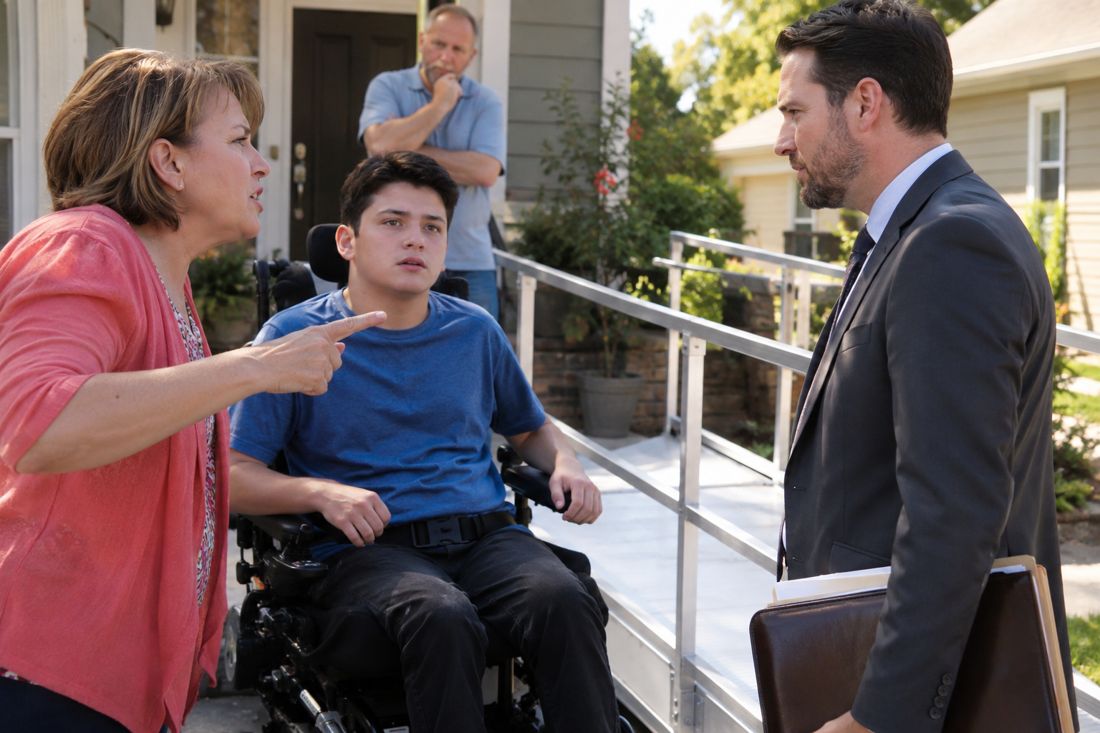
The bright orange violation sticker was slapped directly over the crayon-drawn letters of my nine-year-old son's welcome-home banner.
I had spent the previous evening hanging that banner across our porch railing. My wife, Sarah, had glued gold glitter around the letters: WE LOVE YOU, LEO! WELCOME HOME! It was supposed to be the first thing Leo saw when the medical transport van brought him home after seven grueling months in the hospital.
Instead, the first thing he saw was a neon-orange citation stuck to our door with adhesive so aggressive it tore the white paint down to bare wood when I peeled it off.
Idling at the foot of our driveway was a customized lime-green golf cart.
Behind the wheel, clutching an aluminum clipboard against her chest, sat Brenda Whitmore. Brenda was the reigning president of the Whispering Pines Homeowners Association. She was fifty-eight years old, wore oversized sunglasses, and treated our thirty-home cul-de-sac like a maximum-security prison yard.
Brenda didn't even cut the engine. The electric cart hummed softly as she lowered her shades and glared at me over the rims.
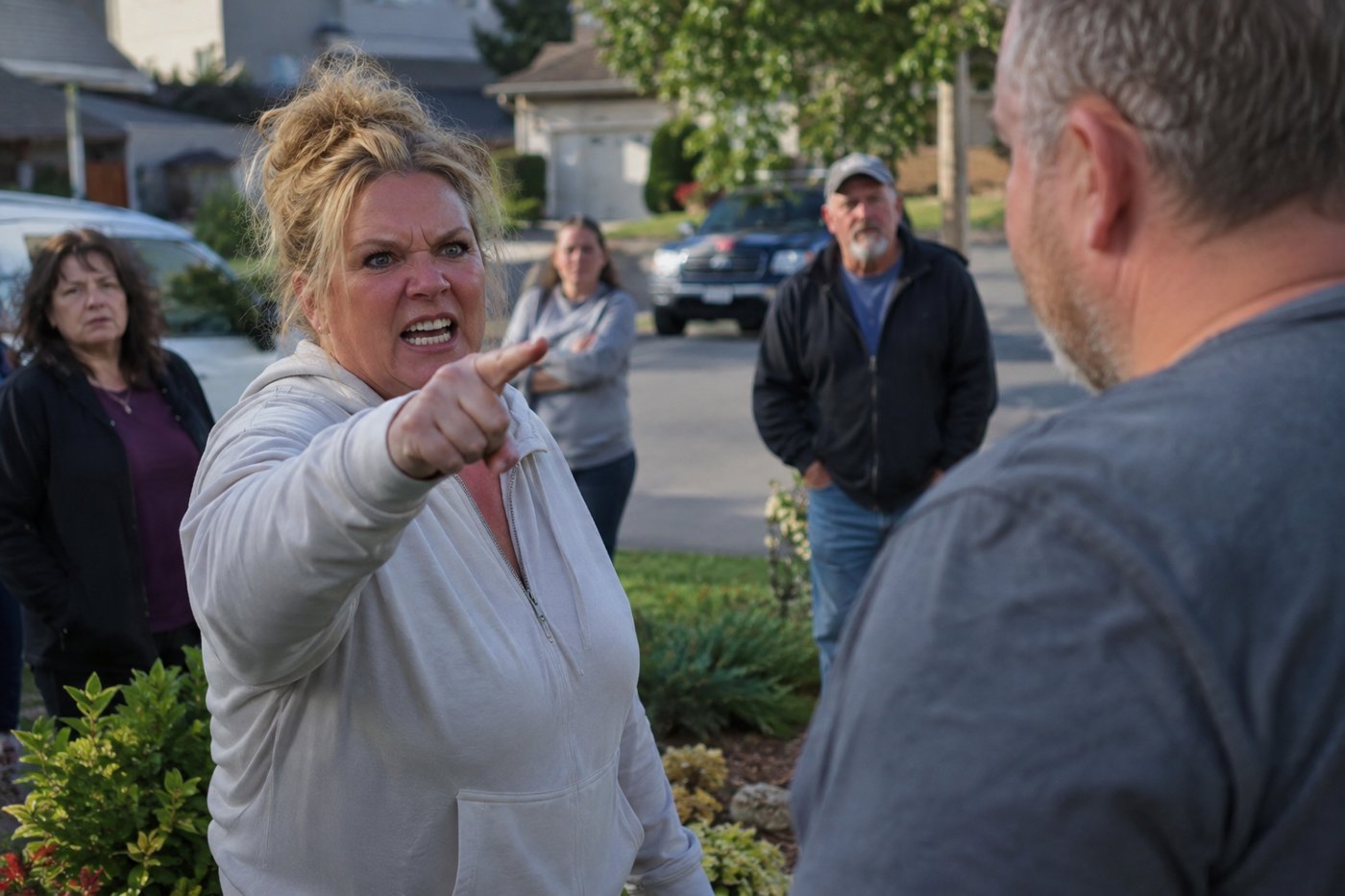
"You are in active violation of Section 6.4, Mr. Callahan," Brenda called out, her voice grating like metal across concrete. "External structural modifications visible from the primary roadway are strictly forbidden without prior architectural committee ratification."
I stood on the porch, my hands shaking with exhausted rage.
"Brenda, my son was discharged from the hospital two hours ago," I said, fighting to keep my voice steady. "Four surgeries. Spinal reconstruction. He cannot walk. This isn't a decorative deck. It is a wheelchair ramp."
Brenda let out a dismissive sigh, clicking her pen twice.
"Personal circumstances do not supersede community covenants, Mr. Callahan," she replied smoothly. "Whispering Pines is an executive enclave. We maintain aesthetic uniformity to protect property values. That industrial aluminum contraption looks like a loading dock. It ruins the visual harmony of the street."
"It has powder-coated black railings, nonslip composite decking, and dwarf boxwoods," I choked out. "We spent eight thousand dollars making sure it matched the craftsman trim of the house. The medical van is literally fifty feet behind you."
Brenda glanced toward the transport van waiting at the curb, then looked back at me without an ounce of empathy.
"The rules are the rules," she said flatly. "You have seventy-two hours to dismantle that unapproved structure and restore the masonry steps. Failure to comply will trigger a daily fine of one hundred dollars, plus retroactive penalties. After seven days, the board will execute exterior abatement via contracted demolition at your expense."
She slammed the cart into reverse, gouged two fresh tire ruts through our sod, and sped away.
To understand how we ended up on Brenda's hit list, you have to understand what happened eight months ago.
I was driving Leo home from soccer practice when a delivery truck ran a red light at forty-five miles per hour, crushing our passenger door like foil.
I walked away with cracked ribs and a broken collarbone. Leo didn't walk away at all.
His thoracic vertebrae at T8 and T9 were pulverized. The surgical team spent eleven hours fusing his spine with titanium rods, but the spinal cord trauma was irreversible. Leo was left paralyzed from the waist down.
What followed was seven months of agony. Endless infections, respiratory therapy, and grueling physical rehabilitation where my sweet boy had to relearn how to navigate the world. Through every tear, the only thing that kept Leo fighting was the promise of coming home.
Dad, will I still be able to play in my room? he would whisper at night.
Yes, buddy, I told him every single night, kissing his forehead while monitors beeped. Everything is going to be waiting for you.
Except our craftsman home had five steep limestone steps leading up to the porch.
Carrying a sixty-five-pound boy up five wet stone steps in your arms while someone else hauls a wheelchair is an accident waiting to happen. More importantly, the therapists drilled one vital truth into us: Independence is dignity. Leo needed to roll in and out of his home under his own power.
Six weeks before discharge, I hired a contractor who designed an ADA-compliant modular ramp beside our walkway.
Before buying a single bolt, I submitted an Architectural Review application with certified letters from Leo's surgeon and therapists requesting a reasonable accommodation under the Fair Housing Act.
Three days later, my paperwork was returned with a red stamp: DENIED.
Attached was a sticky note from Brenda: See Section 6.4. Exterior ramps visible from the roadway are prohibited. Use alternative entry points.
I drove straight to Brenda's house that afternoon.
"Brenda, there is no alternative entry," I pleaded. "The back patio drops six inches onto a steep hill. The garage door opens into a tiny laundry closet with an immediate right-angle turn. A wheelchair cannot turn that corner."
Brenda sipped her tea, looking down her nose.
"Then carry him," she said casually. "You're an able-bodied father. Pick him up, carry him up the stairs, and drag the chair up behind him. We can't have an industrial metal ramp ruining our street's curb appeal. Think of the comps."
"He is a paralyzed child!" I snapped.
"And this is a deed-restricted community," she replied coldly. "If you don't like our standards, put your house on the market."
She shut the door in my face.
With Leo's release date locked in, I told the contractor to build it.
The crew installed the modular ramp on Saturday. It was gorgeous, whisper-quiet, and rock-solid.
When Leo arrived home on Monday, Sarah and I guided his wheelchair to the base of the ramp. He gripped the push rims with his small hands, looked up at the gentle wooden slope, and his eyes lit up.
"Can I really do it, Dad?" he whispered.
"Roll on home, buddy," I said, choking back tears.
He pushed forward, his little arms straining against the wheels. He reached the porch landing, spun around, and threw his arms in the air.
"Mom! Dad! Look!" he shouted, grinning from ear to ear. "I did it all by myself!"
Sarah buried her face in my chest, crying with joy. For the first time in eight months, our boy was home.
Then came Tuesday morning, and Brenda's orange citation.
By Wednesday, an official notice arrived from the HOA management company: a $100 daily fine had begun, alongside a $500 penalty for "willful architectural defiance."
I attended the monthly HOA meeting on Thursday night, carrying a binder filled with HUD regulations and the Fair Housing Act. When the floor opened, I stepped up to the microphone.
"Members of the board," I said. "Under 42 U.S. Code Section 3604, it is illegal to deny reasonable physical modifications necessary for a disabled resident to enjoy their home. I have provided certified medical affidavits. I am formally requesting the board recognize this ramp and dismiss these fines."
Todd Geller, the vice president, looked uneasy. He glanced nervously at Brenda.
Brenda slammed her palm down on a small brass bell. Ding!
"Your time is expired, Mr. Callahan," Brenda said coldly. "The Fair Housing Act does not govern private covenant corporations. We are bound by contract law. You signed our bylaws. Motion to uphold the daily fines, add a seven-hundred-dollar administrative fee, and authorize legal counsel to file an assessment lien."
Todd hesitated, looking down. Brenda glared at him until he slowly raised his hand. Nancy Wilkes, the treasurer, followed suit.
"Motion carries," Brenda declared, banging her plastic gavel.
Over the next three weeks, the fines exploded: $1,400... $3,200... $5,800.
Then came the certified mail from a collections firm: NOTICE OF INTENT TO FORECLOSE ASSESSMENT LIEN AND NOTICE OF SUMMARY ABATEMENT.
Our balance stood at $6,850. If not paid in seven days, the HOA would dispatch a demolition crew to dismantle the ramp and initiate foreclosure against our home.
Sarah sat at the kitchen table, sobbing into her hands. We had poured our savings into Leo's medical bills and accessible bathroom. We were cornered, exhausted, and terrified.
The house next door, at 412 Whispering Pines Lane, had been vacant for seven months after the previous owners moved to Arizona.
On Wednesday, moving vans arrived next door. The new owner—a tall, silver-haired gentleman in tailored trousers and wire-rimmed spectacles—supervised the unloading of heavy mahogany bookcases and boxes marked LEGAL ARCHIVE.
I was outside raking leaves around Leo's ramp when the sharp whine of Brenda's golf cart cut through the air. She drove right up our driveway, cutting across our lawn, and slammed on the brake inches from where I stood.
"Tomorrow is Friday, Mr. Callahan!" she barked, clutching a yellow measuring tape and an orange notepad. "Your abatement window expires at eight a.m. Apex Demolition arrives at eight sharp to saw through these brackets and smash the footings. A sheriff's deputy will escort them. If you interfere, you will spend the weekend in jail."
Sarah rushed out onto the porch, crying. "Brenda, please! Leo has physical therapy tomorrow at ten! If you tear down that ramp, he's trapped inside!"
"Then reschedule your appointment!" Brenda snapped. "We are an executive residential enclave, Mrs. Callahan! Tomorrow morning, this eyesore comes down!"
Through the window, I saw Leo sitting in his wheelchair, clutching his stuffed bear, crying silently.
My vision blurred with fury. "Get off my lawn right now, or I swear—"
"Or what, Mr. Callahan?" Brenda smirked. "Assault an HOA officer? Please, do it. Make it easier for the deputy to cuff you tomorrow."
"Excuse me," a quiet, resonant voice cut through the shouting.
Standing at the edge of our driveway, holding a ceramic coffee mug, was our new neighbor from 412. He was leaning against our brick mailbox, watching Brenda with calm curiosity.
Brenda bristled. "Can I help you, sir? This is an internal HOA enforcement matter. It doesn't concern you."
The man took a slow sip of coffee and stepped across the grass.
"Well, that's a rather dubious claim, madam," he said mildly. "You see, I closed on number 412 yesterday morning. And under the common law of private nuisance, screaming threats at a weeping mother while kicking private fixtures on fee-simple residential property concerns everyone within earshot."
Brenda puffed out her chest. "I am Brenda Whitmore, President of the Whispering Pines Board of Directors. Who are you?"
"My name is Julian Mercer," he said softly. "And executing an extrajudicial summary demolition of an accessibility structure without a judicial writ signed by a circuit judge is a very serious legal mistake."
Brenda laughed loudly. "I don't need a judge! This structure violates Section 6.4 of our covenants! The association has plenary power of exterior abatement!"
Julian tilted his head. "Tell me, Mrs. Whitmore... does Section 6.4 contain an express waiver of the Federal Fair Housing Amendments Act of 1988? Specifically 42 U.S. Code Section 3604(f)(3)(B)?"
Brenda rolled her eyes. "Restrictive covenants are private contracts! Private contracts supersede federal statutory suggestions! Educate yourself before sticking your nose into neighborhood business!"
Julian stared at her in dead silence. Then, he let out a soft laugh.
"Private contracts supersede federal civil rights statutes," Julian whispered, shaking his head. "My former colleagues at the Department of Justice would be thrilled to learn that four decades of federal jurisprudence could be overturned by a subdivision newsletter."
Brenda turned scarlet. "Eight o'clock tomorrow, Callahan! Have your son's toys off the deck, or they go into the woodchipper!"
She stomped into her golf cart and sped down the street.
Sarah went inside to comfort Leo. I stood on the driveway, feeling completely shattered.
"Mr. Mercer... I am so sorry," I breathed. "Brenda has been terrorizing us for a month. We don't have the money to fight her in court."
Julian's casual amusement was gone, replaced by a gaze as sharp and cold as a scalpel.
"Is your boy nine?" he asked softly.
"Yes. Leo. Paralyzed eight months ago in a car crash. Monday was his first day home."
Julian walked over to the ramp, inspecting the black railings and concrete footings.
"One-inch rise per twelve inches of run. Thirty-six-inch clear width. Continuous graspable handrails. Non-skid composite tread," Julian observed quietly. "This is master-craftsman ADA work. Bring your binder over to my kitchen table, Mark. And tell your son nobody is touching his ramp tomorrow morning."
Ten minutes later, I was sitting inside 412 Whispering Pines, surrounded by thousands of leather-bound legal volumes. Framed on the credenza were certificates: United States Department of Justice, Civil Rights Division — Special Commendation for Exceptional Service, and Senior Trial Attorney, Housing and Civil Enforcement Section, Washington D.C.
Julian Mercer was one of the premier civil rights litigators in the country.
For fifteen minutes, Julian silently examined my binder: the medical affidavits, Brenda's red-ink denial stamp, her notes, the daily fines, and the demolition order.
When he finished, a cold smile spread across his face.
"Mark," Julian said softly. "In thirty-four years of federal civil rights practice, I have rarely seen an opposing party gift-wrap their own financial destruction with such breathtaking arrogance."
He tapped the papers.
"Under 42 U.S. Code Section 3604(f)(3)(B), refusing reasonable physical modifications for a disabled resident is black-letter federal discrimination. Assessing daily fines and threatening demolition constitutes unlawful retaliation under Section 3617. And her written insistence that you 'carry your son' documents her discriminatory malice on official letterhead."
Julian leaned forward, his gray eyes flashing.
"HOA boards rely on Directors and Officers liability insurance. But virtually every D&O policy in America contains an ironclad exclusion for willful, intentional civil rights violations. The insurer will issue a total denial of coverage. Brenda Whitmore, Todd Geller, and Nancy Wilkes are personally, jointly, and severally liable. Their personal bank accounts, stock portfolios, and home equity are sitting completely unprotected."
Julian snapped the binder shut.
"I will draft an emergency federal complaint and an application for a Temporary Restraining Order, filing them at sunrise. My standard fee is nine hundred and fifty dollars an hour, Mark. But for the privilege of dismantling Brenda Whitmore on your lawn, my fee is exactly zero dollars. I will see you at seven-fifty-five.
Friday morning arrived under heavy, steel-gray clouds.
At 7:45 AM, Sarah and I stood on our porch with Leo in his wheelchair between us. At 7:52 AM, a flatbed truck from "Apex Demolition" backed into our driveway, carrying cutoff saws and sledgehammers.
Right behind them was Brenda in her golf cart, clutching her clipboard, followed by Deputy Miller in a county cruiser.
Brenda marched toward the contractors. "Cut the mounting brackets at the porch header with the cutoff saw first! Then smash the concrete footings! Deputy, stand by. If Mr. Callahan steps off that porch, arrest him immediately for obstruction!"
The lead contractor, Gary, yanked the pull-cord. The gas saw screamed to life with a deafening screech.
"Shut that engine off," a voice boomed across the yard.
Everyone froze.
Walking down the driveway of 412 was Julian Mercer. He wore a tailored charcoal three-piece suit, a burgundy tie, and carried a leather trial folder filled with red-sealed court documents.
Julian walked past Brenda and stopped directly in front of Gary.
"Good morning, sir. My name is Julian Mercer. At six-fifteen this morning, I filed Civil Action Number 26-CV-4412 in the United States District Court."
Julian handed Gary the four-page federal complaint.
"That document alleges intentional civil rights violations under 42 U.S. Code Section 3604. If your blade touches that ramp, your company will be named as an active co-conspirator. Under state law, participating in extrajudicial property destruction without a signed judicial writ carries statutory treble damages. That means triple the ramp's value, sixty thousand dollars in punitive damages, and my firm's legal fees. Furthermore, by noon today, I will petition the State Board of Contractors to suspend your commercial license."
Gary's eyes bulged. He killed the engine instantly.
"What are you doing?!" Brenda shrieked. "I am paying you five thousand dollars! Cut the ramp!"
"Lady, you told dispatch you had a signed eviction writ from a judge!" Gary roared. He shouted to his crew: "Mike, pack the saws! We're leaving!"
As the truck sped away, Brenda spun toward Deputy Miller. "Deputy! Arrest him! Put him in handcuffs right now!"
Julian turned calmly toward the officer. "Deputy Miller, I spent twelve years as a Senior Trial Attorney for the DOJ Civil Rights Division. Are you familiar with 18 U.S. Code Section 242? Deprivation of rights under color of law?"
Deputy Miller stiffened. "I am, sir."
"Then you know that if an officer facilitates the extrajudicial destruction of a disabled minor's medical equipment without a signed court order, he forfeits qualified immunity and becomes personally subject to federal criminal indictment."
Deputy Miller turned on Brenda, his face pure granite. "Ma'am, did a judge sign an order? Yes or no?"
"No, but the covenants—"
"You made a false report to dispatch to get an armed police escort for an illegal private trespass," Deputy Miller snarled. "Get off this property in ten seconds, or I will arrest you right now."
Julian stepped forward and pressed a thick envelope against Brenda's chest.
"Mrs. Whitmore, you are formally served with federal process in Callahan v. Whispering Pines HOA and Brenda Whitmore individually."
The envelope fell onto the wet grass. Brenda let out a choked gasp, scrambled into her golf cart, and sped away down the street.
The fallout moved with the speed of an avalanche.
By 3:30 PM, Senior U.S. District Judge Robert Sterling granted an emergency Temporary Restraining Order enjoining the HOA from approaching our ramp, scheduling a show-cause hearing for Tuesday.
At 5:00 PM, the HOA's attorney, Harold P. Finch, received the federal docket. Finch knew Julian Mercer's terrifying appellate record. In sheer panic, Finch summoned an emergency mandatory all-homeowner meeting for 7:00 PM at the community clubhouse.
Every resident in Whispering Pines showed up.
Sarah and I walked in with Julian Mercer. At the front table sat Brenda, Todd Geller, and Nancy Wilkes. Brenda looked like she had aged fifteen years.
Harold Finch stepped to the microphone, wiping sweat from his face.
"Ladies and gentlemen, we face an existential catastrophe," Finch announced, his voice shaking. "Earlier today, a federal civil rights lawsuit was filed against our association and board members individually. I tendered defense to our insurer under our D&O policy. Ten minutes ago, I received their response: TOTAL DENIAL OF COVERAGE."
The room gasped in horror.
"The policy excludes intentional civil rights violations!" Finch yelled over the crowd. "The insurer reviewed Mrs. Whitmore's letters demanding that a paralyzed child be 'carried' to protect property values! If this goes to trial, Mr. Mercer's firm bills at nine hundred and fifty dollars an hour. The association faces over four hundred thousand dollars in liability! Our reserve fund has forty-five thousand dollars! Every homeowner in this room will be assessed between twelve and eighteen thousand dollars to pay the judgment!"
The clubhouse erupted into bedlam.
"Eighteen thousand dollars?!" screamed Mrs. Gable. "Because you wouldn't let a paralyzed boy have a ramp?!"
Brenda frantically hammered her plastic gavel. Bang! Bang! Bang! "Silence! I was protecting your property values!"
Todd Geller jumped to his feet, tears of rage on his cheeks. "Shut up, Brenda! I resign right now! Brenda forced this! She threatened to cite my house if I didn't vote with her! I resign!"
Nancy Wilkes broke into hysterical sobs. "I resign too! I'm so sorry, Mark! I'm so sorry, Sarah!"
Julian Mercer stood up in the center aisle, buttoning his charcoal jacket.
"Mr. Finch," Julian said calmly. "My clients will release all claims against the association on four conditions: First, immediate expungement of all fines and a permanent variance for the ramp. Second, an amendment to the CC&Rs explicitly incorporating the Fair Housing Act. Third, the immediate removal and lifetime ban of Brenda Whitmore from association leadership."
"Motion to remove Brenda Whitmore!" shouted Greg Miller.
"All in favor?!" Finch called.
Every single hand in the room shot up—except Brenda's.
"And fourth," Julian said, his voice turning to ice. "To settle individual claims for intentional infliction of emotional distress, Mrs. Whitmore will personally pay twenty-five thousand dollars into a medical trust fund for Leo Callahan by Monday noon, or I will proceed with discovery into her personal assets."
Finch leaned into Brenda's ear, his whisper picked up by the microphone:
“Sign it, Brenda. If you don't, that man will take your house.”
Brenda slumped back into her chair, completely broken. "I'll sign," she whispered.
The certified check arrived on Monday morning.
Twenty-five thousand dollars, drawn directly from Brenda Whitmore's personal account, deposited straight into Leo's medical trust fund. Along with it came a court-mandated written apology, entered into the permanent association records.
Within seventy-two hours, a FOR SALE sign appeared in front of Brenda's house. She packed her belongings in the middle of the night, listed the property at a steep discount, and vanished from Whispering Pines forever.
The new board—chaired by Greg Miller—wasted no time making amends. Two weeks later, a dozen neighbors showed up at our house on a Saturday morning with shovels, mulch, and flats of blooming purple hydrangeas. They spent the entire day planting flowers along the border of Leo's ramp and installing solar lights along the rails.
By sunset, the ramp wasn't just part of our house; it was the pride of the neighborhood.
Three months later, on a warm, golden Saturday in September, I stood on our front porch with a glass of iced tea.
The front door opened, and Leo rolled out into the sunshine. He wore his favorite soccer jersey, laughing as Buster, our golden retriever, trotted beside him.
Leo reached the top of the ramp, placed his hands on the push rims, and let gravity take over. He glided smoothly down the composite decking, took the turn with practiced ease, and rolled out onto the driveway.
"Dad! Watch this!" he yelled, spinning his chair in a clean circle on the asphalt before launching a tennis ball across the lawn for Buster.
Sitting on the porch of 412 Whispering Pines, rocking gently in a high-backed wooden chair, was Julian Mercer. He was reading a thick volume with a cup of tea on the table beside him.
Leo spotted Julian, locked his wheels, sat up straight, and snapped a crisp salute.
"Hey, Mr. Mercer! Look how fast I can roll today!"
Julian slowly lowered his book. He looked over the rims of his glasses, a warm smile spreading across his weathered face. He raised two fingers to his brow and returned the salute.
"Clear skies and smooth rolling, Captain," Julian called back softly. "Clear skies and smooth rolling."
I watched my son laugh in the afternoon sun, the ramp beneath his wheels solid, permanent, and free.
Brenda Whitmore had tried to make our neighborhood a monument to conformity and control.
Instead, thanks to a quiet neighbor with a stack of federal statutes, it had become the place where my boy could roll straight through his front door, his head held high, answering to no one.




COMMENTS
Loading…