HOA Karen Shut Off My Grill—Then the HOA President Asked Why She Ruined His Barbecue
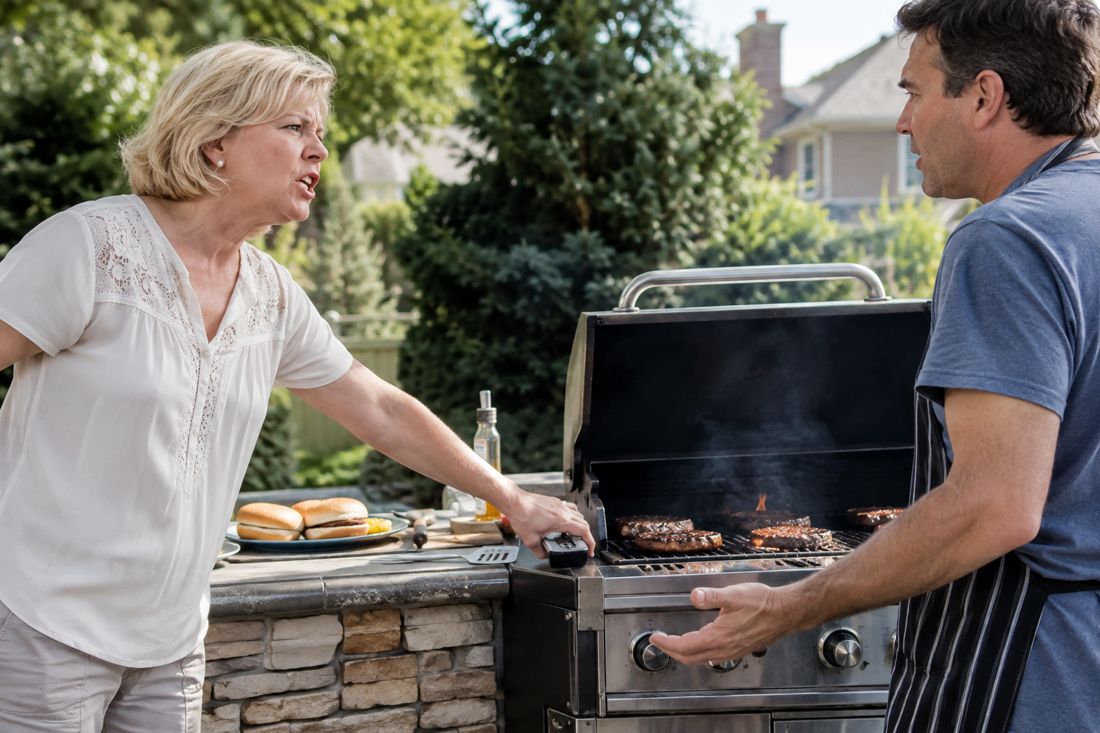
The moment I stepped out onto my patio, Karen already had her fingers clamped around my grill.
Not loitering near it.
Not scowling at it from across the lawn.
Physically handling it.
Her fingers were wrapped firmly around the primary burner dial of my stainless-steel propane rig, and the jet of flame she had just twisted off let out one fading hiss before dying out completely.
Four thick ribeye steaks were sizzling across the cast-iron grates.
A stainless platter piled with seasoned ears of sweet corn sat on the preparation shelf.
A pale plume of fragrant hickory smoke drifted into the balmy Virginia evening air.
I froze on the threshold of the back door.
“TAKE YOUR HANDS OFF THAT.”
Karen Whitmore whipped around on her heel.
She was fifty-eight years old, dressed in crisp white linen slacks, an ironed navy blouse, and wore the haughty scowl of someone thoroughly insulted that her unauthorized presence on private property was being questioned.
She thrust an index finger toward the cooling beef.
“THAT HAZARDOUS FILTH IS STRICTLY FORBIDDEN!”
I stared at her, genuinely struggling to comprehend the scene.
“Did you honestly just unlatch my fence and walk onto my patio to extinguish my dinner?”
Karen marched a step forward, chin lifted in defiance.
“I INTEND TO EXTINGUISH EVERY UNAUTHORIZED FIRE HAZARD IN THIS ENTIRE SUBDIVISION!”
Neither of us moved for several tense seconds.
Then I closed the distance between us, heading straight for the cooker.
Karen raised a manicured palm like a traffic cop.
“Don't you dare touch that.”
I stepped past her without breaking stride.
Reached down.
Gripped the valve knob and cranked the ignition.
CLICK.
WHOOSH.
A bright ring of blue flame immediately roared back to life beneath the seared beef.
Karen's cheeks flushed a furious shade of crimson.
“ARE YOU OUT OF YOUR MIND?!”
“This is my equipment.”
“You are flagrantly breaching residential fire codes!”
“This is my fenced backyard.”
“Property lines don't give you immunity!”
I glanced past her toward the side fence.
The wooden gate stood wide open against the grass.
I always kept the heavy latch secured because of my dog.
That meant Karen hadn't wandered through an accidental gap or peeked over the pickets.
She had deliberately released the bolt.
Pushed her way through.
Strode across my private flagstones.
And shut off my burners.
I pointed an arm toward the open passage.
“Get off my property.”
Karen crossed her arms over her chest, digging her heels in.
“Not until you shut down that contraption.”
“Then we have a serious issue here.”
“You're the one facing consequences, young man.”
She lunged forward, reaching for the gas controls a second time.
I cut in front of her, planting my body between her hands and the metal knobs.
“Keep your hands off my property.”
She halted abruptly.
A condescending smirk spread across her lips.
“You imagine that signing a mortgage three months ago entitles you to ignore community standards?”
“I reviewed every page of the community standards.”
“Clearly your comprehension was lacking.”
“Then cite the exact clause.”
Karen parted her lips to deliver a lecture.
Before a single syllable could escape—
The garden gate creaked on its hinges and swung fully open behind her.
A man stepped into the yard lugging a massive royal-blue cooler by its molded handle.
He was sixty-two, broad-shouldered, silver-haired, sporting faded khaki cargo shorts and a washed-out University of Virginia tee.
Karen turned her head.
I knew who he was the second he appeared.
Thomas Reed.
The elected President of the Cedar Ridge Homeowners Association.
Thomas paused on the grass, taking in the scene.
He looked at Karen.
Then at me.
Then at the four smoking steaks on the grill.
Then down at the heavy cooler in his grip.
Finally, his eyes drifted back to Karen's indignant face.
“Why on earth are you sabotaging my barbecue?”
Total stillness blanketed the yard.
Karen blinked, momentarily losing her footing.
“Your… your what?”
Thomas hoisted the heavy cooler an inch higher.
“My barbecue.”
I crossed my arms and waited.
Karen looked back and forth between the two of us, searching for an angle.
“You're having dinner here?”
Thomas's brow furrowed.
“Yes, Karen.”
“He's operating an unapproved propane appliance.”
“I have eyes.”
“Tom, high-output outdoor gas cookers are banned under the safety rules.”
“No, they aren't.”
Karen went rigid.
Thomas stepped past her, setting the heavy cooler onto my outdoor dining table with a solid thud.
Inside sat chilled bottles of craft beer, cans of soda, seltzers, and a massive glass bowl of potato salad sufficient for an army.
He straightened his posture.
“Where did you fabricate such nonsense?”
Karen pointed a stiff finger back at the grill.
“Section Nine.”
Thomas squinted at her.
“Section Nine of what document?”
“The fire-safety amendment.”
“There is no amendment prohibiting back-patio cooking appliances.”
“There certainly is.”
“No, Karen, there is not.”
“I have been actively citing residents under it for two weeks.”
Thomas's entire demeanor changed in an instant.
The casual evening lightness vanished from his face.
His voice dropped into a measured, chillingly deliberate cadence.
“You have been doing what?”
Karen's eyes flickered, realizing an instant too late that she had stepped into a trap of her own making.
I exchanged a glance with Thomas.
He looked back at me, then over at the unbolted wooden gate resting against the fence posts.
“How exactly did she gain access back here?”
I answered plainly:
“She popped my gate latch and walked in.”
Thomas turned his full attention back to Karen.
“You bypassed a closed fence and entered Jason's private yard?”
Karen threw her chin up, scrambling for moral high ground.
“I was performing a necessary standards compliance walkthrough.”
Thomas stared at her in utter disbelief.
“You were trespassing.”
“I am the presiding chair of the Community Standards Committee!”
“Which grants you precisely zero legal authority to trespass into private fenced yards.”
Karen's pitch escalated, thin and combative.
“There was visible smoke rising over the fence line!”
Thomas glanced toward my grill.
Then at the delicate gray vapor drifting lazily from the browning steaks.
“That is dinner, Karen. It's food.”
“It represents an unacceptable combustion hazard!”
Thomas gestured toward the cooler he'd just brought.
“I brought four pounds of fresh bratwurst to throw on that grate.”
For the first time since opening the patio door, I had to suppress a genuine smirk.
Karen, however, was past the point of amusement.
She pointed an accusatory finger at Thomas's chest.
“You are the president of this association! It is your sworn duty to uphold community regulations!”
“That is precisely what I am doing.”
“Then order him to extinguish those burners right now!”
Thomas turned his head toward me.
“Jason?”
“Yeah, Tom?”
“How do you want these cooked?”
“Medium rare.”
He gave a solemn nod.
“Then don't let Karen distract you into turning them into leather.”
He turned back to face her directly.
“Please remove yourself from this property immediately.”
Under ordinary circumstances, that would have been the final word.
It wasn't.
Because Karen Whitmore hadn't marched onto my flagstones simply because of four ribeye steaks.
The grill was merely the latest territory she had decided she held the right to govern.
And before that long summer ran its course, we would uncover proof that mine was far from the only private yard she had invaded.
My name is Jason Cole.
I was thirty-nine when I signed the closing papers on the two-story house on Hawthorne Lane in Cedar Ridge.
I earned my living as a senior project manager for a commercial building contractor based in Richmond.
Unmarried.
No children.
Just an eight-year-old black Labrador retriever named Murphy.
Murphy's waking life revolved around two singular passions: consuming food, and convincing every human within sniffing distance that he hadn't seen a meal in several weeks.
I chose Cedar Ridge because I wanted a downsized home that required less maintenance than my previous house, but offered significantly more green space than the bland apartment I'd leased after my divorce.
The subdivision had been laid out roughly twenty-five years before.
Lush, mature canopies of oak and maple.
Paved sidewalks curving past brick-front facades.
A shared neighborhood pool.
A modest community clubhouse.
A pair of asphalt tennis courts that had seen better days.
Nothing extravagant.
Nothing run-down.
The monthly association dues were manageable.
The recorded covenants were refreshingly dull and routine.
Which was exactly what I was looking for.
I had spent eleven years inside a marriage that slowly collapsed under a weight of tension and exhaustion that neither of my ex-wife nor I cared to revisit.
We had eventually established a polite, functional peace after the split.
Still, the entire grueling ordeal had left me with an insatiable hunger for uncomplicated quiet.
I wanted four solid walls.
A dependable outdoor grill.
A happy dog sleeping on the rug.
And a patch of turf I could mow without an official tribunal reviewing my tire tracks.
Cedar Ridge seemed like an oasis of normalcy.
Then I met Karen.
Her formal introduction arrived approximately twelve hours after the moving van backed into my driveway.
I was hauling a heavy cardboard crate of kitchenware into the open garage.
“Are you the incoming resident?”
I turned around.
A woman was standing at the edge of my asphalt apron, gripping an aluminum clipboard.
“That's me.”
“Karen Whitmore.”
Her hands stayed firmly clamped around her clipboard; no welcoming handshake was offered.
“Chair of the Community Standards Committee.”
I set the crate onto the concrete floor.
“Jason Cole. Good to meet you.”
“I'm well aware.”
That response alone should have set off warning bells in my head.
She cast a critical eye toward the 26-foot moving truck parked near the curb.
“How much longer do you anticipate that vehicle remaining parked there?”
“The moving truck?”
“Obviously.”
“Until the crew finishes emptying the cargo.”
“And when precisely will that be?”
I glanced back toward the two sweating movers wrestling my sectional sofa through the front entry.
“Hopefully before their bodies give out entirely.”
Her expression remained stone cold.
“Commercial vehicles are strictly prohibited from remaining overnight on residential streets.”
“Then it's a good thing they plan on going home tonight.”
Her gaze shifted abruptly toward Murphy, who was peering out through the glass screen door.
“Canines must be restrained by a leash at all times.”
“He is inside my home.”
“I witnessed him moments ago.”
“Inside my home?”
“At the threshold.”
I stared at her, letting the silence stretch.
Karen clicked her ballpoint pen and checked off a box on a preprinted form.
“Trash collection occurs early Tuesday morning. Bins cannot remain visible from the roadway outside the designated twenty-four-hour window.”
“Noted.”
“Turf height must not exceed four inches.”
“Understood.”
“No exterior structural modifications may commence without prior submission to the review board.”
“Makes sense.”
“Recreational vehicles, campers, and watercraft are prohibited from open storage.”
“Don't own any.”
“Backyard poultry is explicitly forbidden.”
“Murphy will be utterly heartbroken to hear that.”
She paused, narrowing her eyes.
“Your animal?”
“Yes.”
“Why would your retriever care about poultry?”
“He was holding out hope for a coop full of chickens.”
Not a flicker of amusement crossed her features.
She gave a stiff nod, pivoted on her sensible loafers, and strode down the sidewalk toward the cul-de-sac.
One of the movers appeared at the garage door, wiping his brow with a forearm.
“Charming neighbor. Old friend of yours?”
“Evidently,” I replied.
Thomas Reed introduced himself that very evening.
The contrast couldn't have been more pronounced.
He gave three polite raps on the front frame.
When I opened the door, he offered a warm handshake and a thick welcome packet.
“Welcome to the neighborhood. Thought you might need the gate codes and pool passes.”
“Much appreciated.”
“I'm Tom. Currently serving as HOA president.”
I glanced instinctively past his shoulder toward the street.
“In that case, who was the woman conducting an audit with a clipboard this morning?”
Thomas let out a deep, weary chuckle that came straight from his gut.
“Ah. You've met Karen.”
“You're familiar with her routine?”
“To my eternal exhaustion, yes.”
That was the first genuine laugh I had enjoyed in Cedar Ridge.
Thomas leaned against the doorjamb and laid out the lay of the land.
The neighborhood was governed by a five-member elected board of directors.
Karen was not a member of the board.
Her position was purely volunteer—she headed an ad-hoc Standards Committee whose entire mandate was to act as extra eyes and notify the professional management company of potential covenant oversights.
Thomas emphasized that word with particular care: notify.
Not adjudicate.
Not enforce.
Not demand penalties.
And under no circumstances enter private lots.
The professional management outfit issued all formal notices.
The elected board conducted any hearings or formal reviews.
Thomas offered a reassuring smile:
“Don't let her put you on edge. Ninety-nine percent of the people on this street are completely normal.”
“That's comforting.”
“I mean it.”
“Though usually, that's the exact preamble before someone explains that everyone is insane.”
He laughed warmly.
“You'll do just fine here, Jason.”
And for the most part, he was right.
Mostly.
The rest of the immediate block was fantastic.
To my left lived Ben and Alicia Morales along with their two energetic young kids.
To my right lived Carol Brennan, a sweet retired middle-school English teacher who tended flowerbeds.
Directly across the street were Marcus and Hannah Lee, a newly married couple who always waved from their porch.
People shared lawnmowers and hedge trimmers.
Kids left chalk drawings and scooters on the sidewalks.
Lawns occasionally crept a half-inch past the guideline before getting cut on Saturday.
Nobody called in the cavalry.
For my first four weeks, Karen existed merely as a distant neighborhood rumor, a figure glimpsed pacing the curbs with her ever-present binder.
Then I purchased the grill.
It was a gleaming six-burner propane monster constructed from heavy commercial stainless steel.
Was it excessive for a single guy and a retriever?
Completely.
I knew it when I swiped my credit card.
The appliance salesman certainly knew it.
Murphy, who watched the delivery box arrive like it held the holy grail, absolutely knew it.
Cooking outdoors had always been my therapy.
My previous cooker had remained behind at my former residence because my ex-brother-in-law had originally gifted it to us.
So once I settled into Hawthorne Lane, I treated myself.
I spent a sunny Saturday afternoon on the patio bolting the chassis together.
Thomas strolled by the sidewalk while I was wrestling with the infrared side sear burner.
“Planning to cater the annual block party single-handedly?” he called out.
“That's the long-term objective,” I yelled back.
“Good man.”
Forty-eight hours later, a notification pinged in my inbox.
The sender wasn't the property management company.
It was Karen's personal email address.
SUBJECT: UNLICENSED EXTERNAL THERMAL COOKING INSTALLATION
I read through the message twice in sheer disbelief.
According to Karen's lengthy treatise, my freestanding patio grill fell under the definition of an “external thermal appliance” and required an architectural review application, proof of setback compliance, and committee authorization prior to firing.
I pulled up the neighborhood covenant bylaws on my laptop.
Ran a search for thermal installations.
Found nothing regarding backyard barbecues.
I forwarded her text to Thomas with a simple note:
Does my patio grill require HOA clearance?
His response landed nine minutes later.
Absolutely not.
Followed quickly by:
Please do not engage Karen on this topic unless you have an afternoon to burn on pointless circular debates.
I chuckled, archived Karen's message, and went on with my week.
Seventy-two hours later, I walked out to my truck in the morning and found a printed document tucked under my windshield blade.
No association emblem.
No management company letterhead.
Just bold, centered typography:
OFFICIAL ADVISORY OF RESIDENTIAL HAZARD CONCERN
Followed by:
COMBUSTIBLE LIQUID PETROLEUM APPLIANCE DETECTED ON LOT PREMISES.
I snapped a clean photograph of the paper with my phone.
Sent the image directly to Thomas.
Within two minutes, my phone rang.
“Did Karen stick that on your vehicle?” Thomas asked, exasperation dripping from every syllable.
“That would be my educated guess.”
“It holds zero legal weight. It's completely unauthorized.”
“Figured as much.”
“Chuck it in the recycling bin.”
“I was tempted to frame it above the mantel.”
“Don't stroke her ego, Jason.”
I threw the paper into the trash.
That should have marked the conclusion of the saga.
Instead, Karen doubled down.
She began making regular evening rounds through the neighborhood right as the dinner hour arrived.
Not every evening.
Just frequently enough that several households noticed the pattern.
Whenever she caught the scent of charcoal or propane, she stopped her walk.
She would linger on the driveway apron, asking intrusive questions.
How many inches of clearance separated the firebox from the vinyl siding?
Was the propane cylinder stamped with current DOT hydrostatic testing dates?
Did the homeowner intend to store the appliance outdoors on a permanent basis?
One neighbor flatly told her to take a hike off his asphalt.
Another laughed in her face and closed the garage door.
A third resident, however—an elderly widower who lived two streets over—actually wheeled his barbecue into his storage shed because Karen convinced him he was about to incur a $250 association fine.
That was the moment her hobby crossed from annoying eccentricity into genuine trouble.
The HOA board had never enacted, authorized, or contemplated any such penalty.
Thomas only caught wind of it when the widower phoned the management office asking how to submit payment to clear the violation.
There was no violation file.
No warning notice.
No case on record.
Thomas called Karen into a private meeting and explicitly instructed her to cease issuing bogus directives to residents.
She nodded along and promised to stand down.
At least, that was the story she gave him.
Instead of backing down, she manufactured the “fire-safety amendment.”
It wasn't woven out of thin air, which was precisely what made it so insidious.
Roughly six years earlier, following a recommendation from the association's liability underwriter, Cedar Ridge had implemented a series of common-sense rules governing open flames within shared community facilities.
No personal charcoal pits on the concrete pool deck.
No tailgating smokers parked beside the clubhouse doors.
No open ground fires in the neighborhood parks or wooded paths.
Standard, sensible restrictions.
Karen took the wording from that specific resolution and began citing it to homeowners as a mandatory, neighborhood-wide ordinance.
Crucially, she intentionally omitted the clarifying words: COMMON ELEMENTS.
Most residents never took the time to dig up old board minutes.
They simply heard:
Homeowners Association.
Fire regulations.
Insurance risk.
Strict prohibition.
And they assumed she was operating with full administrative backing.
I knew none of this background on the afternoon of my backyard cookout.
All I knew was that Thomas was coming over for dinner.
As were Ben and Alicia Morales.
Carol Brennan from next door.
Marcus and Hannah Lee.
Plus a couple of other neighbors from down the block.
Nothing fancy.
I had dropped a casual message in our neighborhood text thread:
“Firing up the new rig Saturday around five. Drop by if you're hungry.”
Thomas volunteered to supply authentic German brats.
I picked up four gorgeous prime ribeyes from the butcher.
Alicia promised a garden salad.
Carol insisted on baking an authentic peach cobbler.
By quarter to five, I had the cast-iron grates roaring hot and dropped the steaks on.
At 4:49, Murphy began barking frantically from the living room window.
I wiped my hands on a towel and walked inside to see what had set him off.
At 4:51, Karen entered my private property.
I have the precise timestamp because my outdoor security system recorded every single second.
I had mounted three exterior cameras shortly after moving in, a habit formed after losing several parcels to porch pirates at my previous apartment.
One watched the driveway.
One guarded the front porch.
The third was affixed beneath the patio eave, capturing a clean, wide view of the back lawn, the perimeter fence, the wooden gate, and the grill station.
The camera's motion sensor triggered the moment Karen reached the gate.
The footage shows her pausing outside the closed pickets.
She peers across my property toward the rear windows of the house.
Reaches over the top rail.
Fumbles with the gravity latch until it clicks open.
Swings the wooden door inward.
And marches across my lawn.
She never called out my name.
Never knocked on the fence post.
Never offered a polite greeting.
She marched in a beeline straight to the cooking station.
Glared at the smoking ribeyes.
Reached down and twisted the gas valve to the off position.
That was the exact moment I opened the screen door and walked out.
Every word and movement that followed was captured on high-definition video.
Including:
“THAT HAZARDOUS FILTH IS STRICTLY FORBIDDEN!”
And her unhinged boast:
“I INTEND TO EXTINGUISH EVERY UNAUTHORIZED FIRE HAZARD IN THIS ENTIRE SUBDIVISION!”
And Thomas strolling through the gate with his blue cooler.
And the priceless look of cold shock on his face when she blurted out:
“I have been actively citing residents under it for two weeks.”
Even after Thomas ordered her off the premises, Karen refused to budge.
“This association carries a legal duty of care to protect its residents!” she argued, her voice vibrating with righteous indignation.
Thomas kept his tone level and firm:
“Not by trespassing into locked yards, it doesn't.”
“Someone has to enforce basic fire safety!”
“Management oversees compliance after due process and verified complaints.”
“Management does nothing while hazards multiply!”
“Because cooking dinner on a patio is not a violation.”
“It should be!”
“That is an entirely separate debate, Karen.”
She jabbed a finger toward the brick veneer of my home.
“And what happens when these flames catch the exterior trim?”
I spoke up from behind the burners:
“My grill is placed on a solid flagstone surface more than twelve feet away from the nearest exterior wall.”
She snapped her head in my direction.
“Do not interrupt me!”
I stared at her, genuinely stunned by her audacity.
Thomas took a step forward.
“Karen. Enough.”
She paid him no mind.
“You people treat everything like a joke until someone's home is reduced to ash!”
A sudden crack appeared in her voice.
The hostility was still burning in her eyes.
Yet underneath the venom, something far more vulnerable slipped through.
Genuine panic.
Thomas heard it too.
The hard edge in his expression softened by an inch.
“Karen, we are not going to debate neighborhood fire doctrine in the middle of Jason's yard.”
“And why not?”
“Because he has repeatedly instructed you to vacate his private property.”
She cast a frantic look around the yard.
By that point, Ben and Alicia Morales had appeared at the open gate latch.
They had caught the yelling from their adjacent yard.
Alicia was holding a ceramic bowl of leafy greens wrapped in plastic.
Ben gave me a questioning look over the fence pickets.
“Everything alright over here, Jason?”
“Under control,” I said.
Karen immediately rounded on the new arrivals.
“Tell him! Tell him these combustible setups are an imminent danger to our community!”
Ben looked from the sizzling meat to Karen's flushed face.
“Honestly, ma'am, I just came over hoping to eat a burger.”
That did nothing to calm her nerves.
Thomas spoke once more, his tone leaving no room for negotiation:
“Karen. Walk out that gate. Now.”
Finally, she realized her position was untenable.
She turned on her heel and marched toward the exit.
Right before stepping through, she paused, glaring over her shoulder.
“When this whole block goes up in smoke, don't claim I didn't warn every single one of you!”
With that final proclamation, she disappeared down the side path.
Ben watched her go, scratching his beard.
Then he looked at Thomas.
“Is she always that dialed up?”
Thomas let out a heavy sigh, rubbing his temple.
“Historically? No. Not quite like that.”
Alicia stepped onto the patio, holding up the salad.
“So… is the dinner party still on?”
I turned back to inspect the grates.
The forced shutdown had thrown off the sear timing, leaving two steaks well past medium.
“One of these steaks paid the ultimate price,” I announced.
Thomas promptly unlatched the lid of his cooler.
“Which is precisely why I brought backup sausages.”
The cookout went forward despite the opening fireworks.
For the first twenty minutes, Karen was the exclusive topic of conversation.
Then the tension dissipated.
The aroma of sizzling beef and caramelizing onions took over.
Ben's children chased Murphy through the grass.
Murphy managed to snatch half an abandoned roll when nobody was looking.
Carol arrived carrying a warm, bubbling peach cobbler that smelled like heaven.
Thomas ended up slightly charring one of his bratwursts while lecturing me on optimal propane valve calibration.
By the time twilight settled over the trees, the entire bizarre confrontation felt like a funny anecdote.
Almost.
Until Carol set down her iced tea and said quietly:
“She came into my backyard on Thursday.”
The entire table went silent.
I set down my fork and turned to face her.
“Karen did?”
“Yes.”
Thomas leaned forward, his casual demeanor evaporating.
“What are you saying, Carol?”
The retired teacher gave a gentle, apologetic nod.
“I was folding laundry in the upstairs guest room. I happened to look down and saw her through the window.”
“Why didn't you mention this to me?” Thomas asked.
“Honestly, Tom, I just assumed she was being typical Karen. I didn't want to make a fuss.”
“What did she do while she was back there?”
“She left an envelope on my wrought-iron patio table.”
“Containing what?”
“A homemade violation warning about my outdoor gas fire table.”
Thomas stared at her in dismay.
“Your decorative patio fire table?”
“Yes.”
“Did she enter through your side gate?”
“She did.”
“Was the latch secured?”
“Always. I keep it latched so the neighborhood kids don't lose their balls in my rosebushes.”
Thomas dropped his face into both hands, groaning audibly.
Alicia leaned in across the picnic table.
“She did the exact same thing to the Fergusons two weeks ago.”
Thomas lifted his head.
“The Fergusons?”
“Sarah Ferguson mentioned it at the bus stop,” Alicia said. “She said Karen walked behind their garage to take pictures of their ceramic pellet smoker.”
I looked around the table.
“Exactly how many properties has this woman been trespassing on?”
Nobody had an answer.
And just like that, the easygoing mood of Thomas's barbecue vanished into thin air.
First thing Sunday morning, Thomas fired off an urgent email to the entire HOA board of directors.
He made no wild allegations.
He didn't demand Karen's immediate public shaming.
He simply asked one direct, procedural question:
Has this board, at any point or under any circumstance, authorized members of the Standards Committee to enter enclosed private residential lots for the purpose of inspections?
The responses were swift, unequivocal, and unanimous:
No.
The property management firm replied with equal force.
The association's legal counsel weighed in within two hours.
The law was crystal clear: committee volunteers were permitted to observe conditions plainly visible from public streets, sidewalks, and shared common parcels.
They could submit observational reports.
They could draft standard courtesy reminders when authorized by management.
They possessed zero legal right to treat private fenced backyards as their personal jurisdiction simply because the lots resided within the HOA boundaries.
It was an elementary distinction that any adult should have grasped without difficulty.
Evidently, Karen had missed the memo.
Thomas called my mobile on Sunday afternoon.
“Do you still have the camera files from yesterday?”
“Saved on my local drive and backed up to the cloud,” I said.
“Keep the raw unedited files intact.”
“Already done.”
“Would you be willing to transmit a copy to our property management representative?”
“Sent them twenty minutes ago.”
There was a long pause on the other end of the line.
“Jason… I want to apologize to you personally.”
“You didn't dispatch her to my yard, Tom.”
“I'm aware.”
“And you were the one who told her to pack up and leave.”
“I know.”
“Then why are you apologizing?”
“Because she used the authority of an association committee to justify barging onto your property.”
It was a fair point.
I respected him for owning it.
Then curiosity got the better of me:
“What is really driving this behavior, Tom?”
Thomas went quiet for several heartbeats.
“What do you mean?”
“That wasn't standard busybody rule-checking. When I relit that burner, she didn't just look angry. She looked terrified.”
Thomas released a weary breath.
“There's context there.”
“What kind of context?”
“It's not my story to share, Jason.”
I respected his discretion.
At least, for about forty-eight hours.
Because on Monday evening, Karen shared the story herself.
She returned to my house just after dinner.
This time, however, she walked up the front walkway and pressed the doorbell.
Progress.
I answered the door, keeping the storm screen latched between us.
She was cradling a thick manila folder against her chest.
“I would like an opportunity to explain,” she said, her voice unusually tight.
I glanced down at the folder.
“Does this explanation require an uninvited stroll through my fence?”
“No.”
“Then you're already off to a much better start.”
Her lips pinched into a thin line, clearly unamused.
“I concede that unlatching your gate was an error in judgment.”
“It was trespassing, Karen.”
“And I acknowledge that I should not have manipulated your appliance dials.”
“Glad we're on the same page.”
“However,” she pressed, leaning slightly closer to the mesh, “I am not mistaken regarding the catastrophic hazard.”
There it was.
The immovable core.
I leaned my shoulder against the interior doorframe.
“Karen, you are fully entitled to believe propane appliances are inherently unsafe.”
“They are provably dangerous!”
“So are motor vehicles.”
“That is an absurd comparison.”
“Vehicles carry gallons of combustible fuel and cause thousands of fires every year.”
“That is entirely distinct from residential cooking.”
“No, it's an analogy about managing everyday risk.”
Her hands trembled slightly as she opened the folder.
She slid a glossy color photograph against the glass screen.
It showed the smoldering wreckage of a residential home.
Not a house in Cedar Ridge.
I peered through the glass at the devastation.
“Where was this taken?”
“My younger sister's residence,” she whispered.
All the sarcastic quips died in my throat.
The photo documented catastrophic fire damage tearing through the rear elevation of a large colonial home.
The cedar siding was scorched down to blackened studs.
The upper-story windows were blown out, stained with thick soot.
The entire second-story deck had collapsed into an ash heap.
Karen's voice barely carried over the evening breeze:
“Fourteen years ago this coming November.”
I waited, saying nothing.
“My brother-in-law had hosted a family dinner. He walked inside, assuming the unit was completely extinguished.”
I looked at the blackened timbers.
“What triggered it?”
“A grease flare caught the underside of the cedar railing. The flames traveled up the exterior wrap before anyone realized what was happening.”
“Was the family inside?”
“My sister ran back into the utility room trying to rescue their golden retriever.”
A knot tightened in my chest.
“Did she make it out?”
“She suffered second- and third-degree burns across her torso and arms. She spent seventeen days in the intensive burn unit.”
I looked at Karen's face.
The haughty neighborhood enforcer was gone.
In her place stood a woman haunted by a memory she couldn't outrun.
“I'm deeply sorry, Karen. Truly.”
“The skin grafts took eighteen months to heal,” she said, her eyes fixed on the photograph.
That explained the hysteria.
The raw panic.
The unhinged fixation on outdoor flames.
Yet understanding her trauma didn't erase the violation of private boundaries.
Both realities existed side by side.
Karen swallowed hard.
“Homeowners have no concept of how mercilessly fast a fire consumes a structure.”
“I understand why this subject hits you so hard.”
“No,” she countered, her defensive wall creeping back up, “you don't.”
“You're probably right. I don't know your exact pain.”
She seemed caught off guard by my concession.
I kept my voice calm and grounded:
“But your sister's tragedy does not grant you the right to break into my yard and dictate my cooking.”
Her jaw set into that familiar rigid line.
“That is the tragic flaw in everyone's thinking.”
“What is?”
“Everyone treats prevention like an overreaction until the fire trucks arrive.”
I nodded toward the papers in her hands.
“Then lobby the board through established channels. Propose an official rule change.”
“I already did!” she cried out.
“To the elected board?”
“Two years ago.”
“And what was their decision?”
“They gutted the proposal. Turned it into meaningless suggestions.”
That was a crucial piece of the puzzle.
Thomas filled in the remaining blanks over coffee the following week.
Two years prior, Karen had submitted a draft resolution calling for a total, unconditional ban on all backyard grills, smokers, chimineas, and fire pits across every lot in Cedar Ridge.
The board had promptly submitted her draft to the association's legal team and commercial insurance provider.
The response from both professionals was unequivocal:
A comprehensive ban on residential outdoor cooking was legally indefensible, wildly outside normal covenant scope, and completely unjustified by loss-history data.
Instead, the board adopted clear, practical educational reminders:
Recommended standoff distances from combustible walls.
Routine burner and hose maintenance.
Adherence to manufacturer clearance ratings.
And strict enforcement of the existing restrictions on open fires in common shared areas.
To Karen, that sensible compromise was an act of reckless cowardice.
She wanted total abolition.
And when the democratic process rejected her extreme stance, she quietly decided that the old common-area language was vague enough to weaponize on her own.
Except it wasn't.
I looked Karen in the eye right there on my front porch.
“You don't get to manufacture your own private police state just because the board declined your mandate.”
“Then what do you propose when someone is endangering the street?”
“You start by keeping your hands off property that doesn't belong to you.”
She snapped the manila folder shut.
“You still think this is a petty neighborhood squabble.”
“Not at all.”
“You were laughing on Saturday.”
“I was laughing at Tom showing up with bratwurst in the middle of a staged raid.”
Her lips curled in bitter resentment.
“His conduct was disgraceful for an association officer.”
“Karen.”
“What?”
“I believe you about your sister. I believe that trauma shook you to your core.”
Her gaze dropped toward the porch floor.
“I hear your pain,” I added softly. “But terror does not equate to jurisdiction.”
For nearly ten seconds, neither of us uttered a sound.
Then she looked up, her expression hard as flint once more.
“When an accident happens on this street, remember that you stood on this porch and dismissed it.”
She spun around and marched down the walkway.
Still no apology.
Not yet.
By Wednesday, the HOA board officially suspended all field activities of the Community Standards Committee pending a comprehensive procedural overhaul.
That single action sent shockwaves through the neighborhood.
Well, primarily through the neighborhood Facebook group.
One camp praised the board for finally putting an end to what they termed “the Karen surveillance state.”
Another faction lamented that standards were disintegrating and property values would crater.
One particularly frantic homeowner posted that the board had officially legalized “uncontrolled backyard bonfires.”
Nobody had legalized bonfires.
Another claimed our master insurance policy was on the verge of being canceled.
Total fiction.
Thomas stepped in and posted a masterclass in bureaucratic, level-headed communication.
It was delightfully, beautifully mundane.
The association had never enacted a ban on backyard cooking.
Longstanding restrictions on open fires in common parcels remained strictly enforced.
Homeowners were encouraged to observe sensible safety distances and follow equipment manuals.
And under no circumstances were volunteer committee members permitted to enter private enclosed yards.
That was the end of the debate.
Once the official statement went live, the floodgates opened.
Carol shared her story.
The Fergusons came forward.
A resident named David Kim chimed in.
The Morales family.
Even Marcus Lee from across the street.
Over the previous six weeks, Karen had entered or attempted to access at least seven private backyards.
Sometimes gates were latched; sometimes left swinging.
In two cases, she merely deposited warning flyers.
In another, she stood inside a private yard taking measurements of a smoker's chimney.
At a home two blocks down, she had actually physically dragged a portable copper fire bowl several feet away from a cedar fence while the homeowner was at work.
She had never damaged property.
She had never attempted theft.
Yet the pattern of overreach was undeniable.
In her mind, the title of committee chair had transformed her into an untouchable safety inspector.
She was profoundly mistaken.
The most absurd episode involved David Kim.
David owned a high-end electric smoker that plugged into a standard outdoor GFCI outlet.
Karen had slapped a hazard citation onto his garage door anyway.
I ran into David at the mailbox kiosk and asked him about it.
“She cited an electric smoker for open-flame violations?”
David grinned, shaking his head.
“She certainly did.”
“Did you explain that it doesn't even use combustion?”
“Multiple times.”
“And her retort was?”
“That electrical current is a leading cause of residential structure fires.”
I couldn't help but laugh at the sheer stubbornness of it.
David chuckled.
“The woman has mastered a form of technical accuracy that is entirely detached from common sense.”
It was the most accurate summary of Karen Whitmore I had ever heard.
The management company formally served Karen with a binding administrative directive.
She was barred from performing unsupervised property inspections.
She was forbidden from distributing unauthorized enforcement notices.
She was stripped of her committee chair position pending board restructuring.
Karen replied with a blistering twelve-page manifesto detailing historical fire statistics and municipal building codes.
Thomas showed me the opening paragraph over a pint at our local pub.
I pushed the paper back across the wood.
“I've seen enough.”
“Coward,” Thomas grinned.
“Guilty as charged.”
My own situation still required a clean wrap-up.
I had no interest in monetary damages.
The steaks were ruined, but I wasn't about to file a small-claims suit over fifty dollars' worth of beef.
What I wanted was written acknowledgment from the management company confirming that no committee member had authority to enter my yard.
They issued the letter promptly.
I also wanted clear guidelines distributed to all residents.
The board fulfilled that request as well.
I considered the matter closed and resolved.
Karen, however, wasn't ready to let go.
Two weeks later, a certified envelope arrived in my mailbox.
Sent not from the HOA.
From Karen Whitmore personally.
The document alleged that the location of my cooking appliance constituted an “unreasonable nuisance and ongoing structural hazard” to adjoining parcels.
She formally demanded that I relocate the cooker to a safer position on my lot.
My initial reaction was pure annoyance.
Yet after cooling off, I decided to do what I do for a living in commercial construction: I pulled out a tape measure.
I checked the manufacturer's clearance specifications for my specific grill model.
Looked up local municipal fire codes regarding freestanding propane appliances.
I even called the county fire marshal's public information desk to ask an objective question about radiant heat clearances near decorative lattice screens.
And then I moved the grill.
Precisely eighteen inches to the east.
Not because Karen commanded it.
But because, upon careful review, shifting the firebox an extra foot and a half away from a decorative wooden privacy trellis was objectively good practice.
It irritated me to no end.
I admitted the adjustment to Thomas a few days later.
“Promise me you will take that secret to your grave,” I told him.
He burst into laughter.
“Why?”
“Because if Karen finds out, she'll declare total victory.”
“Jason,” Thomas smiled, “it's perfectly acceptable to adopt a sound safety measure even if the person who prompted it is deeply obnoxious.”
“I fundamentally reject that philosophy.”
“You are a model of emotional maturity.”
Yet that revelation became the turning point of the entire saga.
Karen was completely out of line regarding her authority.
She was wrong about the covenants.
She was wrong to break through my gate.
She was dead wrong to put her hands on my controls.
Yet the core truth remained: outdoor cooking involves real, undeniable fire risks.
Pretending those risks didn't exist out of pure spite toward an annoying neighbor would have been childish.
So Thomas took action.
He didn't seek to enact new restrictions.
Instead, he reached out to the county fire department and asked if an inspector would be willing to host an informal fire-safety clinic for the community.
The battalion's public safety officer eagerly accepted the invitation.
Naturally, Karen opposed the event.
Which caught me off guard.
“You'd think she'd be throwing a parade,” I mentioned to Thomas.
“She doesn't want dialogue,” Thomas explained.
“What does she want?”
“She wants unilateral authority.”
That was the distinction in a nutshell.
The safety clinic took place at the community clubhouse on a bright Saturday morning.
I attended primarily because Thomas promised complimentary breakfast pastries.
In a delicious twist of irony, the breakfast sausage was prepared outside on the clubhouse patio.
On a propane grill.
Karen sat alone in the final row of folding chairs, arms folded tightly over her chest.
The fire inspector walked through a fantastic presentation: checking regulator fittings, cleaning grease traps, maintaining proper clearance from exterior walls, inspecting propane tank valves, and keeping a rated fire extinguisher within reach.
At no point did he declare that outdoor cooking was a neighborhood menace.
During the question segment, Karen raised her hand.
“Wouldn't the most effective fire-prevention policy be an outright prohibition on backyard cookers?”
The inspector offered a patient, thoughtful smile.
“Ma'am, the only guaranteed method to prevent residential cooking fires is to ban cooking entirely.”
A ripple of laughter swept through the room.
Karen did not smile.
The inspector continued:
“Practical fire prevention is about mitigating real hazards through sensible habits, not pretending that everyday risks can be reduced to zero.”
I caught Thomas's eye across the aisle.
Neither of us smiled.
We were making a conscious effort to be gracious adults.
The officer concluded:
“HOA boards have the legal right to draft their own property covenants, but that's a governance issue. My purpose here is simply to teach you how to enjoy your backyards safely.”
It was the perfect response.
Karen had no ground left to stand on.
When the presentation concluded, she walked up to speak with the inspector privately.
I didn't overhear their discussion.
Thomas did.
He later shared that Karen had opened her envelope and shown the officer the photographs of her sister's burned home.
The inspector didn't brush her off.
He treated her grief and anxiety with profound dignity.
Yet he held firm against her extreme conclusions.
He explained that living through a traumatic fire often skews a person's perception of risk, making them see catastrophic danger in routine situations.
He gently urged her to channel that protective instinct into positive safety education rather than aggressive confrontation.
Thomas noted that Karen wiped tears from her eyes.
That revelation changed how I viewed her.
It didn't excuse her trespassing.
Not by a long shot.
Yet it stripped away the caricature and revealed the broken person underneath.
Over the next month, Karen vanished from neighborhood enforcement.
No clipboards on the sidewalk.
No evening stakeouts of smoking chimneys.
No threatening flyers tucked beneath wipers.
Residents jokingly whispered that Cedar Ridge had entered an unprecedented era of peace.
Then came a quiet Tuesday afternoon.
A gentle knock sounded on my front door.
No manila folder.
No aluminum binder.
Just Karen standing on the porch, looking unusually uncertain.
“Do you have a brief moment?”
“Sure,” I replied, stepping back.
Her eyes drifted toward the side fence line.
“I promise I have no intention of going near your gate.”
A faint smile touched my mouth.
“That's always a relief.”
Her expression remained serious, but the defensive hostility had melted away.
“I came here to deliver an apology, Jason.”
I waited quietly.
“I crossed an unacceptable line when I unlatched your gate without permission.”
“You did.”
“I had no right to touch your cooking equipment.”
“Agreed.”
“And I manipulated the language of the common-area guidelines to suit my own ends.”
That particular admission caught me off guard.
“Yes, you did.”
“It was completely improper, and I apologize.”
I nodded slowly, letting the weight of her words settle between us.
“Thank you, Karen. I genuinely appreciate that.”
She shifted her feet, clearly uncomfortable with the vulnerability.
Then she offered a dry grimace:
“I still detest outdoor cookers.”
I couldn't help but laugh out loud.
A faint, self-deprecating smirk cracked through her stern face.
“I figured as much,” I said.
“I suspect I will always find them terrifying.”
“That is entirely your prerogative.”
She looked at me intently.
“You truly believe that?”
“Of course.”
“I am permitted to think your setup is hazardous?”
“Every day of the week.”
“Just so long as I don't touch your dials.”
“Now you're getting the hang of community living.”
This time, she gave a genuine chuckle.
Then she glanced up, a spark of mischief in her eye.
“Tom mentioned that you adjusted its position.”
I looked over the rooftops toward Thomas's house, shaking my head.
“The man is an incorrigible blabbermouth.”
Karen let out a full laugh.
“Eighteen inches, he claimed?”
“Roughly.”
“What motivated the move?”
“I reviewed my patio layout.”
“And?”
“And expanding the buffer between the firebox and the wood trellis was the sensible move.”
Her demeanor shifted.
Not into smug vindication.
Into pure, unvarnished relief.
“So you actually heard what I said.”
“Let's be clear,” I countered, deadpan. “I performed independent construction research.”
Her face tightened playfully.
“That is essentially the same as listening.”
“It is objective analysis, Karen.”
“You are an infuriating man.”
“I consider that a professional asset.”
For the very first time since my moving van pulled into the drive, we concluded an interaction without anger.
Shortly thereafter, the board formally restructured the Community Standards framework.
The old vigilante committee was dissolved entirely.
The independent management firm assumed full responsibility for conducting regular drive-by reviews.
Residents could still report legitimate concerns through an online portal.
However, volunteer residents were explicitly barred from issuing notices, threatening penalties, stepping onto private property, or tampering with homeowner belongings.
Formal enforcement now required proper photographic evidence, official written notifications, and mandatory hearing timelines.
Thomas dubbed the new protocol “aggressively boring.”
I raised my glass during our next patio beer:
“Boring is the greatest gift in suburban life.”
He tapped his bottle against mine.
“Here's to boring.”
Karen stayed in Cedar Ridge.
Many assumed she would sell her home after losing her committee post.
She didn't.
She still showed up to every quarterly meeting.
Still asked ten questions too many about the irrigation budget.
Still grumbled about overgrown shrubs along the entrance monument.
Still insisted that half the neighborhood parked their SUVs too far from the curb.
Yet something fundamental had shifted.
Whenever she rose to speak, she began framing her concerns differently:
“Is there an existing covenant that addresses this?”
She began verifying the rules before claiming they existed.
Real progress.
The following June, I hosted another neighborhood cookout.
Same stone patio.
Same six-burner grill.
Murphy was a year older, moving a bit more deliberately across the grass.
Thomas marched through the gate hauling that exact same royal-blue cooler.
I pointed at the scratched plastic.
“Do you keep that ancient thing solely for grand theatrical arrivals?”
“It's part of my brand, Jason.”
Ben arrived with smoked pork ribs.
Alicia brought her famous macaroni salad.
Carol carried over another fresh peach cobbler.
David Kim contributed a massive platter of wings he proudly proclaimed had been roasted on his “lethal electric smoker.”
At half-past six, a distinct sound came from the side fence.
Not the latch rattling open.
A polite, deliberate knock against the wood.
I walked over and peered around the gatepost.
Karen was standing on the lawn, cradling a ceramic bowl.
I swung the wooden door open.
“Can I help you?”
She held up the dish.
“Homemade potato salad.”
I looked from the bowl to her face, keeping an exaggerated straight face.
“Did you take a wrong turn?”
“No.”
“You are fully aware that an active propane flame is burning roughly fourteen feet from this gate?”
“I can clearly see the smoke.”
“Do you require me to turn it off?”
“I do not.”
Thomas's booming voice carried across the patio:
“Karen! Are you planning to join the party, or are you conducting an unscheduled inspection?”
She called back over my shoulder:
“Mind your own business, Tom!”
The entire patio erupted in laughter.
I stepped back, opening the gate wide.
“Come on in, Karen.”
And she stepped through.
With permission.
That single detail made all the difference in the world.
She stayed for nearly an hour.
She passed on the grilled steaks and pork ribs.
Stuck to Alicia's pasta salad and a roll.
Chose a chair in the farthest corner of the patio, well away from the heat source.
Nobody mocked her or brought up the previous year's blowup.
Nobody should have.
Trauma doesn't become comical just because it causes a disruption.
Midway through the evening, Murphy ambled over to her chair and rested his heavy chin on her knee.
Karen looked down, paused, and began scratching behind his ears.
I called over from the grill tongs:
“Careful, Karen. He hasn't received official committee certification.”
She glanced up, deadpan.
“The grass height guideline remains four inches.”
“What about it?”
“Your dog just informed me your lawn is pushing four and a half.”
Laughter rippled across the yard.
Karen offered a small, quiet smile.
In that brief moment, she was simply another neighbor enjoying a warm evening.
Then Ben inadvertently stepped on a landmine.
He looked over from the picnic table and asked casually:
“So what really took place with your sister's home, Karen?”
The patio fell instantly silent.
Ben realized his mistake the second the words left his mouth, his face washing with regret.
Karen could have shut the question down.
Instead, she set her plate in her lap and looked toward the grass.
“My brother-in-law had shut off the burner valves,” she said softly.
Everyone listened intently; nobody interrupted.
“He assumed the unit was cold. But grease had collected in the lower tray over years of neglect. The residual heat triggered an ignition. Within five minutes, the deck joists caught fire.”
She paused, swallowing hard.
“My sister ran back into the utility hallway because she couldn't bear the thought of losing their dog.”
Alicia placed a hand over her heart.
“Oh, Lord…”
“She suffered severe burns down her right side,” Karen continued, her voice trembling slightly.
“Did the dog survive?” Ben asked quietly.
Karen nodded.
“She got him out through the garage.”
Thomas spoke with genuine warmth:
“I'm so sorry, Karen.”
Karen looked down at her hands.
“She healed physically,” she whispered. “But after that… every time I smell lighter fluid or propane burning near a house, my mind goes straight back to the smell of the emergency room.”
There it was laid bare.
Not an obsession with bureaucratic control.
A scar that had never fully closed.
Ben said softly:
“I had no idea.”
“Very few people did,” she answered.
I looked over from the patio edge.
“Why didn't you just explain that to everyone from the start?”
Karen gave me a weary, bittersweet look.
“Because if I told you the truth, I would have had to admit that I was terrified.”
Nobody at the table had a glib comeback for that.
That single conversation transformed the atmosphere in Cedar Ridge far more effectively than any policy document could have.
It didn't mean everyone suddenly adopted Karen's extreme views on grilling.
They didn't.
Yet it allowed neighbors to understand her fears without capitulating to her demands.
That distinction was vital.
True empathy does not require the destruction of personal boundaries.
The tragedy of her sister's fire explained why Karen panicked at the sight of smoke.
It did not grant her a license to unlatch my gate.
My legal right to prepare dinner on my patio did not require me to humiliate a hurting neighbor.
Both truths could coexist under the same sky.
Mature community living requires the grace to hold two conflicting realities at the same time.
A few months later, Thomas announced he would not seek another term as HOA president.
He had held the gavel for four consecutive years.
“What's the reasoning?” I asked him over the fence.
“I'd like to actually enjoy my retirement years.”
“Tom, you're still working full-time.”
“Not from this unpaid headache, I'm not.”
“You're abandoning your post.”
“Without a shred of remorse.”
Almost immediately, neighbors began lobbying me to submit my name for the ballot.
I turned them down flat.
Repeatedly.
Then Carol cornered me at the mailboxes:
“You critique neighborhood operations constantly.”
“I critiqued Karen's trespassing, Carol.”
“That counts as administrative oversight.”
“No, it doesn't.”
Thomas stopped by with a grin:
“You know how to interpret contracts.”
“I build office parks, Tom.”
David Kim added:
“You possess common sense.”
“You clearly haven't observed my life choices.”
Alicia threw her hands up:
“You have empty evenings!”
“I am beginning to dislike all of you,” I muttered.
I eventually allowed my name to be placed on the ticket.
I blame pure suburban arm-twisting.
I took over as HOA president that following January.
The very first correspondence waiting in my dedicated inbox came from Karen Whitmore.
SUBJECT: CONGRATULATIONS / CRITICAL PRIORITY ITEMS
I let the message sit unopened for most of the workday.
When I finally clicked it, the body contained an eleven-point enumerated list.
Point four raised concerns about non-standard mailbox numbering.
Point seven questioned the placement of portable basketball hoops.
Point eleven read:
Recommend distributing an annual fire-safety advisory prior to peak grilling season.
I read that final sentence three times.
Not an outright ban.
An educational advisory.
I tapped out a quick reply:
Fully support item #11. I will have property management coordinate with the county fire marshal.
Karen's response arrived within minutes:
Much appreciated.
No arguments.
No threats.
I genuinely wondered for a second if someone had compromised her email account.
Serving as board president was an eye-opening, deeply humbling experience.
It is effortless to mock homeowners associations from the comfort of a lawn chair.
It is an entirely different beast when the phone calls land on your desk.
A messy drainage dispute between two sloping backyards.
A resident refusing to pay three years of roof maintenance assessments.
An eighty-foot pine tree crashing onto a shared walking path during a summer thunderstorm.
Contractor delays on the community pool pump.
Surging liability insurance premiums.
Engineering reserve audits for future road resurfacing.
A resident outraged that their neighbor installed a composite fence.
Another resident equally furious that the association had regulations about fences at all.
Every homeowner demanded aggressive enforcement when they felt aggrieved.
Every homeowner demanded absolute personal freedom when someone complained about their property.
Often within the span of forty-eight hours.
I quickly understood why Thomas always looked exhausted after board meetings.
And I began to see how a person like Karen could gradually drift from a well-meaning volunteer into an overzealous enforcer.
Suburban environments often incentivize rigid confidence.
If someone speaks with unwavering certainty, people naturally assume they hold the authority to back it up.
That dynamic is dangerously seductive.
So whenever a resident approached me demanding action:
“Can the association legally do that?”
I stopped relying on intuition or memory.
I verified the documents.
Review the recorded covenants first.
Offer opinions second.
It slowed down the process and annoyed impatient people.
Good.
In an unexpected turn of events, Karen became one of the association's greatest assets.
She possessed an extraordinary gift for scrutinizing financial ledgers.
Truly exceptional.
When our multi-year groundskeeping agreement came up for competitive bidding, she discovered a recurring billing duplication for seasonal aeration that three prior boards had overlooked.
Her eagle eye saved the community nearly seven thousand dollars over the life of the contract.
I ran into her at the clubhouse following the vote.
“You realize that detail-checking is practically your superpower, right?”
She looked at me suspiciously.
“In what regard?”
“Forensic document review.”
“I have always taken documentation seriously, Jason.”
“Then why on earth did you invent a fake grill ban?”
She shot me a sharp glare.
I flashed a wide grin.
Still a bit too soon.
Even three years later.
Perhaps it would always be a bit too soon.
Eventually, she was appointed to the Finance Advisory Committee.
Not Community Standards.
Finance.
It was an inspired placement.
She grilled vendors with relentless precision.
Demanded supporting receipts.
Drove contractors to pull their hair out.
And never set foot on anybody's private patio.
It was a victory for the entire subdivision.
Murphy passed away when I was forty-four.
A rapid-onset splenic cancer.
Completely merciless.
One week he seemed a little sluggish on our morning walk.
Three weeks later, I was sitting on the cold linoleum floor of the veterinary hospital, holding his graying muzzle as he drifted into eternal sleep.
I returned home to an unbearable, hollow quiet.
For the first time since signing the deed, my house felt vastly too large.
Word spread through the street quickly.
Neighbors began showing up on the porch.
Carol delivered a pot of hot vegetable beef soup.
Alicia brought a tray of chicken enchiladas.
Thomas arrived with a six-pack of cold beer.
The following afternoon, I found a small package resting near my front door.
Inside was a simple five-by-seven wooden frame holding a candid photograph.
It captured Murphy at that second summer cookout.
He was sitting upright beside Karen's lawn chair, his head tilted as she rubbed his ears.
I had no idea she had ever taken the picture.
Tucked into the frame was a handwritten card:
He was a remarkable companion. Even if his commitment to turf-height regulations was profoundly lacking. — Karen
I sat down on my front steps and wept like a child.
Grief has a curious way of recalibrating old grievances.
It doesn't wash them out of existence.
It simply shrinks their significance down to perspective.
Karen's husband, Paul, passed away three years later.
A massive coronary event while tending his garden.
Completely sudden.
Karen was sixty-five.
I attended the memorial service at their church.
After the reception, I found her standing alone near the edge of the parking lot, looking frail and overwhelmed.
“I have no idea what to do with the property,” she admitted, her voice trembling.
“You don't need to make any grand decisions today, Karen.”
“Paul managed every single chore outside.”
“Then let the outside rest for a while.”
A faint flicker of the old enforcer broke through her grief:
“The turf will exceed the covenant limit within a week.”
I looked at her.
She looked back at me.
And through her tears, she let out a gentle laugh.
It was the first time anyone had heard her laugh since the ambulance pulled away.
Ben Morales and I took turns cutting her grass for the rest of that summer.
She hated feeling indebted to anyone.
We ignored her protests completely.
One warm August evening, I carried her bundled mail up from the curbside box.
She was resting on her front porch wicker chair.
“Jason?”
“Yes, Karen?”
“Do you ever think about your first cookout on Hawthorne?”
I chuckled, leaning against the railing.
“Hard to forget that one.”
“I was monstrous to you.”
“You were definitely a handful.”
“You could make some small attempt to flatter me.”
“You asked for an honest answer.”
She offered a wistful smile.
Then her eyes shifted toward the street:
“I honestly, truly believed I was defending our neighbors.”
“I know you did.”
“Which in hindsight, makes my behavior even more shameful.”
“Why do you say that?”
“Because I convinced myself that noble intentions justified violating someone's dignity.”
I pulled up the matching chair and sat down beside her.
“That was always the heart of the mistake.”
She gave a slow, solemn nod.
“Paul gave me an earful that night.”
“Did he?”
“The minute I walked through the door.”
“What did he tell you?”
Karen's eyes softened with memory.
“He looked at me and said, ‘Karen, you cannot trespass in the name of safety.’”
I smiled warmly.
“Paul was a remarkably wise man.”
“He usually was.”
We sat together in comfortable silence as the dusk faded.
Then she murmured:
“I despised you for relighting that burner right in my face.”
“I figured.”
“I convinced myself you were trying to humiliate me.”
“Honestly, Karen? I was just trying to keep eighty dollars' worth of ribeyes from turning into charcoal.”
She let out a rich, genuine laugh.
“Which somehow makes it even more insulting.”
I completed two full terms as association president.
Then I stepped down.
Nothing could induce me to run for a third.
Thomas sent a single text the day the election finalized:
Deserter.
I texted back:
Proudly.
Over the passing seasons, Cedar Ridge subtly remade itself.
Fresh young families moved in.
Familiar faces downsized and relocated.
Tricycles were replaced by bicycles, which were replaced by used sedans, which eventually drove off to college.
The tree canopy grew taller, casting deep shade across Hawthorne Lane.
Roof shingles were replaced.
Siding was washed and painted.
The clubhouse received two coats of fresh paint.
The pool was resurfaced.
The community regulations evolved alongside the residents.
Certain outdated clauses were retired.
A few new rules were ratified.
The total grill ban Karen had championed never materialized.
Yet the annual spring fire-prevention flyer became a cherished tradition.
Brief.
Informative.
Zero hysteria.
Purely practical guidance.
Karen helped draft the language every single spring.
A decade later, I finally retired my six-burner stainless grill.
The internal burners had oxidized past the point of safe repair.
When the freight truck arrived with the new crate, Karen happened to be out for her daily afternoon stroll.
She was seventy now.
Her stride was noticeably slower, but her mind remained razor-sharp.
She stopped at the foot of the driveway, eyeing the massive cardboard crate.
“Another culinary war machine?” she called out.
“You know it.”
“Could you not find a cooker designed for normal human proportions?”
“Where's the entertainment in that?”
“How many burners are on this beast?”
“Seven,” I grinned proudly.
Her eyes went wide with faux horror.
“Seven burners?!”
“Modern engineering marvel.”
“That is pure reckless extravagance.”
I stepped toward the gate with a broad smile.
“Care to conduct an official inspection?”
She raised a finger toward the latched gate.
“I am far too seasoned to take that bait, Jason Cole.”
“I'm granting explicit permission!”
“Not a chance.”
“Come on, Karen. Live dangerously.”
“Never.”
I laughed from my patio.
She turned and began walking back up the sidewalk.
Then, without looking back, she called over her shoulder:
“Ensure you maintain twelve inches of clearance from that siding!”
“I HEAR YOU, KAREN!”
That was the rhythm of Cedar Ridge now.
When I eventually listed the property for sale, the buyers were a lovely young couple expecting their second child.
During our final walkthrough, the husband stepped out onto the back flagstones.
“Did you run a grill out here?”
“Constantly,” I said.
“Does the HOA have any restrictions on outdoor cooking?”
A sudden laugh escaped my chest before I could stifle it.
The young couple and their real estate agent stared at me, bewildered.
I cleared my throat:
“No blanket prohibitions whatsoever. Naturally, you should review the current bylaws for your own records.”
“Understood,” he replied.
I pointed toward the stone footprint.
“Just maintain sensible spacing from the wood surfaces. Keep the grease trap clean. Follow manufacturer safety guidelines.”
The husband nodded gratefully.
“Makes total sense.”
For a fleeting second, I considered narrating the entire history.
Karen.
The raw steaks.
The unlatched gate.
Thomas marching in with his blue ice chest.
I kept it to myself.
Every established street is inhabited by gentle ghosts that newcomers never see.
Karen relocated six months before I handed over my keys.
She moved to North Carolina to live five minutes away from her daughter and young grandchildren.
On her moving day, I helped load the final boxes into the van.
Thomas came along as well.
He was seventy-eight years old, complaining about his lower back the entire morning.
At lunchtime, the three of us sat on folding stools on Karen's bare patio, sharing deli sandwiches.
No outdoor grill.
Naturally.
Thomas took a bite of his turkey sub and looked at Karen.
“You do realize Jason still recounts the story of how you attempted to cancel dinner?”
Karen waved her half-eaten sandwich at him.
“You were the chief instigator in that whole debacle!”
“I simply arrived bearing cured sausages.”
“You completely dismantled my authority!”
“Karen, you possessed no authority to dismantle.”
“I am painfully aware of that now, Tom.”
I piped up:
“Look at that—personal growth in real time.”
She tossed a crumpled napkin right at my forehead.
Then a quiet hush settled over the patio.
“I was truly terrified back then,” she said, her voice dropping.
We both looked at her with gentle understanding.
“And I made the entire neighborhood bear the burden of my fear.”
It was perhaps the most perceptive assessment of herself she had ever spoken aloud.
I reached over and touched her shoulder.
“We all carry our own baggage, Karen.”
She looked up at me, eyes glistening.
“That is very kind of you to say.”
“Don't get used to it. I'm getting sentimental in my old age.”
“You're still thoroughly irritating.”
“And that consistency is a comfort.”
Before stepping into her daughter's vehicle, she handed me a small kraft envelope.
Inside rested the original glossy photograph of her sister's fire-ravaged home.
I looked down at the charred image, then up at her.
“Karen, I can't keep this.”
“I want you to have it.”
“Why me?”
“Because I don't need to carry it around anymore.”
I understood precisely what she was trying to convey.
She hadn't erased the grief.
She hadn't forgotten the danger of fire.
The memory of the hospital ward hadn't dissolved into thin air.
Yet she no longer required a physical token to validate that her fear was real.
She knew her fear was real.
What she had finally learned was that fear never justified imposing control over others.
I gently slid the photograph back toward her hand.
“Take it with you, Karen.”
She frowned slightly.
“Why?”
“Because it belongs to your family's journey.”
I offered a gentle smile.
“You don't need to brandish it like courtroom evidence ever again.”
Karen stared at me for several long seconds.
A single tear rolled down her cheek.
She nodded softly and slipped the envelope into her purse.
Her final words before closing the passenger door were:
“Try not to incinerate your next residence.”
I grinned back:
“Try not to conduct unauthorized backyard audits in North Carolina.”
She laughed warmly.
“Agreed.”
And the car rolled down Hawthorne Lane.
I completed my own move three months afterward.
A smaller home on a quiet cul-de-sac.
A different zip code.
No homeowners association.
That wasn't entirely accidental.
Mostly.
I purchased a five-burner outdoor grill.
A modest reduction in hardware.
Call it suburban maturity.
Thomas came over for dinner during my first summer at the new place.
He ambled up my new driveway carrying that identical, beaten-up blue cooler.
I stopped in my tracks.
“You honestly still haul that plastic relic around?”
“It keeps beverages cold, doesn't it?”
“My old grill cooked food, and you made me replace it.”
“Your old grill was a public menace.”
We sat together on my new patio.
Grilled two thick steaks.
Reminisced about the old days in Cedar Ridge.
Thomas took a pull from his beer.
“Have you heard from Karen lately?”
“Received a handwritten Christmas card.”
“Did she cite you for any holiday violations?”
“She noted that my festive wreath was slightly askew.”
“Classic Karen.”
We shared a rich laugh into the evening.
Thomas looked over at the flames dancing under the iron grates.
“You know, the most comical element of that entire afternoon wasn't me showing up with the sausages.”
“What was it?”
“You boldly relighting the burner right in her face.”
“Why was that funny?”
“Because you had no idea who she was or what she was talking about. You just refused to let anyone ruin your dinner.”
“I knew she had broken through my gate.”
“Precisely.”
He was right.
Whenever friends heard the anecdote over the years, they inevitably gravitated toward Thomas's cinematic entrance.
The HOA president strolling unannounced through a garden gate with a cooler full of bratwurst.
The furious committee enforcer demanding an immediate shutdown.
Thomas taking in the scene.
Glancing at the meat.
And delivering that immortal line:
“Why on earth are you sabotaging my barbecue?”
It was a brilliant comedic reversal.
Yet that wasn't the image that stayed etched in my memory.
What remained was the opening sight: standing on my patio threshold and witnessing a neighbor leaning over my grill.
Someone who convinced herself that an informal title in a planned community gave her the moral license to breach a sacred boundary.
That was the true conflict.
It was never about propane versus charcoal.
Never about ribeye steaks.
It was never even about HOA bylaws.
It was about boundaries.
Karen had allowed her personal terror to overrun other people's space.
And yet I also carried away an uncomfortable realization.
She was right that open flame requires vigilant respect.
I adjusted the position of my cooker.
I scrubbed the grease trays far more diligently.
I mounted a certified chemical extinguisher by the back door.
I respected standoff clearances from vinyl and wood.
Not because Karen possessed the power to mandate it.
Because wisdom is worth accepting even when the messenger delivers it poorly.
Swallowing that reality was vastly more difficult than winning a silly neighborhood argument.
Yet it carried far greater value.
If I had framed the entire episode as a cartoon battle of good versus evil:
Jason right, Karen villainous
I would have learned nothing.
Karen would have learned nothing.
The neighborhood would have simply drifted toward its next bitter clash.
Instead, she gradually discovered that safety concerns do not grant unchecked authority.
I discovered that standing your ground does not require ignoring legitimate hazards.
And Thomas learned that nobody in Cedar Ridge actually liked his store-bought potato salad.
We all evolved.
Mostly.
Years later, while transferring files between computer hard drives, I stumbled upon the original security video from that afternoon.
I paused over the cursor, nearly dragging it into the trash.
Then I clicked play.
There she was.
Fifty-eight years old.
Marching aggressively through my side gate.
Assessing the patio.
Approaching the cooker.
Reaching down for the primary knob.
CLICK.
The flame dying out.
Then myself opening the door.
Younger.
Noticeably leaner.
Infinitely more combative.
“TAKE YOUR HANDS OFF THAT.”
Karen spinning on her heel:
“THAT HAZARDOUS FILTH IS STRICTLY FORBIDDEN!”
“Did you honestly just unlatch my fence and walk onto my patio to extinguish my dinner?”
“I INTEND TO EXTINGUISH EVERY UNAUTHORIZED FIRE HAZARD IN THIS ENTIRE SUBDIVISION!”
Then myself closing the distance, ignoring her hand, reaching past her shoulder:
CLICK.
WHOOSH.
Karen turning scarlet:
“ARE YOU OUT OF YOUR MIND?!”
And right on cue—
The wooden gate swinging wide.
Thomas Reed lumbering into the frame carrying that absurd blue cooler.
Stopping.
Looking at Karen.
Looking at me.
Surveying the smoking beef.
And delivering the question that would echo through our lives for a decade:
“Why on earth are you sabotaging my barbecue?”
I chuckled aloud at my desk watching the replay.
Yet the video continued to roll.
That was the portion that viral video clips never capture.
Karen defending her panic.
Thomas gently correcting her overreach.
Neighbors gathering at the fence line in solidarity.
The friction.
The vulnerability.
The painful opening act of a long journey toward reconciliation.
I watched until Karen stepped back through the pickets and vanished.
Then I closed the window.
I didn't erase the file.
Yet I had no need to watch it ever again.
The camera footage captured Karen at her absolute lowest moment.
It showed none of the restitution that followed.
It didn't record her heartfelt apology on my porch.
It didn't capture her sitting at my second cookout, sharing potato salad.
It didn't show her tears as she described her sister's burning home.
It didn't record her saving the neighborhood thousands in landscaping fees.
It didn't capture the photograph of Murphy she left on my porch after my dog passed away.
It didn't show Ben and me mowing her grass after her husband's funeral.
It didn't show her learning to knock on a gate and await an invitation.
A lens only records the immediate surface of what passes before it.
That is useful for evidence.
Yet human beings are far more complex than the worst fifteen seconds caught on an electronic sensor.
Karen grew beyond that clip.
And so did I.
If you approached her today and inquired whether backyard cookers pose a fire hazard, she would unequivocally say yes.
If you asked me the same question, I would offer the identical answer.
Anything combining propane, grease, and live combustion warrants careful handling.
Yet if you asked Karen whether she holds the right to walk into your yard and extinguish your burners—
I know without a shadow of a doubt what her response would be.
No.
Not because fire ceased to be dangerous.
Because she finally comprehended the vital boundary between caring about safety and assuming you are in control of the world.
That quiet understanding rescued our neighborhood from years of pointless hostility.
Whenever Thomas retells the incident today, he still embellishes every single detail.
According to his version, he arrived just as Karen was preparing to physically dismantle my burners with a pipe wrench.
Pure fiction.
He claims I was trembling with panic behind the patio table.
Equally untrue.
He insists his ice chest was packed with “strategic disaster relief provisions.”
It contained generic soda, light beer, and store-bought potato salad.
He also insists his greeting was:
“Karen, what in the name of all that is holy are you doing to my barbecue?”
It wasn't.
The camera audio proves otherwise.
His exact, unvarnished words were:
“Why on earth are you sabotaging my barbecue?”
I correct him every single time he launches into the tale.
He simply waves his hand:
“My phrasing carries much better dramatic weight.”
Perhaps it does.
Yet the truth requires no exaggeration to be memorable.
Karen taught me that lesson as well.
Completely by accident.
The peculiar thing is that whenever I reflect on those years in Cedar Ridge, my thoughts don't dwell on the argument.
I think about golden summer dusks.
Murphy snoozing peacefully beneath the picnic table.
Carol's warm peach cobbler.
Ben slightly charring his ribs and insisting that's how authentic barbecue is done.
Alicia's infectious laughter.
David Kim championing his electric smoker.
Thomas hauling that absurd blue cooler across the lawn.
And Karen Whitmore, eventually, resting peacefully in a lawn chair far from the burners, smiling with a paper plate in her lap.
A community is not defined by the absence of conflict.
People will inevitably clash.
Place enough human beings in close proximity, and someone will inevitably develop an obsessive passion over a property line, an overgrown maple, an unapproved mailbox hue, a trash container, or an outdoor grill.
What defines a neighborhood is whether those disagreements become an excuse to stop treating each other as neighbors.
For a brief, volatile season, Karen forgot that truth.
So did the rest of us.
Then, through patience and humility, we found our way back together.
I still fire up the grill for dinner.
Steaks, medium rare.
I maintain a generous clearance between the burners and anything flammable.
I inspect the regulator fittings.
I clean out the grease collection pan.
I keep an extinguisher mounted within arm's reach.
And every now and again, as I turn the primary dial—
CLICK.
WHOOSH.
—my mind drifts back to that first Saturday on Hawthorne Lane.
Karen standing over the metal controls.
Her fingers clamped around the knob.
Four steaks cooling on dead grates.
Her shrill cry:
“THAT HAZARDOUS FILTH IS STRICTLY FORBIDDEN!”
My baffled question:
“Did you honestly just unlatch my fence and walk onto my patio to extinguish my dinner?”
Her aggressive step forward:
“I INTEND TO EXTINGUISH EVERY UNAUTHORIZED FIRE HAZARD IN THIS ENTIRE SUBDIVISION!”
My hand reaching past her shoulder.
Igniting the burner once more.
Her outrage:
“ARE YOU OUT OF YOUR MIND?!”
And then—
The creak of the wooden gate swinging open.
Thomas Reed lumbering into the yard with that ridiculous blue ice chest.
Stopping in his tracks.
Looking at Karen.
Looking at my grill.
And asking the quietest, most devastating question of the entire day:
“Why on earth are you sabotaging my barbecue?”
Karen assumed the HOA president had arrived to enforce her fabricated decree.
He hadn't.
There was no decree.
There was no authorized safety audit.
There was no neighborhood prohibition on backyard cookers.
There was only a frightened woman dragging an old, unhealed grief into someone else's sanctuary, mistaking her panic for administrative power.
It took months for her to understand that reality.
It took me even longer to grasp something equally profound.
The true victory wasn't Karen backing down.
It wasn't me proving my point.
It wasn't even Thomas deflating her self-righteous crusade with a cooler full of sausages.
The true victory arrived the following summer.
Same private yard.
Same six-burner grill.
Same wooden gate.
Except that time—
Karen paused on the outside.
Raised her hand.
Knocked.
Waited patiently.
And when I opened the door, she lifted a bowl of potato salad and asked:
“May I come in?”
That simple question was worth infinitely more than every rule we had ever contested.
Because at long last, she recognized where her authority reached its limit.
At the garden gate.
And where true community finally begins.
With an invitation.
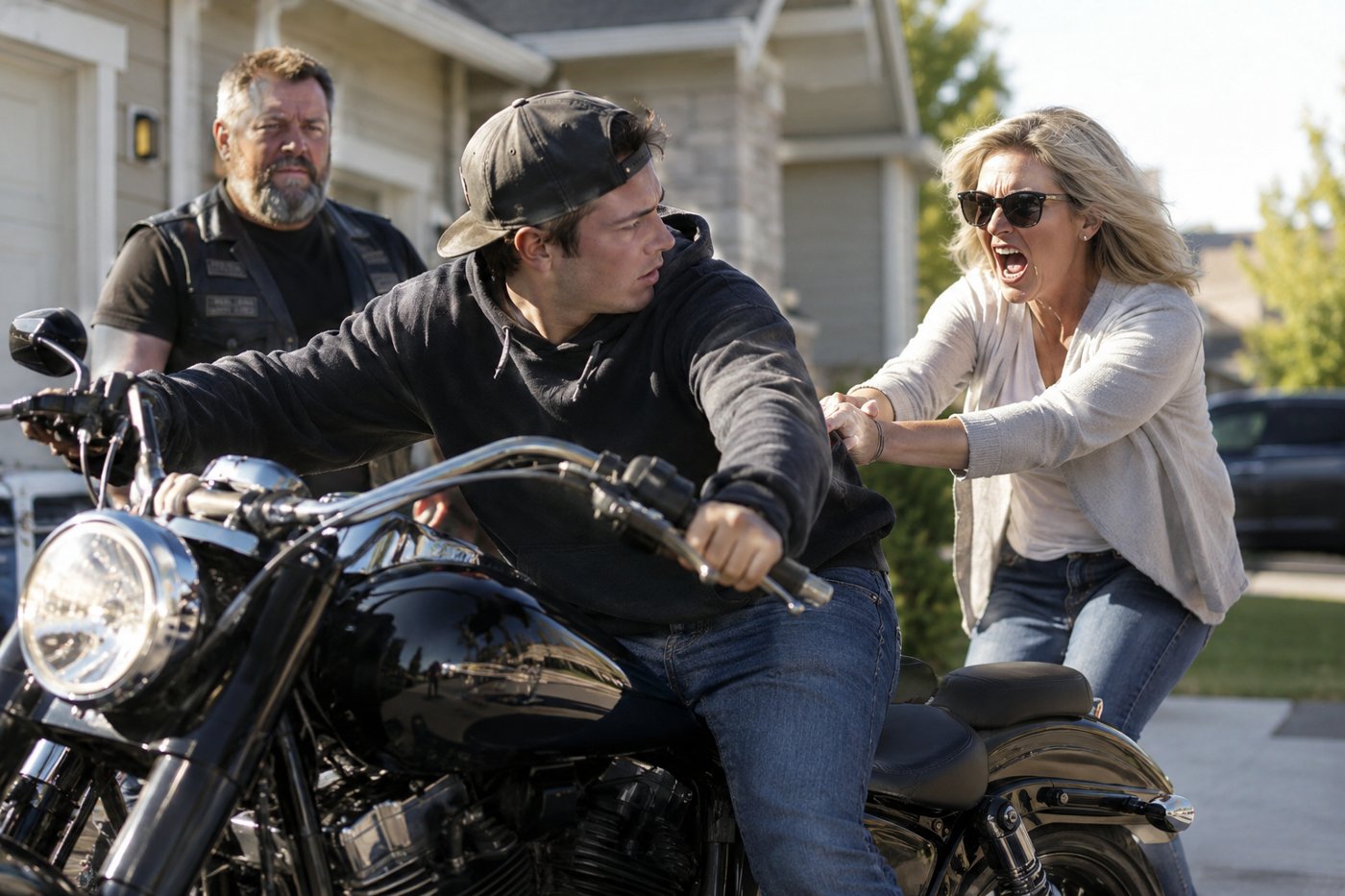


COMMENTS
Loading…