Dirty Cops Robbed an 85-Year-Old Veteran—Then Two Military Vehicles Pulled Up
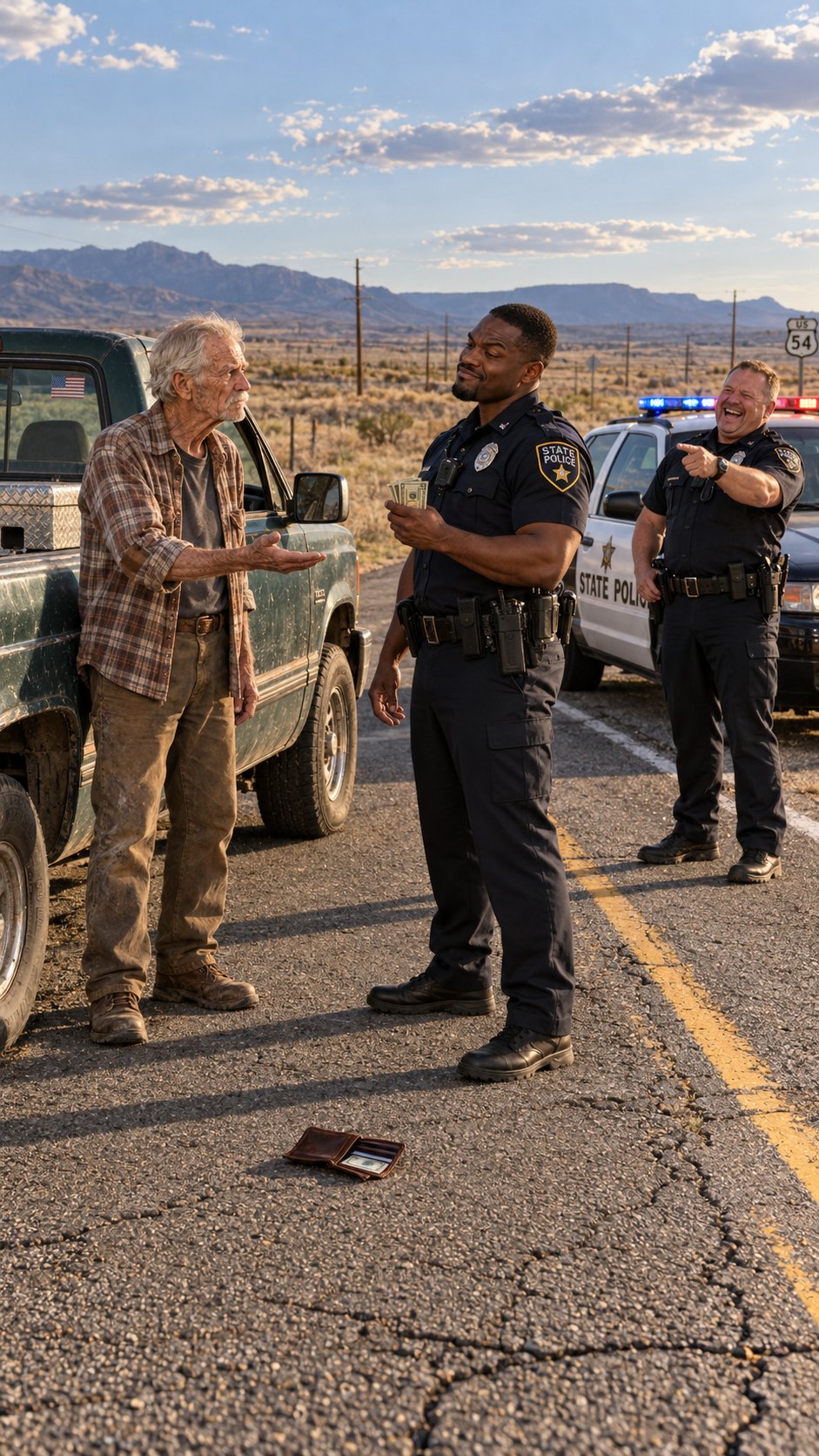
The patrol lights came on behind me at 10:42 in the morning.
Blue.
Red.
Blue again.
I looked at the speedometer.
Fifty-three.
The posted limit on that stretch of highway was fifty-five.
I checked my mirrors.
No other cars.
No intersection.
No shoulder for another hundred yards.
So I eased my old Ford pickup forward until the pavement widened beside a weathered guardrail, switched on my hazards, and stopped.
I was eighty-five years old.
I had been driving since Dwight Eisenhower was president.
I knew how a traffic stop was supposed to work.
What happened next wasn't one.
The first officer reached my window without introducing himself.
He was tall, maybe forty, with a heavy jaw and mirrored sunglasses.
His nameplate read D. HARLAN.
His partner stayed a few steps behind.
Younger.
Thinner.
Maybe thirty-four.
Nameplate:
M. VEGA.
Harlan tapped the glass.
I lowered it.
“License.”
No greeting.
No explanation.
I handed him my driver's license.
He looked at it.
Then at me.
“Registration.”
I opened the glove compartment.
Before I could pull out the folder, Harlan said:
“Wallet.”
I stopped.
“My registration's here.”
“I said wallet.”
I looked at him.
“Why?”
His partner laughed.
Harlan leaned toward the window.
“You want to turn a traffic stop into a problem, old man?”
I had learned a long time ago that there are moments when pride is useful and moments when pride gets in the way of seeing clearly.
So I took out my wallet.
Held it up.
Harlan reached through the window—
and SNATCHED it from my hand.
I stared at him.
He opened it.
Pulled out my insurance card.
Then my retired military identification.
He paused.
“Veteran?”
“Retired Army.”
He looked at the card again.
“How long?”
“Thirty-two years.”
Vega whistled.
“Damn.”
Harlan didn't care.
He flipped past the cards.
Then found the cash.
I had withdrawn it that morning.
Eight hundred dollars.
Mostly twenties.
Some fifties.
Money I was carrying to pay a local carpenter who had been repairing the porch at my daughter's house.
Harlan pulled out the stack.
Held it up.
Smirked.
“Well, look at that.”
I opened my door.
“Put that back.”
His hand slammed against the door.
BANG.
“Stay in the vehicle.”
“That's my money.”
Vega laughed from behind him.
Harlan counted several bills.
Slowly.
Like he wanted me to watch.
I said:
“Give me my money back.”
Harlan looked toward his partner.
Then back at me.
“You carrying this much cash for what?”
“That's none of your business unless you have a lawful reason to ask.”
Vega laughed again.
“Listen to Grandpa Lawyer.”
I ignored him.
“Harlan.”
He looked surprised I'd read his name.
“Give me my wallet.”
He stepped backward.
Then pulled the rest of the cash free.
I watched him fold it once.
My voice stayed level.
“Officer, return my money.”
He smiled.
Then threw the wallet onto the highway.
It hit the asphalt beside my front tire.
Cards scattered.
My retired military ID slid beneath the truck.
Harlan held the cash up one last time.
Then said:
“GO AHEAD—CALL SOMEONE!”
Vega pointed at me and laughed.
Both men turned.
Walked back toward their cruiser.
And for several seconds, I remained behind the wheel.
I didn't shout.
Didn't chase them.
Didn't reach for anything.
I watched.
Harlan opened the passenger door.
Vega walked around toward the driver's side.
Neither man knew that the small camera mounted behind my rearview mirror was still recording.
Neither man knew why I was driving that highway.
And neither man knew who was waiting for me twelve miles ahead.
I opened my door slowly.
Stepped onto the pavement.
My knees weren't what they used to be.
At eighty-five, very little is.
I picked up my Medicare card.
My bank card.
A photograph of my late wife.
Then I got down carefully beside the truck and reached underneath for my military ID.
The cruiser sat forty feet behind me.
Harlan was watching.
I could see him smiling through the windshield.
I put everything back into my wallet.
Except the money.
That was gone.
Then I took out my phone.
Harlan had told me to call someone.
So I did.
One call.
The man answered on the second ring.
“Sir?”
I said:
“Colonel, I'm going to be late.”
There was a pause.
“General?”
“I've been stopped on Route 17.”
“Are you all right?”
“For the moment.”
His voice changed immediately.
“What happened?”
I looked into my mirror at the cruiser.
“Bring the people who were supposed to meet me at the gate.”
“How many?”
“The two vehicles will be enough.”
Another pause.
“Do you need local law enforcement?”
“I already have some.”
That silence lasted longer.
Then:
“Understood.”
I ended the call.
Climbed back into my pickup.
And waited.
Seven minutes later, Harlan got out of the cruiser again.
He was still holding my money.
He started walking toward me.
Then a low diesel rumble rolled down the highway behind him.
Harlan turned.
Two olive-drab military vehicles appeared over the rise.
The first was a government SUV with military markings.
The second was a larger tactical utility vehicle carrying four uniformed soldiers.
They slowed.
Turn signals flashing.
Then pulled onto the shoulder behind the police cruiser.
Vega stepped out.
Harlan stopped walking.
A colonel climbed from the first vehicle.
Two other uniformed officers followed.
The colonel looked at the patrol cruiser.
Then at me.
Then at the money still visible in Harlan's hand.
He walked forward.
Harlan's smile disappeared.
Completely.
But the colonel didn't reach for him.
Didn't arrest him.
Didn't threaten him.
He simply stopped several feet away and asked:
“General Whitaker, are you all right?”
Officer Harlan looked at me.
Then at the retired military identification card now resting on my dashboard.
Then back at the colonel.
And for the first time that morning—
he understood that the old man he'd chosen wasn't alone.
What none of us understood yet was that eight hundred dollars was about to expose something much larger than one bad traffic stop.
My name is Samuel Whitaker.
Most people call me Sam.
The Army called me many things over thirty-two years.
Lieutenant.
Captain.
Major.
Colonel.
Eventually brigadier general.
But I had been retired for more than two decades by the morning Officers Harlan and Vega stopped me.
That distinction matters.
Retirement doesn't turn a former general into some kind of civilian king.
I couldn't command the local police.
I couldn't order soldiers to arrest anybody.
I couldn't make laws disappear because someone had once saluted me.
And I didn't want to.
I had spent too much of my life serving institutions to believe institutions should bend around individuals.
What I did have was a name people in the military still recognized.
And, more importantly, I had witnesses.
I was driving that morning to Fort Adams, a fictional Army installation about twelve miles beyond the stop.
The post commander had invited me to speak at a leadership event honoring retired service members and mentoring junior officers.
I almost declined.
At eighty-five, invitations that begin with:
“We'd be honored if…”
usually mean somebody expects you to put on a jacket, stand too long, and tell younger people how things used to be.
I had already done enough of that.
But Colonel Nathan Brooks called personally.
“Sir, these lieutenants need to hear from people who made mistakes before they did.”
I laughed.
“You're advertising me well.”
“It's honest.”
So I agreed.
The plan was simple.
I would meet Brooks near the east gate.
We'd drive together to the event.
He had two vehicles scheduled to move personnel from a training site nearby, and they were supposed to pass that highway around the same time.
That's who I called.
Not a rescue squad.
Not my private military force.
People who happened to be nearby and could witness what was happening.
Colonel Brooks approached my driver's window.
He was forty-seven.
Tall.
Black.
Shaved head.
Calm eyes.
The kind of officer who didn't need volume to establish authority.
“Sir?”
“I'm fine.”
He looked at Harlan.
Then Vega.
Then at my scattered cards still visible near the truck.
“What happened?”
Before I could answer, Harlan stepped forward.
“Routine traffic stop.”
I looked at him.
Brooks did too.
Harlan tucked the cash closer to his body.
That was a mistake.
Brooks noticed.
“What is that?”
Harlan's voice hardened.
“Police matter, Colonel.”
Brooks nodded.
“Understood.”
No challenge.
No posturing.
Then he looked at me.
“General, do you want me to contact the county sheriff or state police?”
Harlan interrupted.
“That won't be necessary.”
I answered Brooks.
“Yes.”
Harlan's head snapped toward me.
“Sir, you're being detained.”
“For what?”
“Traffic investigation.”
“What traffic offense?”
He hesitated.
Vega stepped closer.
“Failure to maintain lane.”
I looked at him.
“That wasn't mentioned until now.”
Vega shrugged.
Brooks said nothing.
He simply took out his phone.
Harlan raised one hand.
“Colonel, don't interfere with an active stop.”
Brooks answered calmly:
“I'm not interfering. General Whitaker asked me to contact another law-enforcement agency.”
“You don't have jurisdiction here.”
“Correct.”
That answer seemed to confuse Harlan.
Brooks continued:
“Which is why I'm calling someone who does.”
One of the soldiers from the second vehicle had already begun recording from a respectful distance.
Not secretly.
Not provocatively.
His phone was visible.
Vega noticed.
“Tell him to stop filming.”
Brooks turned.
“Sergeant Lewis, remain off the roadway.”
“Yes, sir.”
Vega said:
“I said stop filming.”
Brooks looked at him.
“Is there a lawful restriction preventing him from recording from where he's standing?”
Vega's face tightened.
Harlan jumped in.
“Everybody needs to calm down.”
I almost smiled.
Ten minutes earlier, he'd thrown my wallet onto the asphalt.
Now he wanted calm.
I pointed at his hand.
“My eight hundred dollars.”
Brooks looked.
Harlan immediately said:
“Evidence.”
I asked:
“Evidence of what?”
“Possible criminal activity.”
“What activity?”
“That's under investigation.”
“Then document the seizure.”
He stared.
“Excuse me?”
“Give me a receipt.”
His jaw tightened.
“You don't tell me how to do my job.”
“No.”
I nodded toward his body camera.
“Your department probably does.”
That was the first moment I saw real concern in his face.
Not fear of soldiers.
Fear of records.
Harlan touched his body camera instinctively.
Vega looked at his own.
Neither said anything.
I noticed.
So did Brooks.
That tiny gesture would matter later.
At the time, I didn't know why.
The county sheriff's deputy arrived first.
Then a state trooper.
Brooks had called the sheriff's office.
One of his staff had also contacted state police after hearing the situation.
The arriving deputy was Sergeant Alicia Monroe.
She stepped out of her SUV and immediately looked unhappy.
Not at me.
At Harlan.
She knew him.
“Derek.”
Harlan answered:
“Alicia.”
That told me more than either intended.
Monroe looked at the military vehicles.
Then at Brooks.
Then at my pickup.
“What happened?”
Harlan said:
“Routine stop that's gotten out of control.”
I said:
“He took eight hundred dollars from my wallet.”
Monroe looked at Harlan's hand.
He still had the cash.
That was the second major mistake.
If he'd pocketed it immediately, the situation would've become my word against his until the video was reviewed.
Instead, he'd been caught in the awkward space between theft and explanation.
Monroe asked:
“Why do you have his cash?”
Harlan answered:
“Potential evidence.”
“Of?”
Harlan hesitated again.
“Possible proceeds.”
“Proceeds of what?”
“We're investigating.”
Monroe stared at him.
Then at Vega.
“What was the reason for the stop?”
Vega answered:
“Failure to maintain lane.”
Harlan said at almost the same time:
“Suspicious driving.”
Monroe's eyes moved between them.
Two answers.
One stop.
Bad beginning.
The state trooper arrived two minutes later.
Trooper James Patel.
He didn't know me.
Didn't care that I'd been a general.
Good.
He asked everyone to separate.
Also good.
He spoke to me alone near my truck.
“Sir, tell me exactly what happened from the beginning.”
I did.
Speed.
Lights.
Shoulder.
License.
Registration.
Wallet.
Cash.
Throwing the wallet.
The words.
The call.
I didn't embellish.
Didn't call Harlan corrupt.
Didn't call Vega dirty.
Didn't tell Patel what conclusion to reach.
I described actions.
Then I said:
“My dash camera recorded it.”
Patel stopped writing.
“Video and audio?”
“Yes.”
“Continuous?”
“As far as I know.”
“Can you preserve it?”
“Yes.”
“Please don't alter or delete it.”
“I won't.”
He nodded.
That was the moment the entire atmosphere changed.
Not when the military vehicles arrived.
When independent evidence entered the conversation.
Patel walked back toward Monroe.
They spoke quietly.
Then Monroe approached Harlan.
“Derek, I'm going to need you to keep the cash visible and untouched until this is sorted.”
Harlan's face darkened.
“You don't supervise me.”
“No.”
She pointed toward the approaching second county unit.
“But Lieutenant Gaines does.”
Harlan turned.
Another sheriff's vehicle was pulling onto the shoulder.
His confidence dropped another inch.
I later learned Harlan and Vega worked for a small municipal police department whose jurisdiction included a narrow section of highway near the town of Bellwood.
The road crossed several overlapping boundaries.
Town.
County.
State-maintained highway.
That complexity apparently gave Harlan room to believe outside scrutiny would be slow.
He had been wrong.
Lieutenant Robert Gaines arrived.
Fifty-three.
Twenty-seven years in law enforcement.
He spoke first to Monroe.
Then Patel.
Then Harlan.
I couldn't hear everything.
I heard:
“Body camera.”
Then:
“Supervisor.”
Then:
“Why wasn't dispatch notified?”
That last question mattered.
Harlan looked toward Vega.
Vega looked at the cruiser.
Gaines repeated:
“Why wasn't the stop called in?”
Silence.
My traffic stop had never been properly logged with dispatch.
At least not before the military vehicles arrived.
Gaines walked to me.
“Mr. Whitaker?”
“Sam is fine.”
“I understand you're retired military.”
“Yes.”
“What rank?”
“Brigadier general.”
He nodded.
No dramatic reaction.
“Thank you for your service.”
“Thank you.”
Then:
“I want to be clear. Your prior rank doesn't change how we handle this.”
“Good.”
He looked slightly surprised.
I continued:
“It shouldn't.”
He nodded again.
“We're going to document the allegation and secure available evidence.”
“That's all I'm asking.”
That wasn't entirely true.
I also wanted my eight hundred dollars back.
But process first.
Harlan finally handed the cash to Gaines.
Gaines counted it in view of his body camera.
Eight hundred dollars.
Exactly.
He placed it in an evidence envelope temporarily while the circumstances of the seizure were documented.
I didn't like seeing my money disappear into another official container.
But this time there was a record.
A number.
A witness.
A chain.
That difference was everything.
Vega was sweating.
It wasn't hot.
He kept glancing toward Harlan.
Harlan avoided him.
Patel asked whether their body cameras were recording.
Harlan said yes.
Vega said:
“Mine might have malfunctioned.”
Patel looked at him.
“When?”
“I don't know.”
“Did you activate it for the stop?”
“I thought I did.”
That answer aged badly.
My dashcam didn't malfunction.
It captured Harlan approaching.
His demand for my wallet.
My question.
His hand taking it.
The cash.
The laughter.
The wallet hitting asphalt.
And Harlan saying:
“GO AHEAD—CALL SOMEONE!”
It also captured something I hadn't heard clearly at the time.
As Harlan and Vega walked back toward their cruiser, Vega said:
“How much?”
Harlan answered:
“Eight.”
Vega laughed.
Then said:
“Lunch is on Grandpa.”
The microphone caught it.
Perfectly.
I didn't know that until later that afternoon.
By then, my leadership speech had been canceled.
Colonel Brooks asked whether I wanted to reschedule.
I said:
“Nathan, I think today already turned into a leadership lesson.”
He didn't laugh.
Not yet.
The two officers were not arrested on the highway.
That disappointed some people when the story eventually became public.
They expected cinematic justice.
Military convoy arrives.
General points.
Bad cops handcuffed.
Credits.
Real investigations don't work that way.
And I'm glad they don't.
A uniform should not be enough to condemn someone.
Mine included.
Evidence needed to be preserved.
Authority needed to be clear.
Statements needed to be taken.
The officers had rights too.
That's what makes due process meaningful.
It protects people you don't like.
Harlan and Vega were relieved from street duty later that day pending review.
Their department's chief, Raymond Talbot, called me personally.
I didn't know him.
He sounded exhausted.
“General Whitaker, I want to apologize for what you experienced.”
I answered:
“Chief, you don't know yet exactly what I experienced.”
He paused.
“Fair.”
“Investigate first.”
“We are.”
“Then we'll talk afterward.”
Another pause.
“Yes, sir.”
I almost corrected the “sir.”
Old habits.
The dashcam file was copied.
The original storage card preserved.
My statement recorded.
The money was returned after investigators documented it and determined it wasn't legitimate evidence of any offense.
I signed for it.
Counted it.
Eight hundred.
Then drove home.
The carpenter could wait.
My daughter, Rebecca, was furious.
She was fifty-six.
A cardiologist.
And still capable of talking to me as though I were fifteen.
“You should've called me.”
“For what?”
“You were on the side of a highway with two corrupt police officers.”
“Allegedly corrupt.”
“Dad.”
“Investigation first.”
“They took your money!”
“Yes.”
“That's corruption!”
“It's certainly not good.”
She stared.
“You are impossible.”
Her husband, Paul, wisely left the kitchen.
Rebecca asked:
“Why were you carrying eight hundred dollars anyway?”
“For Frank.”
“Who?”
“The carpenter.”
“You were paying him cash?”
“He prefers cash.”
“Dad.”
“He gives receipts.”
“That isn't the point.”
“What is the point?”
“You're eighty-five.”
“I noticed.”
“You shouldn't be carrying that much.”
I smiled.
“Apparently Officer Harlan agrees.”
She did not laugh.
Too soon.
That night, I couldn't sleep.
Not because I feared Harlan.
Because something about the stop bothered me beyond the money.
He had been too comfortable.
That's difficult to explain.
People doing something for the first time often hesitate.
Check surroundings.
Overthink.
Harlan hadn't.
He took my wallet as though he'd done it before.
Vega laughed as though he'd seen it before.
Maybe that was just arrogance.
Maybe.
But thirty-two years in the Army had taught me to pay attention to behavior that looked rehearsed.
I called Lieutenant Gaines the next morning.
“I have a question.”
“Yes, sir?”
“Were there previous complaints?”
Silence.
That answered part of it.
Gaines said:
“I can't discuss an active investigation.”
“I understand.”
“Why are you asking?”
“Harlan didn't improvise.”
Another silence.
Then:
“We're reviewing prior stops.”
That was enough.
Investigators began pulling records.
Dispatch logs.
Body-camera files.
Citation histories.
Traffic-stop data.
Complaints.
Vehicle searches.
Property receipts.
Evidence records.
The more they looked, the stranger the pattern became.
Harlan and Vega had worked together frequently over the previous eighteen months.
Especially on that highway.
Especially late mornings and evenings.
Especially in stretches with poor cell service and little traffic.
They issued fewer citations than expected for the number of stops they conducted.
That wasn't proof of wrongdoing.
Officers give warnings.
Stops don't always become tickets.
But several motorists had complained about cash.
The first prior complainant investigators reexamined was a construction worker named Luis Mendoza.
Fifty-one.
He had been stopped eight months earlier.
He claimed Harlan found $1,200 in cash inside his work bag and accused him of carrying “drug money.”
Luis said Harlan took $300 and told him he could contest the rest through court if he wanted trouble.
No seizure receipt existed.
Luis reported it.
The complaint had been classified as unsubstantiated.
Why?
No video.
No independent witness.
Harlan denied it.
Vega said he hadn't seen cash taken.
Case closed.
Until mine.
The second was a woman named Patricia Greene.
Sixty-seven.
Retired school librarian.
She had been driving home from a craft fair with $460 in cash from selling handmade quilts.
She said Vega searched a tote bag after claiming he smelled marijuana.
Patricia had never used marijuana.
Nothing illegal was found.
She later discovered $120 missing.
She complained.
Again:
No video.
No proof.
No action.
Then there was Marcus Bell.
Twenty-eight.
Army sergeant.
That one got my attention.
He'd been driving back to base after visiting family.
Harlan stopped him.
Marcus had $600 his mother had given him toward a car repair.
He claimed Harlan threatened to seize it as suspicious cash unless Marcus could prove where it came from.
Marcus argued.
Eventually Harlan let him go.
Money intact.
But Marcus filed a complaint about the threat.
No sustained finding.
I called Colonel Brooks.
“Do you know Sergeant Bell?”
“Which Bell?”
“Marcus.”
Pause.
“Yes.”
“Why?”
“He's in the brigade.”
“Did you know about his complaint?”
“No.”
That angered Brooks.
Not because Bell was military.
Because Bell had apparently believed nothing would happen.
More people surfaced.
Not dozens at first.
Five.
Then nine.
Then thirteen.
Different stories.
Not identical.
That mattered.
Real experiences rarely line up like copied scripts.
Some alleged missing cash.
Some said Harlan threatened seizure but returned it.
Some said Vega demanded to search vehicles without clearly explaining the basis.
Some described humiliating roadside questioning.
Two had filed complaints.
Most hadn't.
Why?
Because amounts were relatively small.
Because they feared escalation.
Because they didn't know where to complain.
Because they assumed nobody would believe them.
One man said:
“It was two cops against me. What was I supposed to prove?”
I understood.
I had been one old man against two officers too.
The difference was my camera.
The military vehicles became the public version of the story.
That annoyed me.
A local reporter learned about the investigation after administrative records began circulating.
Headline:
RETIRED GENERAL'S TRAFFIC STOP SPARKS POLICE MISCONDUCT PROBE
Then television.
Then national attention.
Every story wanted the same image.
Two military vehicles behind a police cruiser.
Retired general.
Dirty cops.
Roadside confrontation.
Dramatic.
Simple.
Incomplete.
I told one reporter:
“The vehicles didn't expose anything. The evidence did.”
She asked:
“But their arrival changed the situation.”
“Yes.”
“Would you have gotten your money back without them?”
I thought.
“I don't know.”
That was the honest answer.
Then she asked:
“Do you believe your rank protected you?”
That question mattered.
“Yes.”
She seemed surprised.
I continued:
“Not legally. Socially.”
“What do you mean?”
“When Colonel Brooks arrived and called me General Whitaker, everyone immediately understood I had institutional credibility.”
I looked at her.
“Luis Mendoza didn't have that.”
She stopped writing for a moment.
“Patricia Greene didn't have that.”
I continued:
“Marcus Bell had a uniform too, but he was a sergeant complaining about police. Different power.”
“So you think your status mattered?”
“Obviously.”
“Does that bother you?”
“Yes.”
Because it did.
Deeply.
If justice only becomes efficient when the victim has rank, money, cameras, or influential friends, then the system isn't functioning equally.
I didn't want people to admire the fact that I could make one phone call.
I wanted them to ask what happened to the people who couldn't.
The department chief eventually placed Harlan and Vega on administrative leave.
Then the state bureau of investigation became involved.
The county prosecutor requested an independent review because local relationships complicated matters.
Again:
Slow.
Paperwork.
Interviews.
Subpoenas.
Digital evidence.
Financial records.
Body-camera audits.
No dramatic midnight raid that I saw.
Real cases are built in offices long before they reach courtrooms.
The body-camera issue became significant.
Harlan's camera had recorded the beginning of my stop.
Then stopped.
According to device logs, it had been manually deactivated.
Vega's camera was never activated.
That didn't automatically prove theft.
Officers can fail to activate cameras for many reasons.
But investigators compared other stops.
Patterns emerged.
On routine citation stops, cameras usually worked.
On several stops involving cash complaints, recordings were missing, incomplete, or ended early.
That pattern became difficult to explain as coincidence.
Then investigators found something worse.
Text messages.
Not movie-villain messages saying:
LET'S ROB PEOPLE TODAY.
People committing misconduct rarely label it conveniently.
Instead:
Good road today.
Cash guy again.
No paper.
Split later.
Ambiguous individually.
Damaging in context.
One message from Vega to Harlan after a prior stop read:
Old guy never even asked for receipt lol.
That one stayed with me.
Old guy.
Could've been me.
Almost was.
Chief Talbot requested a meeting.
I agreed.
He came to my house alone.
No uniform.
Gray suit.
He looked older than his photograph.
Rebecca wanted to sit in.
I told her no.
She told me I was stubborn.
Correct.
Talbot sat in my living room.
He looked at the photograph of my wife, Eleanor, on the mantel.
Then at me.
“I failed.”
I didn't answer immediately.
He continued:
“We had complaints.”
“I know.”
“They were reviewed.”
“Were they?”
His jaw tightened.
“Not well enough.”
That was more honest.
I asked:
“Did you know Harlan personally?”
“Yes.”
“How long?”
“Fifteen years.”
“Friend?”
He hesitated.
“We hunted together twice. Department events. Our families knew each other.”
There it was.
Not necessarily corruption.
Familiarity.
The quiet enemy of scrutiny.
I asked:
“When the first complaint came in, who did you believe?”
Talbot looked at the floor.
“Harlan.”
“Why?”
“He had a good record.”
“And Mendoza?”
“I didn't know him.”
Exactly.
Talbot rubbed his hands together.
“We treated Harlan's credibility as evidence.”
I nodded.
“And the complainant's lack of status as the absence of evidence.”
Talbot looked at me.
“Yes.”
That was one of the most important admissions anyone made.
Not because it proved criminal conduct.
Because it explained how misconduct can survive before anyone proves it.
I asked:
“What happens now?”
“The independent investigation continues.”
“To you?”
He looked surprised.
“What do you mean?”
“Your department missed complaints.”
“I know.”
“Is anyone reviewing that?”
“Yes.”
“Good.”
He nodded.
I wasn't trying to destroy him.
Leadership isn't measured by whether failure happens under you.
Failure always happens somewhere.
Leadership is measured by what you do when the institution's comforting story stops working.
Talbot had a choice.
Defend the badge reflexively.
Or examine what the badge had hidden.
To his credit, eventually he chose the second.
Too late for some people.
But not never.
My eight hundred dollars became almost irrelevant.
Frank the carpenter eventually got paid.
He said:
“I would've taken a check.”
I stared.
“You told me cash.”
“I said cash was easier.”
“You're telling me I got robbed because cash was easier?”
He laughed.
I did too.
Rebecca did not find it funny.
Still too soon.
The criminal case took more than a year to fully develop.
During that time, Harlan resigned.
Vega initially remained employed but was later terminated following internal proceedings separate from the criminal process.
Their attorneys disputed significant parts of the allegations.
That mattered.
Public accusation isn't conviction.
The state had to prove specific conduct with admissible evidence.
Some older complaints were difficult to establish beyond reasonable doubt.
Memories faded.
Records were incomplete.
Cash is difficult to trace.
Some alleged victims couldn't identify exact dates.
Investigators did not simply bundle every accusation into one dramatic story.
They separated what could be supported from what could not.
That's how it should work.
My stop was different.
Dashcam.
Audio.
Money physically present when independent officers arrived.
Inconsistent explanations.
No documented lawful seizure basis at the time.
Body-camera irregularities.
Witnesses.
That gave prosecutors something concrete.
Other supported incidents added context where legally appropriate.
I testified.
I hated it.
People assume retired generals enjoy speaking publicly.
Some do.
I never did.
Command briefings were work.
Court testimony was different.
Every word mattered.
Harlan's attorney asked:
“General Whitaker, you were angry that morning, correct?”
“Yes.”
“You felt disrespected.”
“Yes.”
“You believed Officer Harlan had no right to question you.”
“No.”
The attorney paused.
“No?”
“He had every right to conduct a lawful traffic stop.”
“But you challenged him.”
“I asked why he wanted my wallet.”
“You told him your cash was none of his business.”
“I said unless he had a lawful reason.”
The attorney looked at the transcript.
Then:
“You contacted military personnel.”
“Yes.”
“Why?”
“Because they were nearby and I wanted witnesses.”
“You wanted to intimidate the officers.”
“No.”
“You summoned military vehicles to a civilian traffic stop.”
“I called Colonel Brooks.”
“Knowing military vehicles would arrive.”
“I asked him to bring the people who were already supposed to meet me.”
The attorney leaned forward.
“You were a general. You knew the visual impact.”
I looked at him.
“I also knew the Army had no authority to arrest those officers.”
Silence.
Then:
“I wanted witnesses. Not soldiers acting as police.”
That distinction held.
Vega eventually cooperated with investigators.
I learned that much later.
Not out of sudden nobility.
His legal situation worsened.
He provided information about Harlan.
Harlan's defense argued Vega was shifting blame.
Probably partly true.
People rarely become pure truth-tellers simply because prosecutors enter the room.
But Vega's information helped investigators locate additional records and reconstruct several stops.
The case did not end with every allegation proven.
Some were never charged.
Some couldn't be established.
Some may have had innocent explanations.
That frustrated victims.
Understandably.
Luis Mendoza told me:
“They took my money. I know they did.”
I believed him.
But belief and proof are different obligations.
I told him:
“I know that's painful.”
He said:
“So they get away with mine?”
“Maybe legally.”
“That isn't justice.”
“No.”
It wasn't.
Due process can protect the innocent.
It can also mean some wrongdoing goes unpunished when evidence is insufficient.
Both are true.
There is no honest justice system without that tension.
Harlan was ultimately convicted on charges tied to provable misconduct, including conduct associated with my stop and other supported evidence.
Vega entered a plea agreement involving his role and cooperation.
The exact penalties mattered less to me than what followed institutionally.
Bellwood's department adopted stronger body-camera auditing.
Supervisors began random review of stop footage.
Cash seizures required clearer documentation and supervisory notification.
Property receipts became mandatory and electronically tracked.
Traffic stops not properly logged with dispatch triggered review.
Complaint intake changed.
Outside review became available for certain allegations involving supervisory conflicts.
None of those reforms were exciting.
Good.
The boring changes are often the ones that prevent the next victim.
Chief Talbot retired two years later.
Before he did, he invited several complainants to a public community meeting.
Luis attended.
Patricia attended.
Sergeant Bell attended.
I attended.
Talbot stood at a podium.
No flags behind him.
No dramatic music.
He said:
“Our department failed to treat earlier complaints with the seriousness they deserved.”
Not:
Mistakes were made.
He said:
Our department failed.
Then:
“We cannot know with certainty whether earlier action would have prevented later misconduct, but we do know stronger review should have occurred.”
That was carefully worded.
And honest.
Luis asked:
“Why did it take a general?”
The room went silent.
Talbot looked at me.
Then back at Luis.
“It shouldn't have.”
Luis said:
“But it did.”
“Yes.”
Talbot didn't defend himself.
That mattered.
After the meeting, Luis approached me.
He was shorter than I expected.
Strong hands.
Work boots.
He said:
“You're the general.”
“Retired.”
He smiled.
“They listened to you.”
“Yes.”
“They didn't listen to me.”
“No.”
I hated admitting it.
He looked at me.
“You could've pretended it was because your case was better.”
“My case had video.”
“Yeah.”
“And witnesses.”
“Yeah.”
“And status.”
He studied me.
“Most people with status don't say that part.”
I shrugged.
“I'm eighty-seven now.”
“What does that mean?”
“I don't have enough time left for convenient lies.”
He laughed.
We became friends.
Patricia Greene became the unexpected force behind a civilian complaint-support group.
The retired librarian.
Of course.
Give a librarian an administrative failure and she will build a filing system capable of frightening governments.
She created guides explaining:
How to preserve records.
How to request reports.
Where to file complaints.
How to document interactions accurately.
What not to exaggerate.
She was relentless about that last part.
“If you don't know, say you don't know.”
She'd tap the paper.
“Don't improve your story.”
I liked her immediately.
Sergeant Marcus Bell later became an instructor.
He incorporated his traffic stop into ethics discussions.
Not as:
Police bad, military good.
That would've been stupid.
He taught authority.
Accountability.
Documentation.
How professional loyalty becomes dangerous when it turns into automatic disbelief of outsiders.
Those lessons apply to every uniform.
Police.
Military.
Medicine.
Corporations.
Families.
Anywhere humans protect insiders.
Colonel Brooks retired before I turned ninety.
At his ceremony, he asked me to speak.
I told him:
“You still haven't learned.”
He laughed.
“Ten minutes.”
“Five.”
“Eight.”
“Six.”
“Deal.”
I spoke for twelve.
Old generals are hypocrites.
I told the audience about Route 17.
Not the dramatic version.
I said:
“When those military vehicles arrived, some people later called it a show of force.”
The room was quiet.
“It wasn't.”
I looked at Brooks.
“The most important thing Colonel Brooks did was understand what authority he did not have.”
Several young officers listened carefully.
“He did not threaten civilian police. He did not order soldiers to interfere. He called the proper agencies, preserved distance, created witnesses, and let jurisdiction work.”
Then I said:
“Restraint is not weakness. Knowing the limits of your authority is one of the clearest signs that you deserve authority.”
Brooks looked down.
He knew exactly who I was also talking about.
Harlan.
Afterward, a young captain approached.
“Sir, weren't you angry?”
“Extremely.”
“How did you stay calm?”
I laughed.
“I was eighty-five.”
He looked confused.
I explained:
“At twenty-five, you think every insult requires immediate response.”
“At eighty-five?”
“You know most idiots will eventually create paperwork for themselves.”
He laughed so hard Brooks turned around.
That line became more popular than my actual speech.
Typical.
People continued asking about the cash.
“Why didn't you fight him?”
Because he had a badge and a weapon and I was on a lonely highway.
That wasn't cowardice.
It was judgment.
I had spent decades teaching soldiers that surviving an encounter can be more important than winning the argument inside it.
The roadside was not the place to physically contest possession of eight hundred dollars.
Money can be recovered.
A bad decision made in three seconds can become irreversible.
So I watched.
Remembered.
Recorded.
Called.
Waited.
People asked:
“Why didn't you tell him you were a general immediately?”
Because it shouldn't have mattered.
Also because I had shown him my retired military ID.
He already knew I was a veteran.
If basic dignity required stars on my old uniform, then we had a bigger problem.
I never wanted the lesson to become:
Don't rob old men because one might be a general.
The lesson was:
Don't rob people.
Simple.
Rebecca hated media attention.
She accused me of enjoying it.
I denied it.
She showed me three television interviews.
“Evidence.”
“I was asked.”
“You wore a tie.”
“I own ties.”
“You practiced answers.”
“Preparation isn't enjoyment.”
She stared.
“You're impossible.”
Family consensus remained strong.
At ninety, I stopped driving long distances alone.
Rebecca won that battle.
Mostly.
My eyesight remained legal.
My reflexes were acceptable.
But I had begun understanding that legal capability and wise capability aren't always identical.
She drove me past Route 17 one afternoon.
The shoulder looked ordinary.
No memorial.
No sign.
No evidence anything happened there.
I pointed.
“Right there.”
She slowed slightly.
“That spot?”
“Yes.”
“Where they stopped you?”
“Yes.”
She looked ahead.
“Do you think about it often?”
“Not anymore.”
“Really?”
“Not the way you think.”
“What do you think about?”
I looked through the windshield.
“Luis.”
She nodded.
“The carpenter?”
I laughed.
“No. Mendoza.”
“Oh.”
“Patricia.”
“The librarian?”
“Yes.”
“Bell?”
“Yes.”
Rebecca glanced at me.
“Not the cops?”
“Sometimes.”
“Not the money?”
“No.”
“Not the military vehicles?”
I shook my head.
“They're the least important part.”
But people loved those vehicles.
I understand why.
Visual storytelling.
Old man alone.
Two officers laughing.
One phone call.
Military vehicles cresting the hill.
Officer freezes.
Power reversal.
Perfect.
Except reality was better.
Because the soldiers didn't save me by overpowering anyone.
They changed the situation by becoming witnesses.
Then civilian law enforcement did its job.
Then investigators did theirs.
Then prosecutors had to prove their case.
Then administrators had to confront why complaints had failed before mine.
The satisfying part wasn't that I knew powerful people.
The satisfying part was that, eventually, the process stopped caring who I knew and started caring what the evidence showed.
That's the standard worth defending.
Harlan wrote me a letter years later.
I almost didn't open it.
No return address I recognized.
Inside:
General Whitaker,
I stopped reading at “General.”
Put it down.
Made coffee.
Came back.
He wrote that he had spent years blaming Vega.
The department.
The prosecutor.
The media.
Me.
The military vehicles.
Anyone except himself.
He said prison and counseling forced him to confront the pattern.
He did not ask forgiveness.
At least not directly.
He wrote:
I told myself people carrying cash were suspicious. Then I told myself taking some of it was teaching them a lesson. Then I stopped needing the excuse.
That sentence disturbed me.
Not because it was dramatic.
Because it described moral decline accurately.
People rarely wake up one morning transformed into villains.
They move boundaries.
Small.
Then smaller.
Then the old boundary becomes difficult to remember.
He wrote:
The worst thing I said to you was not “call someone.” The worst thing was laughing because I believed you couldn't.
I sat with that.
Then:
I know now that the people before you may have called someone too. We just counted on nobody listening.
That was the sentence I remembered.
Not the apology.
That one.
They counted on nobody listening.
I never wrote back.
Not because I hated him.
I didn't know what response would serve either of us.
His accountability did not require my participation.
If his remorse was real, it needed to remain real without reward.
I put the letter in a drawer.
Later, I gave a copy to Patricia with permission to use one sentence anonymously in her training materials.
She chose the same one.
We counted on nobody listening.
Of course she did.
Librarians understand the danger of unheard records.
At ninety-one, I attended Patricia's memorial.
Cancer.
She'd outlived her husband and one of her children.
Her community center displayed quilts she had made.
One had been sold at the craft fair the day she was stopped years earlier.
Her daughter told me:
“Mom kept the complaint file.”
“I'd expect nothing less.”
“Three binders.”
“Only three?”
Her daughter laughed.
Then handed me an envelope.
Patricia had written:
Sam,
You had stars. I had quilts. Turns out the camera cared about neither. That's why records matter.
I smiled.
Below it:
Also, you still owe me twenty dollars from lunch.
I did.
She'd never let me pay.
I donated twenty dollars to the library.
Then another thousand because guilt compounds.
Luis Mendoza eventually opened his own construction company.
When my porch needed repair, I hired him.
Rebecca said:
“You already have a carpenter.”
“Frank retired.”
“Of course he did.”
Luis came out.
Looked at the porch.
Then at me.
“You paying cash?”
I stared.
He burst out laughing.
I laughed too.
Finally.
It had taken years.
He did the work.
I paid by check.
Rebecca approved.
National crisis avoided.
My military career had taught me that institutions are strange creatures.
People talk about them as though they possess character independently.
“The Army believes…”
“The police would never…”
“The company cares…”
“The government failed…”
Institutions are systems built from human choices.
Policies matter.
Training matters.
Culture matters.
Oversight matters.
But at critical moments, an institution becomes one person deciding whether to question a friend.
One supervisor deciding whether a complaint deserves another look.
One officer deciding whether a camera stays on.
One witness deciding whether to speak.
One victim deciding whether to call.
Chief Talbot once asked me whether I thought he was responsible for what Harlan did.
I said:
“No.”
He looked relieved.
Then I added:
“But you're responsible for what you did after people warned you.”
Relief disappeared.
He nodded.
“Fair.”
That distinction applies to leadership everywhere.
You cannot control every subordinate's choices.
You are responsible for what you tolerate after evidence appears.
I thought about my own Army career.
Times I'd trusted an officer too quickly.
Times rank influenced whose story I heard first.
Times someone junior probably decided it wasn't worth bringing me a problem.
I couldn't pretend police departments alone suffer from institutional loyalty.
Military organizations know it well.
So do families.
That's why I never enjoyed stories portraying the military vehicles as morally superior symbols arriving to discipline bad police.
Wrong lesson.
Every institution needs scrutiny.
Especially the one you respect.
At ninety-two, a cadet asked me during a university event:
“What did being a general teach you about power?”
I said:
“That people notice when you use it.”
He waited.
“And?”
“They notice less when you choose not to.”
He looked confused.
I explained.
“The most dangerous moment is when you can do something and nobody around you is likely to stop you.”
Harlan believed he was in that moment.
Lonely highway.
Old man.
Partner laughing.
No traffic.
No dispatch record.
No obvious witness.
He thought nobody would stop him.
Power reveals character most clearly when resistance appears unlikely.
That was why my dashcam mattered.
It created a witness where Harlan thought there wasn't one.
The military vehicles created more.
Monroe.
Patel.
Gaines.
Records.
Investigators.
Complaints.
Eventually the people before me became witnesses too.
One old man's eight hundred dollars connected a series of voices that had previously existed separately.
Not because my experience was more true.
Because mine was harder to dismiss.
I wish that weren't the case.
But wishing doesn't repair systems.
Records do.
Policy does.
Leadership does.
People willing to revisit comfortable conclusions do.
I kept the old Ford until I was ninety-three.
Rebecca wanted me to sell it years earlier.
When I finally did, my grandson Caleb helped clean it.
He was twenty-two.
He found the dashcam.
“Grandpa.”
“What?”
“Is this the camera?”
“Yes.”
“The one?”
“Yes.”
He held it like a museum artifact.
“This thing got those cops.”
“No.”
He looked at me.
“What?”
“It recorded them.”
“Same thing.”
“No.”
I sat on a stool in the garage.
“The investigators got the evidence. Prosecutors built the case. Other people came forward.”
“But without this…”
“Without this, maybe my complaint would've gone where the others went.”
Caleb looked at the little camera.
Then:
“Can I keep it?”
“Why?”
“History.”
I smiled.
“You sound like your grandmother.”
He never met Eleanor.
But he had heard enough stories.
I gave it to him.
The Ford sold to a seventeen-year-old kid named Tyler.
His father came with him.
They walked around it.
Checked the engine.
Tires.
Frame.
Tyler asked:
“Was this really your truck during that police thing?”
I sighed.
Small towns.
“Yes.”
His eyes widened.
“Where the Army showed up?”
“The Army did not ‘show up.’”
His father laughed.
Tyler grinned.
“That's what everybody says.”
“Everybody is wrong.”
“Still cool.”
I surrendered.
At ninety-three, you learn to pick battles.
Before he drove away, I looked through the windshield.
For a moment, I could see myself at eighty-five.
Hands on the wheel.
Patrol lights in the mirror.
Not frightened yet.
Just confused.
Then Harlan's face at the window.
Wallet.
Cash.
Asphalt.
Laughter.
“GO AHEAD—CALL SOMEONE!”
That sentence had been intended to make me feel powerless.
Instead, it became the beginning of his problem.
Not because I called someone powerful.
Because I called a witness.
That's what I wish people understood.
If Colonel Brooks had arrived and ordered soldiers to surround Harlan, the story would've been worse.
If he'd threatened the officers, worse.
If I'd tried to use my former rank to demand immediate punishment, worse.
Authority answering abuse with different abuse isn't justice.
It's competition.
Brooks did something much less cinematic.
He asked if I was safe.
Called the proper jurisdiction.
Kept his people back.
Recorded.
Waited.
Boring.
Professional.
Correct.
The first time I saw the television reenactment of the incident, they made the military vehicles look like tanks.
They weren't.
I called the producer.
Rebecca begged me not to.
I did anyway.
“That isn't what happened.”
“General Whitaker, it's dramatization.”
“You've got something that looks armored enough to invade Belgium.”
“Sir—”
“And Brooks looks twenty-eight.”
“We cast—”
“Nathan was forty-seven.”
Rebecca took the phone away.
“Dad.”
“Accuracy matters.”
“You're yelling at television.”
“They started it.”
She hung up.
We didn't speak for ten minutes.
Then she laughed.
I did too.
Eleanor would've loved the whole absurdity.
She died six years before the stop.
Breast cancer.
Forty-nine years of marriage.
She was the person who taught me that rank impresses people who don't have to live with you.
The first time I was promoted to general, I came home.
She looked at the star.
Then handed me a trash bag.
“Congratulations. Garbage goes Tuesday.”
Perfect woman.
If Eleanor had been alive on Route 17, Harlan would've regretted stopping us before he ever touched the wallet.
Not because she'd threaten him.
Because she could ask questions until people confessed simply to escape.
I sometimes imagine telling her.
“They took eight hundred dollars.”
She'd say:
“Why were you carrying eight hundred dollars?”
Exactly like Rebecca.
Then:
“Did you get it back?”
“Yes.”
“Good.”
Then she'd want to know about everyone else.
Luis.
Patricia.
Bell.
That's why I stayed involved after my own money came back.
Because Eleanor would've asked:
“What about the people before you?”
That became the real question.
Not:
Why did two military vehicles arrive?
Not:
Was the old man really a general?
Not:
How scared did Harlan look?
Those are entertainment.
The question that mattered was:
What happened when ordinary people complained before someone important did?
The answer wasn't good.
And once we knew that, fixing only my case would've been another failure.
Years after the convictions, Bellwood's new police chief invited me to review their updated complaint process from a civilian perspective.
I told her:
“I'm not a policing expert.”
She said:
“Good.”
I laughed.
She continued:
“I have policing experts.”
“Then why me?”
“You know what it feels like to be on the other side of the window.”
Fair.
I attended one meeting.
Mostly listened.
Their new system allowed complaints to be submitted online, in person, or through an external portal.
Complainants received tracking numbers.
Supervisors couldn't close certain complaints involving themselves or close associates.
Body-camera metadata was automatically flagged when recording stopped unexpectedly during enforcement encounters.
Nothing perfect.
Better.
I asked:
“What prevents somebody from filing false complaints?”
The chief answered:
“Nothing prevents someone from filing one.”
Good answer.
She continued:
“We investigate evidence. A complaint isn't a conviction.”
Exactly.
Accountability systems have to protect officers from unsupported accusations too.
Otherwise good people stop trusting the process.
Balance isn't weakness.
It's design.
I met young officers in that department later.
Most had never worked with Harlan.
They hated being associated with him.
I understood.
One said:
“People hear Bellwood and think we're all thieves.”
I told him:
“Then give them different evidence.”
He frowned.
“What?”
“Every stop. Every report. Every interaction.”
Reputation isn't repaired by demanding trust.
It's repaired by accumulating reasons for it.
Slowly.
Unfairly slowly.
But that's how it works.
At ninety-four, I stopped public speaking.
Mostly.
Colonel Brooks said:
“You've retired four times.”
“I like practice.”
My last scheduled talk was at a veterans center.
Someone asked me to tell the highway story.
I said:
“You've heard it.”
A younger veteran shouted:
“Tell it anyway.”
So I did.
Short version.
When I reached the part where Harlan threw my wallet, the room got angry.
When I reached the military vehicles, they cheered.
I raised my hand.
“Wrong part.”
They quieted.
“The vehicles are not the victory.”
I told them about Patricia.
Luis.
Bell.
The complaints.
The missing recordings.
The reforms.
Then I said:
“If all you remember is that a retired general knew who to call, you've missed the point.”
A man in the back asked:
“What's the point?”
I answered:
“No citizen should need to be a retired general to be taken seriously.”
Silence.
Then applause.
That part I accepted.
I'm old enough now that people ask what I'm proudest of.
They expect military answers.
Commands.
Operations.
Promotions.
I usually disappoint them.
I'm proud that my children still call.
Proud my grandchildren visit without being bribed.
Proud I stayed married to Eleanor for forty-nine years and that she only threatened to kill me approximately twelve times.
Proud I learned to apologize faster as I got older.
And I'm proud that on one lonely highway, when two men with badges expected anger or fear to make an old man careless, I didn't give them either.
I gave them time.
Time for the camera to keep recording.
Time for witnesses to arrive.
Time for their own explanations to conflict.
Time for the system to see what they had assumed nobody would see.
I still remember Harlan's face when the vehicles appeared.
That part is real in my memory.
He had been walking toward my truck.
My money in his hand.
Confident.
Then diesel engines behind him.
He turned.
First vehicle.
Second.
Military markings.
Doors opening.
Colonel Brooks stepping out.
Harlan's body changed before his face did.
Shoulders stiffened.
Hand lowered.
Then Brooks walked forward.
No shouting.
No weapon.
No dramatic command.
Just:
“General Whitaker, are you all right?”
Harlan looked at me.
For the first time, he didn't see an old man.
That's the part that still bothers me.
Because I had been the same person ten seconds earlier.
Same eighty-five-year-old body.
Same wallet.
Same rights.
Same money.
Same truth.
Only his perception changed.
He thought my value had increased because someone important knew my name.
It hadn't.
Luis Mendoza's value hadn't been lower.
Patricia Greene's hadn't been lower.
Every motorist he'd stopped had possessed the same basic right not to have their property taken without lawful basis.
Rank didn't create that.
The Constitution didn't become more applicable because a colonel stepped out of an SUV.
The witnesses simply made ignoring it harder.
That's why, when people ask what I said to Harlan after the military vehicles arrived, they're disappointed.
They expect:
You picked the wrong old man.
I never said that.
I hate that line.
It implies there was a right old man to rob.
There wasn't.
I said:
“Officer, I'd like my money documented and returned through the proper process.”
Not exciting.
But accurate.
And when Colonel Brooks asked if I wanted him to contact the sheriff, I said yes.
That was the call that mattered after my first one.
Not military retaliation.
Civilian accountability.
Proper jurisdiction.
Evidence.
Process.
Those words don't make good action movies.
They make better institutions.
The last time I spoke with Chief Talbot before he died, he asked me:
“Sam, do you think people can come back from something like that?”
He meant Harlan.
Maybe himself.
I said:
“Come back to what?”
“Being decent.”
I thought about Harlan's letter.
“I think people can change.”
“Does that mean forgiveness?”
“No.”
“Redemption?”
“Maybe.”
He waited.
I said:
“Redemption isn't getting your old reputation back. Sometimes it's accepting that you don't.”
Talbot nodded.
He understood.
Harlan would always be the officer who took cash from motorists.
If he became a better man later, good.
That didn't erase Luis.
Patricia.
Me.
Change doesn't rewrite the record.
It changes what you add after it.
That's enough.
My grandson Caleb now keeps the old dashcam in a glass case in his office.
Ridiculous.
Under it is a small card.
He asked me what to write.
I said:
DASH CAMERA — FORD F-150 — ROUTE 17
He said:
“Boring.”
“Accurate.”
He wanted:
THE CAMERA THAT TOOK DOWN TWO CORRUPT COPS
I refused.
We compromised.
The card says:
THE WITNESS THAT DIDN'T BLINK.
I'll admit that's better.
But if I could add one line beneath it, I'd write:
The witness mattered because people finally listened.
That's the whole story.
Everything else is scenery.
The highway.
The cruiser.
The cash.
The military vehicles.
The old general.
The frozen smile.
Scenery.
The real story is what happens when someone with authority believes the person in front of him has no way to challenge his version.
Harlan believed that.
Until the camera.
Until the witnesses.
Until the records.
Until the old complaints were opened again.
And yes, I still remember the beginning exactly.
The patrol lights.
The shoulder.
The window lowering.
“License.”
My registration.
“Wallet.”
His hand coming through the window.
The cash.
His smirk.
Vega laughing.
Me saying:
“Give me my money back.”
Then my wallet flying.
THUD.
Cards sliding across the asphalt.
Harlan holding eight hundred dollars.
“GO AHEAD—CALL SOMEONE!”
Both officers walking away laughing.
Me getting slowly out of the truck.
Picking up my wife's photograph.
My bank card.
My retired military identification.
My knees hurting as I reached under the truck.
Then my phone.
One call.
“Colonel, I'm going to be late.”
Seven minutes.
Diesel engines.
Two military vehicles coming over the rise.
Harlan turning.
The laughter stopping.
Colonel Brooks stepping onto the shoulder.
And asking:
“General Whitaker, are you all right?”
That was when Harlan froze.
But it wasn't when he lost.
He lost much earlier.
The moment he decided an old man on an empty highway didn't matter.
The moment he believed a badge could turn theft into authority.
The moment he counted on nobody listening.
He was wrong.
Not because I had once worn a general's star.
Not because soldiers arrived.
Not because my name carried weight.
He was wrong because the truth had been sitting behind my windshield the entire time—
quietly recording.
And this time,
when the old man spoke,
someone finally listened.